





Top 10 Ancient Strategy Games From Around the World
 By Dhiraj Sharma · Published
Share Post
Loading…
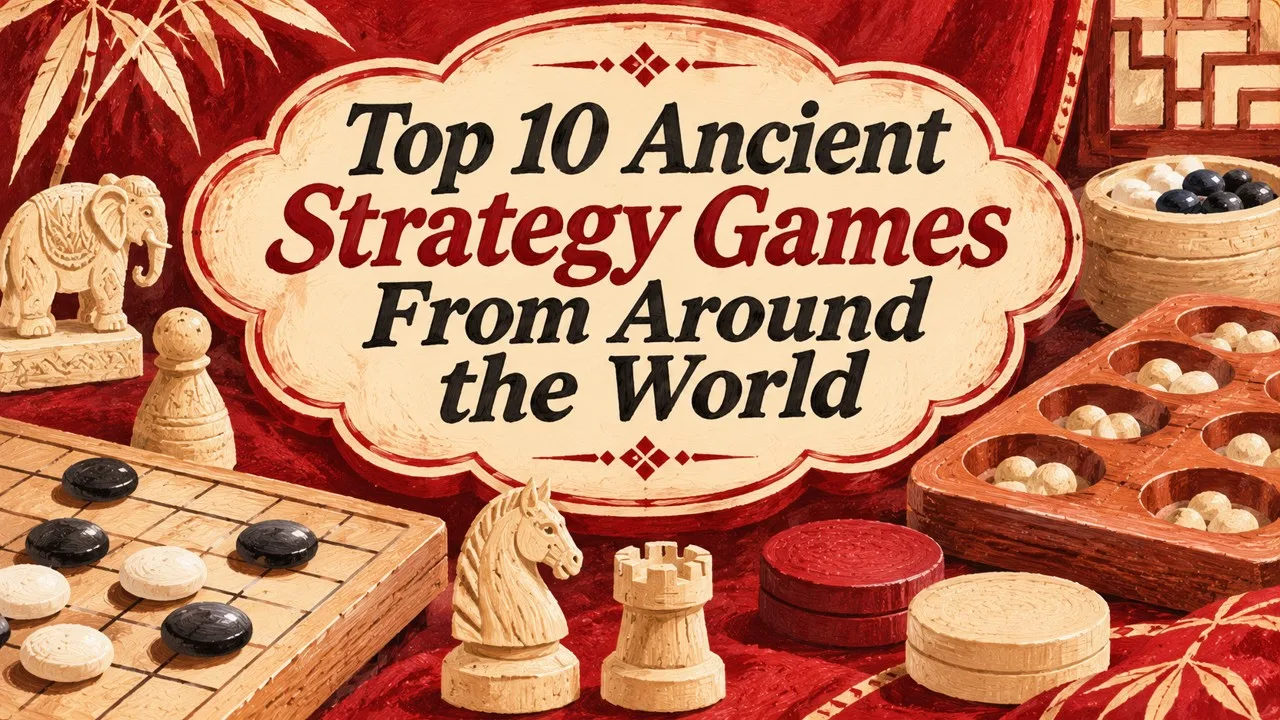
People played strategy games long before chess, from Egypt's senet and the Royal Game of Ur to Go, Norse hnefatafl, Roman soldier games and Aztec patolli. Board games are among the oldest forms of entertainment. Long before cards, chess or video games, people across the ancient world scratched grids into stone, carved pieces from bone and wood, and spent hours trying to outwit each other.
Archaeologists have found game boards in royal tombs, on temple roofs, in soldiers' camps and in ordinary homes. Many ancient games mixed strategy with chance, using dice, throwing sticks or beans to decide moves, while others relied on pure skill. Some were linked to religion and the afterlife, while others were simply fun.
The ten games below are senet, the Royal Game of Ur, Go, liubo, mancala, chaturanga, petteia, ludus latrunculorum, hnefatafl and patolli. They come from Egypt, Mesopotamia, China, Africa, India, Greece, Rome, Scandinavia and Mesoamerica.
For several of these games, the original rules have been lost, and modern versions rely on reconstructions by historians. Where the rules are uncertain, that is noted.
These games show that the desire to plan, compete and outthink an opponent is deeply human. They also reveal how games spread along trade routes and through conquest, changing as they traveled, sometimes giving rise to the games still played today.
Game boards are also useful evidence for archaeologists. Because they were often scratched into stone or carved into durable materials, they survive where other everyday objects have vanished. A grid cut into a temple step or a fortress wall can reveal where people gathered, how they spent their spare time and which cultures were in contact with each other through trade, travel and war.
Key Facts
| # | Game | Where it was played | Approximate age |
|---|---|---|---|
| 1 | Senet | Ancient Egypt | About 5,000 years old |
| 2 | Royal Game of Ur | Ancient Mesopotamia | About 4,500 years old |
| 3 | Go | Ancient China | More than 2,500 years old |
| 4 | Liubo | Ancient China | About 2,000 to 2,500 years old |
| 5 | Mancala | Africa and the Middle East | More than 1,300 years old |
| 6 | Chaturanga | Ancient India | About 1,500 years old |
| 7 | Petteia | Ancient Greece | About 2,500 years old |
| 8 | Ludus latrunculorum | Ancient Rome | About 2,000 years old |
| 9 | Hnefatafl | Viking Age Scandinavia | About 1,200 years old |
| 10 | Patolli | Mesoamerica | Hundreds of years before the Spanish conquest |
1. The Game of Passing
Senet is one of the oldest known board games. Boards and depictions of the game date back to around 3100 BC in Egypt. The game was played on a board of thirty squares arranged in three rows of ten, with pieces moved according to throws of sticks or bones [1].
Senet was popular with all levels of society. Several game boards were found in the tomb of Tutankhamun, and paintings show people, including Queen Nefertari, playing the game. Over time, senet took on religious significance, with the game representing the soul's journey through the afterlife [1].
The original rules have not survived. Modern scholars have proposed reconstructions based on paintings and later texts, and these are used in modern versions of the game sold today.
2. A Game Rediscovered From a Tablet
In the 1920s, the archaeologist Leonard Woolley excavated the Royal Cemetery at Ur in present-day Iraq. Among the treasures were beautifully decorated game boards dating to about 2600 to 2400 BC, with twenty squares inlaid with shell and lapis lazuli [2].
Related: Top 10 Ancient Board Games That Shaped Modern Play
The game was a race game, in which two players moved pieces along a track using dice. For decades its rules were a mystery. Then Irving Finkel of the British Museum studied a clay tablet written by a Babylonian scribe in 177 BC, which described a version of the rules. This allowed a reconstruction [2].
Remarkably, a version of the game was played by members of the Jewish community in Kochi, India, into the twentieth century, suggesting it survived for thousands of years.
3. Stones on a Grid
Go, known in China as weiqi, is a game in which two players place black and white stones on a grid, trying to surround territory. Written references to it go back to at least the fourth century BC, making it one of the oldest board games still played in its original form [3].
The rules are simple, but the game is extraordinarily complex. In China, it was considered one of the four arts of a cultured scholar, along with calligraphy, painting and playing a stringed instrument. It spread to Korea and Japan, where it became extremely popular [3].
For decades, Go was considered too complex for computers to master. In 2016, the program AlphaGo, developed by DeepMind, defeated the top professional Lee Sedol in a five-game match, a milestone for artificial intelligence.
4. A Lost Game of the Han Dynasty
Liubo was one of the most popular games in China during the Warring States period and the Han dynasty. It was played on a square board with distinctive markings, using pieces and throwing sticks or dice [4].
The game was so popular that it appears in tomb paintings, carved stones and pottery figurines showing people absorbed in play. It was also linked to cosmology and divination, and its board patterns appear on bronze mirrors of the period [4].
By the end of the Han dynasty, liubo declined in popularity and its rules were lost. Scholars have tried to reconstruct them from texts and archaeological finds, but many details remain uncertain.
Related: Top 10 Things That Existed While Woolly Mammoths Were Still Alive
5. Sowing Seeds
Mancala is not a single game but a family of games in which players sow seeds or stones into pits on a board and capture their opponents' pieces. Well-known versions include oware in West Africa and bao in East Africa [5].
The origins of mancala are uncertain, but archaeologists have found boards that may date to the first millennium AD in East Africa, including sites in Ethiopia and Eritrea. Rows of pits carved in stone have also been found elsewhere, though their dating can be difficult [5].
Mancala games spread across Africa, the Middle East and Asia, and were carried to the Caribbean by enslaved Africans. They remain popular today, played with boards, seeds or simply holes dug in the ground.
6. An Army on a Board
Chaturanga is widely considered the ancestor of chess. It developed in India by around the sixth century AD. Its name refers to the four divisions of an ancient Indian army: infantry, cavalry, elephants and chariots [6].
The pieces were the ancestors of modern chess pieces. The infantry became pawns, the cavalry became knights, the elephants eventually became bishops and the chariots became rooks. The king was there from the beginning, while the queen was originally a much weaker piece [6].
Chaturanga spread to Persia, where it became chatrang, and then to the Arab world as shatranj. From there it reached Europe, where the rules gradually changed into modern chess by the late fifteenth century.
7. A Game of Greek Heroes
Petteia was a strategy game played in ancient Greece. Pieces were moved on a grid, and players tried to capture their opponent's pieces by surrounding them. The exact rules are not known [7].
The game is mentioned by several ancient writers. Plato referred to it, and Aristotle compared a man without a city to an isolated piece in petteia. A famous vase painted by Exekias in the sixth century BC shows the heroes Achilles and Ajax playing a board game during a break in the Trojan War [7].
Related: Top 10 Ways the Ancient Olympics Differed from the Modern Games
Petteia is thought to have influenced the Roman game ludus latrunculorum. Like many ancient games, it is known mainly through brief references, and modern versions rely on scholarly reconstruction.
8. The Game of Soldiers
Ludus latrunculorum, often translated as the game of soldiers or mercenaries, was a popular Roman strategy game. Players moved pieces on a grid and captured enemy pieces by trapping them between two of their own [8].
The game is mentioned by Roman writers, including the poet Ovid, and a poem praising a Roman nobleman describes his skill at it. Game boards have been found at sites across the Roman Empire, from Britain to the Middle East, including scratched into stone in public places [8].
The full rules have not survived, and different reconstructions exist. The game's popularity with soldiers may explain why boards have been found at military sites along Rome's frontiers.
9. The King's Table
Hnefatafl, sometimes called the king's table, was a strategy game played in Scandinavia and other Norse lands. It was unusual because the two sides were unequal. One player had a king in the center surrounded by defenders, while the other had a larger force of attackers trying to capture the king [9].
Game boards and pieces have been found in Viking Age graves and settlements, showing the game was valued by warriors and leaders. Players won by moving the king to safety or by capturing him [9].
The game declined after chess arrived in Scandinavia. Modern versions rely partly on a description of a related game called tablut, recorded by the Swedish naturalist Carl Linnaeus among the Sami people in 1732.
Related: Top 10 Most Bizarre Phobias: Strange Fears That Exist
10. A Game of High Stakes
Patolli was a game played across ancient Mesoamerica, including by the Aztecs. It used an X-shaped board, with pieces moved according to throws of marked beans that served as dice [10].
Patolli was associated with gambling and could involve high stakes, including valuable goods and even, according to Spanish accounts, a player's own freedom. It also had religious meaning, with players calling on the god of games before throwing [10].
After the Spanish conquest, missionaries suppressed patolli because of its religious associations and gambling. Much of what is known about it comes from Spanish chroniclers such as Diego Duran, who described how it was played.
Conclusion
These games show that strategic play is one of the oldest human pastimes. From royal tombs in Egypt and Mesopotamia to Viking graves and Roman forts, people have always enjoyed testing their skill against each other.
They also show how games travel. Chaturanga became chess, mancala spread across continents, and Go moved from China to Korea and Japan. Each culture adapted the games it received, changing the rules and the meaning.
Many of these games are still played or have been revived. Playing them today offers a direct connection to the people who played them thousands of years ago.
Museums such as the British Museum hold many of these ancient boards, and some have produced modern versions so that visitors can try the games themselves. Online communities and game designers have also helped revive interest, publishing reconstructed rules and organizing tournaments for games that had not been played for many centuries.
In that sense, these ancient pastimes are still very much alive.
- ^ [1] Accounts of senet. Wikipedia: senet Wikipedia: Tutankhamun
- ^ [2] Accounts of the Royal Game of Ur. Wikipedia: Royal Game of Ur Wikipedia: Irving Finkel
- ^ [3] Accounts of Go. Wikipedia: Go (game) Wikipedia: AlphaGo versus Lee Sedol
- ^ [4] Accounts of liubo. Wikipedia: liubo Wikipedia: Han dynasty
- ^ [5] Accounts of mancala. Wikipedia: mancala Wikipedia: oware
- ^ [6] Accounts of chaturanga. Wikipedia: chaturanga Wikipedia: shatranj
- ^ [7] Accounts of petteia. Wikipedia: petteia Wikipedia: Exekias
- ^ [8] Accounts of ludus latrunculorum. Wikipedia: ludus latrunculorum Wikipedia: Ovid
- ^ [9] Accounts of hnefatafl. Wikipedia: tafl games Wikipedia: tablut
- ^ [10] Accounts of patolli. Wikipedia: patolli Wikipedia: Diego Duran





















Discussion
Log in with