






Top 10 Unusual Drinks Made With Strange Ingredients
 By Dhiraj Sharma · Published
Share Post
Loading…
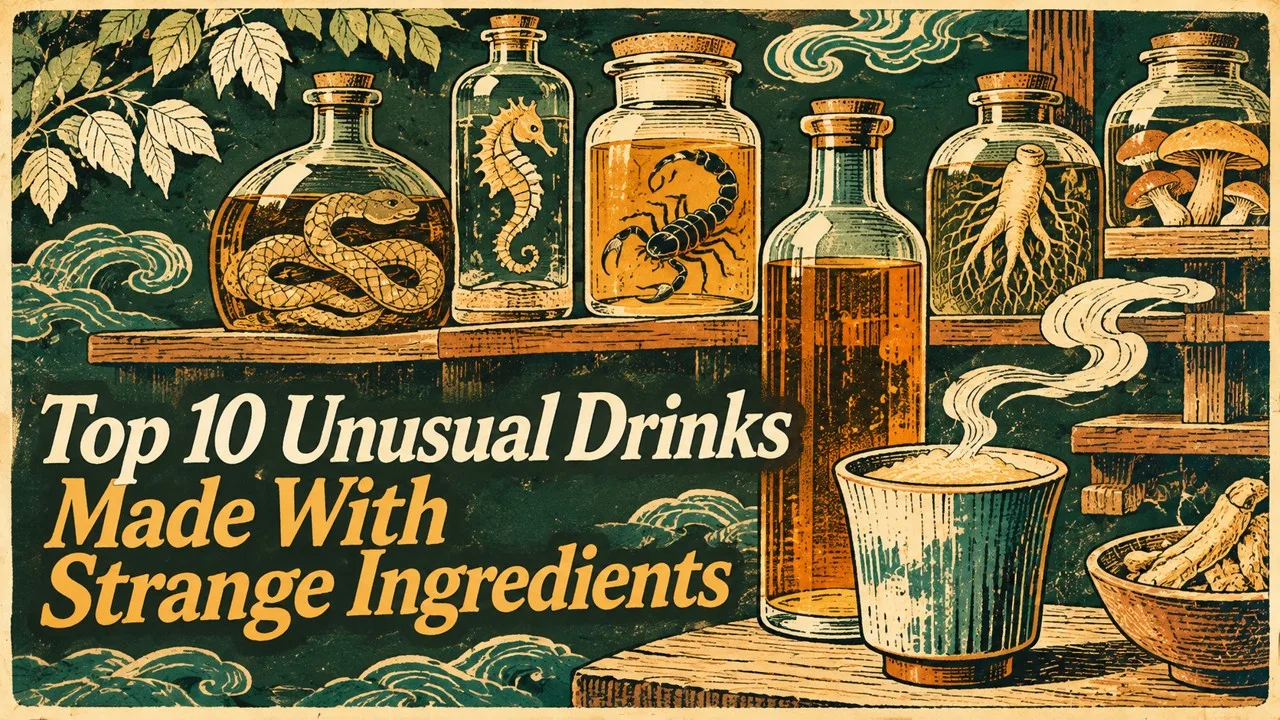
Some drinks use startling ingredients, from coffee beans passed through civets and elephants to snake wine, chewed maize beer and a cocktail with a toe. Every culture has its favorite drinks, and most of them are made from familiar ingredients such as grapes, grain, tea leaves, coffee beans or milk. But some drinks rely on ingredients that can surprise or even shock people who encounter them for the first time.
Some of these drinks use animals in unexpected ways, either as part of the process or as an ingredient. Others depend on methods that seem strange today but made perfect sense in the places where they developed, such as chewing grain to start fermentation or adding butter and salt to tea to survive at high altitude.
The ten drinks below are kopi luwak, Black Ivory Coffee, snake wine, chicha, kumis, the Sourtoe Cocktail, butter tea, kvass, salep and drinks made from edible bird's nests. They come from Asia, South America, Europe and even a small town in northern Canada.
Some of these drinks raise animal welfare or conservation concerns, and those are noted where relevant. Health claims made for some traditional drinks are often unproven, and this article does not endorse them.
Strange as they may seem, many of these drinks are deeply rooted in local traditions. They show how people have used whatever was available, from local plants and animals to leftover bread, to create drinks that nourish, celebrate and bring people together.
Fermentation plays a part in many of the drinks below. Long before people understood microbes, they learned that leaving milk, grain, fruit or bread to sit under the right conditions could produce something tasty, longer-lasting and sometimes mildly alcoholic. Many of the world's oldest drinks were discovered this way, through trial, error and careful observation passed down over generations.
Key Facts
| # | Drink | Strange ingredient | Where it comes from |
|---|---|---|---|
| 1 | Kopi luwak | Coffee cherries eaten and passed by civets | Indonesia |
| 2 | Black Ivory Coffee | Coffee cherries eaten by elephants | Thailand |
| 3 | Snake wine | Whole snakes soaked in rice wine | China and Southeast Asia |
| 4 | Chicha | Maize chewed to start fermentation | The Andes |
| 5 | Kumis | Fermented milk from horses | Central Asian steppes |
| 6 | Sourtoe Cocktail | A preserved human toe | Dawson City, Yukon, Canada |
| 7 | Butter tea | Yak butter and salt mixed with tea | Tibet and the Himalayas |
| 8 | Kvass | Fermented rye bread | Eastern Europe |
| 9 | Salep | Flour made from orchid tubers | Turkey and the Middle East |
| 10 | Bird's nest drink | Nests made from swiftlet saliva | Southeast Asia and China |
1. Coffee From a Civet
Kopi luwak is coffee made from beans that have passed through the digestive system of the Asian palm civet, a small cat-like mammal. The civets eat ripe coffee cherries, and the beans are collected from their droppings, cleaned and roasted [1].
The drink is often said to have originated in colonial Indonesia, when workers on coffee plantations were not allowed to harvest coffee for themselves and instead collected beans from civet droppings. Supporters claim that fermentation in the civet's gut makes the coffee smoother, though tasters disagree about whether it is really better [1].
Kopi luwak became famous as one of the most expensive coffees in the world. Its popularity led to the caging and force-feeding of civets on some farms, and animal welfare groups have criticized the trade. Many products sold as kopi luwak are also believed to be fake.
2. Coffee From Elephants
Black Ivory Coffee is a rare coffee produced in northern Thailand. Arabica coffee cherries are fed to elephants, and the beans are later picked out of the elephants' dung by hand, cleaned and roasted [2].
Related: Top 25 Interesting Facts About the Solar System
The product was created by the Canadian entrepreneur Blake Dinkin and launched in 2012, in partnership with an elephant foundation. According to the producers, digestive enzymes in the elephant's gut break down proteins that cause bitterness, giving the coffee a smoother taste [2].
Large quantities of coffee cherries are needed to produce a small amount of coffee, because many beans are chewed, broken or lost. As a result, it is among the most expensive coffees in the world, usually sold by the cup in luxury hotels.
3. A Snake in the Bottle
Snake wine is made by placing a whole snake, sometimes venomous, into a bottle of rice wine or grain alcohol and leaving it to infuse. The alcohol is strong enough to break down the snake's venom, making the drink safe in that respect [3].
The drink has a long history in China and is also found in Vietnam and other parts of Southeast Asia. It has traditionally been valued in folk medicine as a tonic for vitality and health, though there is no good scientific evidence for such benefits [3].
Snake wine is often sold to tourists as a souvenir, but many countries restrict its import because some snakes used are protected species. Conservation groups have raised concerns about the trade in wild snakes.
4. Beer Started by Chewing
Chicha is a fermented drink made in the Andes and other parts of South and Central America, most commonly from maize. In a traditional method, maize was chewed and spat into a container. Enzymes in saliva break down starch into sugars, which then ferment into alcohol [4].
Chicha has been made for thousands of years. It was important in the Inca Empire, where it was used in religious ceremonies, festivals and political gatherings, and large amounts were brewed for state occasions [4].
Today, most chicha is made by malting the maize rather than chewing it, though the chewing method survives in some communities. Chicha remains an important drink at celebrations in Peru, Bolivia and Ecuador.
Related: Top 25 Interesting Facts About the Universe
5. Fermented Mare's Milk
Kumis is a fermented drink made from mare's milk. It is traditional among the nomadic peoples of the Central Asian steppes, including Kazakhs, Kyrgyz and Mongols, for whom horses have long been central to life [5].
The milk is fermented in containers made of animal hide or wood and stirred regularly. The result is slightly sour, fizzy and mildly alcoholic. Medieval European travelers such as the friar William of Rubruck described kumis in the thirteenth century [5].
Kumis remains popular in Kazakhstan, Kyrgyzstan and Mongolia, where it is often served in summer when mares produce more milk. In the nineteenth century, kumis cures became fashionable in Russia, with sanatoriums offering it as treatment for illnesses such as tuberculosis.
6. A Cocktail With a Toe
At the Downtown Hotel in Dawson City, Yukon, visitors can join a club by drinking the Sourtoe Cocktail, a shot of alcohol containing a preserved human toe. The tradition began in 1973, after a local man found a preserved toe in a cabin [6].
The rule of the club is that the drinker's lips must touch the toe. Drinkers who swallow it face a hefty fine. Over the years, several toes have been lost, swallowed or stolen, and new ones have been donated by people who lost toes to frostbite, accident or surgery [6].
The Sourtoe Cocktail has become one of the most unusual tourist attractions in Canada. Tens of thousands of people have joined the club, receiving a certificate to prove they took part.
7. Tea With Butter and Salt
Butter tea is a traditional drink of Tibet and neighboring Himalayan regions. It is made by boiling tea leaves, then churning the tea with yak butter and salt until it becomes creamy. The result is rich, salty and filling [7].
At high altitudes, where the air is cold and dry, butter tea provides calories and fat, helping people stay warm and energetic. Many Tibetans traditionally drink many cups a day, and hosts often refill guests' cups as soon as they take a sip [7].
Related: Top 10 Mythical Creatures in World Mythology - That Inspired Myths Across Civilizations (unchanged)
The drink is also part of social and religious life, offered to guests and served in monasteries. Visitors are often surprised by its salty taste, which is very different from sweet milk tea.
8. A Drink Made From Bread
Kvass is a fermented drink traditionally made from rye bread. Stale bread is soaked in water with sugar and yeast or other starters, and left to ferment. The result is a slightly sour, mildly fizzy drink with very little alcohol [8].
Kvass has been popular in Eastern Europe for many centuries, with references in medieval chronicles. It was drunk by peasants and nobles alike and was valued as a cheap, refreshing drink that used leftover bread [8].
In the Soviet Union, kvass was sold in summer from yellow tanker trucks on street corners, poured into glasses for passersby. Today it is sold in bottles and cans, and many families still make it at home.
9. A Drink Made From Orchids
Salep is a hot, thick, milky drink made with flour ground from the dried tubers of certain wild orchids. It is flavored with sugar and cinnamon and is especially popular in Turkey during winter [9].
The drink was popular in the Ottoman Empire and spread to Europe. In eighteenth-century England, a drink called saloop was sold on the streets of London before coffee and tea became cheap [9].
Because making salep requires digging up wild orchids, overharvesting has threatened orchid populations. Turkey restricts the export of real salep, and many products sold abroad use substitutes such as cornflour instead of orchid flour.
Related: Top 25 Weird Facts About Left-Handed People
10. Bird Saliva in a Bottle
Some species of swiftlet build their nests almost entirely from their own saliva, which hardens into a cup-like structure. These edible bird's nests have been prized in Chinese cuisine for centuries and are used in soups and sweet drinks [10].
The nests are harvested from caves and, increasingly, from special buildings designed to attract swiftlets. They are among the most expensive animal products eaten by humans, and are sold in bottled drinks as well as dried form [10].
Bird's nest is traditionally believed to have health benefits, though scientific evidence is limited. Harvesting from wild caves can be dangerous for collectors and can disturb bird colonies if not managed carefully.
Conclusion
These drinks show how creative people have been in turning local resources into beverages. From chewed maize and stale bread to orchid tubers and bird saliva, almost anything can become a drink in the right hands.
They also show how tastes are shaped by culture. A drink that seems bizarre to one person may be an everyday comfort to another. Butter tea, kvass and kumis are ordinary in their homelands, while kopi luwak and the Sourtoe Cocktail are novelties even where they are made.
Some of these drinks also raise important questions about animal welfare and conservation. Enjoying unusual foods responsibly means learning where they come from and how they are produced.
Travelers who want to try these drinks are best served by seeking out reputable sources, asking how the ingredients are obtained and respecting local customs around how and when the drinks are served.
- ^ [1] Accounts of kopi luwak. Wikipedia: kopi luwak Wikipedia: Asian palm civet
- ^ [2] Accounts of Black Ivory Coffee. Wikipedia: Black Ivory Coffee Wikipedia: Asian elephant
- ^ [3] Accounts of snake wine. Wikipedia: snake wine Wikipedia: wildlife trade
- ^ [4] Accounts of chicha. Wikipedia: chicha Wikipedia: amylase
- ^ [5] Accounts of kumis. Wikipedia: kumis Wikipedia: William of Rubruck
- ^ [6] Accounts of the Sourtoe Cocktail. Wikipedia: Sourtoe Cocktail Wikipedia: Dawson City
- ^ [7] Accounts of butter tea. Wikipedia: butter tea Wikipedia: Tibetan cuisine
- ^ [8] Accounts of kvass. Wikipedia: kvass Wikipedia: rye bread
- ^ [9] Accounts of salep. Wikipedia: salep Wikipedia: Orchis
- ^ [10] Accounts of edible bird's nests. Wikipedia: edible bird's nest Wikipedia: swiftlet
























Discussion
Log in with