





 By
American cheese has a surprising story, from a Swiss invention and a 1916 Kraft patent to legal labels, wartime rations and government cheese stockpiles. American cheese is one of the most recognizable foods in the United States. Its bright orange slices melt on burgers, sandwiches and grilled cheese, and it fills supermarket shelves in individually wrapped stacks. It is also one of the most debated foods, praised by some chefs for its perfect melt and dismissed by others as not real cheese.
The truth is more interesting than either view. American cheese has a long history that includes Swiss inventors, a Chicago cheese seller, wartime rations, government programs and some precise legal definitions. Its unique texture comes from careful food science rather than mystery ingredients.
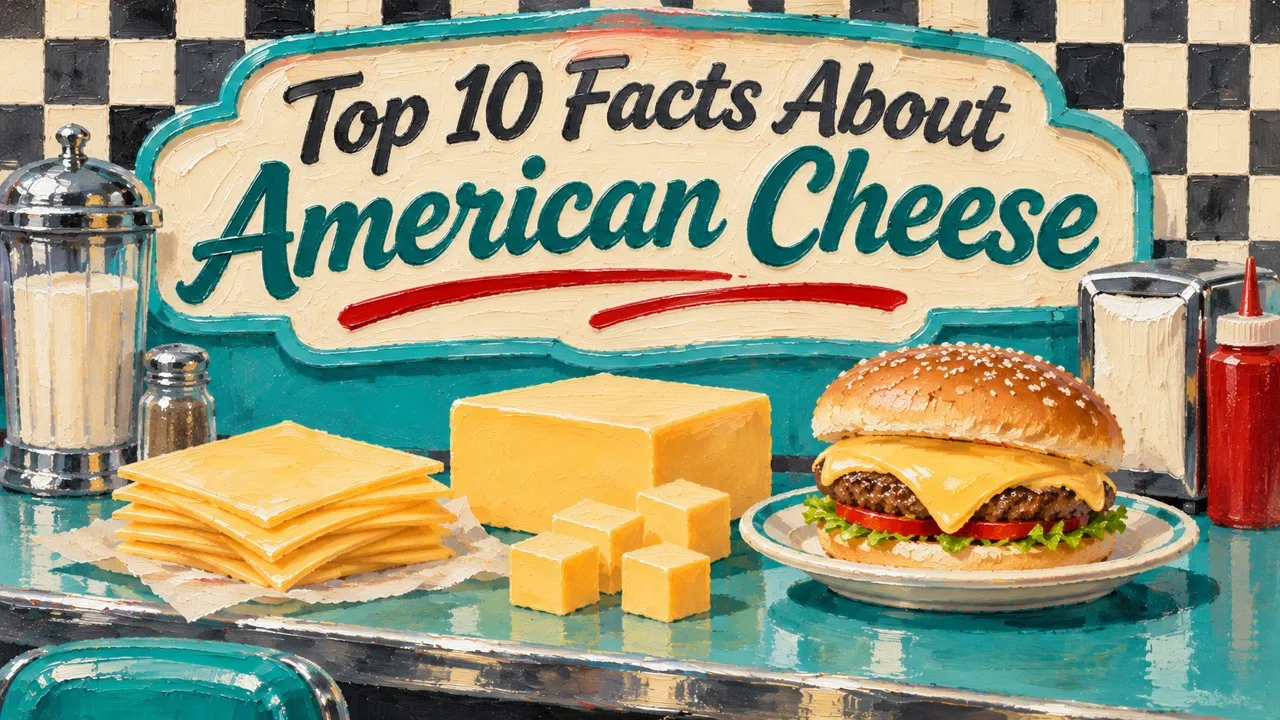
The ten facts below cover the original meaning of American cheese, the Swiss invention of processed cheese, James L. Kraft's patent, its role in the First World War, its legal labels, the science of its melt, the story of Velveeta, the invention of sliced and wrapped cheese, the government cheese program and the source of its orange color.
The details come from food histories, company histories and government regulations. Where claims are approximate or debated, that is noted.
Whatever one thinks of its taste, American cheese is a remarkable example of how food technology has shaped everyday eating. Its story reflects the growth of industrial food production, mass marketing and changing ideas about convenience and quality.
It also shows how much a single food can mean to a culture. For many Americans, it is linked to childhood lunches, diners and backyard cookouts, which helps explain why it has stayed popular despite changing tastes.
Key Facts
| # | Fact | Key detail | Date or period |
|---|---|---|---|
| 1 | Original meaning | Cheddar-style cheese made in the American colonies | 18th and 19th centuries |
| 2 | Swiss origins | Walter Gerber and Fritz Stettler | 1911 |
| 3 | James L. Kraft | A patent for processed cheese | 1916 |
| 4 | First World War | Kraft supplied tinned cheese to the military | 1917 and 1918 |
| 5 | Legal categories | Process cheese, cheese food and cheese product | Defined by federal rules |
| 6 | Emulsifying salts | Keeps fat and protein together | Food science |
| 7 | Velveeta | A smooth cheese product from New York | Introduced around 1918 |
| 8 | Sliced and wrapped cheese | Presliced cheese and individually wrapped slices | 1950 and 1965 |
| 9 | Surplus cheese program | Federal stockpiles distributed to the needy | 1980s |
| 10 | Annatto | A natural color from seeds | Used for centuries in cheese making |
1. It Once Meant Cheddar
Before processed cheese existed, the phrase American cheese meant something different. In the eighteenth and nineteenth centuries, it referred to cheddar-style cheese made in the American colonies and later the United States, much of which was exported to Britain [1].
British buyers sometimes called it Yankee cheese, and it was often considered cheaper and lower in quality than English cheddar. Factories in New York and Wisconsin produced large quantities of it in the nineteenth century, as American dairy farming expanded rapidly [1].
The meaning shifted in the twentieth century as processed cheese became popular. Today the phrase is almost always used for the processed product, though some older recipes and regional uses still refer to American cheddar.
2. Processed Cheese Was Invented in Switzerland
The first processed cheese was developed not in America but in Switzerland. In 1911, Walter Gerber and Fritz Stettler of Thun found a way to melt Emmental cheese with sodium citrate, creating a product that kept longer and could be shipped to warmer climates without spoiling [2].
Their goal was to solve a practical problem. Natural cheese could go bad quickly in hot weather and during long journeys, limiting exports. Processed cheese could be stored much longer and remained stable [2].
Related: Top 10 Unusual Science Experiments Involving Food
The Swiss invention was soon followed by similar efforts elsewhere. Within a few years, an American cheese seller would develop his own process and turn processed cheese into a mass-market product in the United States.
3. The Kraft Patent
James L. Kraft was a Canadian-born businessman who started selling cheese from a horse-drawn wagon in Chicago in the early twentieth century. With his brothers, he built a cheese business that became Kraft Foods [3].
In 1916, Kraft received a United States patent for a method of processing cheese. The process involved heating and stirring cheese, often with emulsifying salts, and sealing it in tins. The result was a smooth cheese that could be stored for long periods without refrigeration [3].
Kraft's patent helped launch the processed cheese industry in America. The company's products became widely available, and Kraft became one of the most recognizable names in American food.
4. Cheese for the Army
When the United States entered the First World War in 1917, the military needed food that could survive long journeys and difficult conditions. Kraft's tinned processed cheese was ideal, because it did not spoil easily [4].
Kraft supplied large quantities of tinned cheese to the United States Army during the war. Company histories often cite millions of pounds, though exact figures vary between sources. For many soldiers, it was their first taste of processed cheese [4].
When the soldiers came home, many had developed a taste for it. Wartime supply helped build a market for processed cheese in American homes, and demand grew rapidly in the 1920s.
5. What the Label Means
In the United States, processed cheese is regulated by the Food and Drug Administration, which has detailed rules called standards of identity. These rules define what can be labeled pasteurized process cheese, pasteurized process cheese food and pasteurized process cheese spread [5].
Each category has different requirements for how much real cheese it must contain, how much moisture it may have and what other ingredients are allowed. Products that do not meet any of these standards must use other terms, such as cheese product [5].
Related: Top 10 Everyday Foods with Origins in Military Rations
This is why some well-known brands of American cheese slices are labeled pasteurized prepared cheese product rather than cheese. The label does not mean the product contains no cheese, but that it does not meet the specific legal definition.
6. Why It Melts So Well
American cheese is famous for melting smoothly without becoming greasy or stringy. The secret lies in emulsifying salts, such as sodium citrate and sodium phosphate, which are added during processing [6].
In natural cheese, heating can cause the fat to separate from the proteins, leaving a pool of grease and a rubbery mass. Emulsifying salts help keep the fat and proteins bound together, producing a smooth, even melt [6].
Many chefs who prefer natural cheeses still use American cheese on burgers for this reason. Some cooks even add sodium citrate to other cheeses to create smooth sauces, borrowing the same chemistry.
7. The Story of Velveeta
Velveeta was developed around 1918 by Emil Frey, a Swiss-born cheese maker working in Monroe, New York. He found a way to use broken pieces of cheese to create a smooth, meltable product, which he named for its velvety texture [7].
The Velveeta Cheese Company was founded in 1923 and was bought by Kraft in 1927. Velveeta was marketed as a nutritious food, and in its early years it even received approval from the American Medical Association [7].
Today Velveeta is classified as a pasteurized prepared cheese product. It remains popular in recipes such as macaroni and cheese and queso dips, valued for its smooth texture when melted.
8. Slices and Wrappers
For many years, processed cheese was sold in blocks and tins. In 1950, Kraft introduced presliced processed cheese, making it easier to use for sandwiches and burgers [8].
Related: Top 10 Most Bizarre Phobias: Strange Fears That Exist
In 1965, Kraft launched individually wrapped slices, sold as Kraft Singles. Each slice was wrapped in its own plastic film, keeping it fresh and preventing slices from sticking together. The product became an iconic part of American food culture [8].
The convenience of wrapped slices made American cheese a staple of school lunches, diners and fast food restaurants. It also helped make the cheeseburger one of the most popular foods in the United States.
9. Government Cheese
In the late 1970s and early 1980s, federal price support programs led the United States government to buy huge amounts of surplus dairy products, including processed cheese, to support farmers. Stockpiles grew to hundreds of millions of pounds stored in warehouses [9].
In 1981, the government began distributing the surplus cheese to low-income families, elderly people and others in need. The large blocks became known as government cheese and were widely remembered by people who grew up in the period [9].
The program became a symbol of both government waste and food aid. Government cheese remains a familiar cultural reference in the United States, appearing in music, comedy and memoirs.
10. Where the Orange Comes From
The bright orange color of many American cheese slices comes from annatto, a natural coloring made from the seeds of the achiote tree, native to tropical regions of the Americas [10].
Cheese makers have colored cheese with annatto and other dyes for centuries. In England, some cheeses were colored to suggest they were made from rich summer milk. The tradition continued in American cheddar and later in processed cheese [10].
Not all American cheese is orange. White American cheese is also common, especially in delis in the northeastern United States. The difference is simply the coloring, not the flavor.
Related: Top 10 Oldest Buildings in the World
Conclusion
These facts show that American cheese is more than a simple slice. It has a history that includes Swiss inventors, a Chicago entrepreneur, soldiers, government programs and careful food science.
Its reputation is mixed. Some people love it for its nostalgia and melt, while others see it as a symbol of industrial food. Both views reflect the role it has played in American life for more than a century.
Whatever one's opinion, American cheese is a good example of how food technology can change what people eat and how they think about food. It remains one of the most familiar foods in the United States.
Recent years have brought new versions, including slices with simpler ingredient lists and premium deli varieties. The debate over what counts as real cheese is likely to continue as long as people keep putting it on burgers.
For cooks, the lesson is practical. Processed and natural cheeses each have their strengths, and many recipes work best with a combination, using a natural cheese for flavor and a little processed cheese or sodium citrate for texture. Understanding the science behind American cheese makes it easier to choose the right cheese for the job, whether that is a burger, a sauce or a simple sandwich.
Its long history suggests it will remain a fixture of American kitchens for years to come.
Few foods have inspired so much affection and so much argument at the same time.
- ^ [1] Accounts of American cheese. Wikipedia: American cheese Wikipedia: cheddar cheese
- ^ [2] Accounts of processed cheese. Wikipedia: processed cheese Wikipedia: Emmental cheese
- ^ [3] Accounts of James L. Kraft. Wikipedia: James L. Kraft Wikipedia: Kraft Foods
- ^ [4] Accounts of food in the First World War. Wikipedia: field ration Wikipedia: American entry into World War I
- ^ [5] Accounts of cheese labeling rules. Wikipedia: standard of identity Wikipedia: Food and Drug Administration
- ^ [6] Accounts of emulsifying salts. Wikipedia: sodium citrate Wikipedia: emulsion
- ^ [7] Accounts of Velveeta. Wikipedia: Velveeta Wikipedia: Monroe, New York
- ^ [8] Accounts of Kraft Singles. Wikipedia: Kraft Singles Wikipedia: cheeseburger
- ^ [9] Accounts of government cheese. Wikipedia: government cheese Wikipedia: Commodity Credit Corporation
- ^ [10] Accounts of annatto. Wikipedia: annatto Wikipedia: Bixa orellana





















Discussion
Log in with