






 By
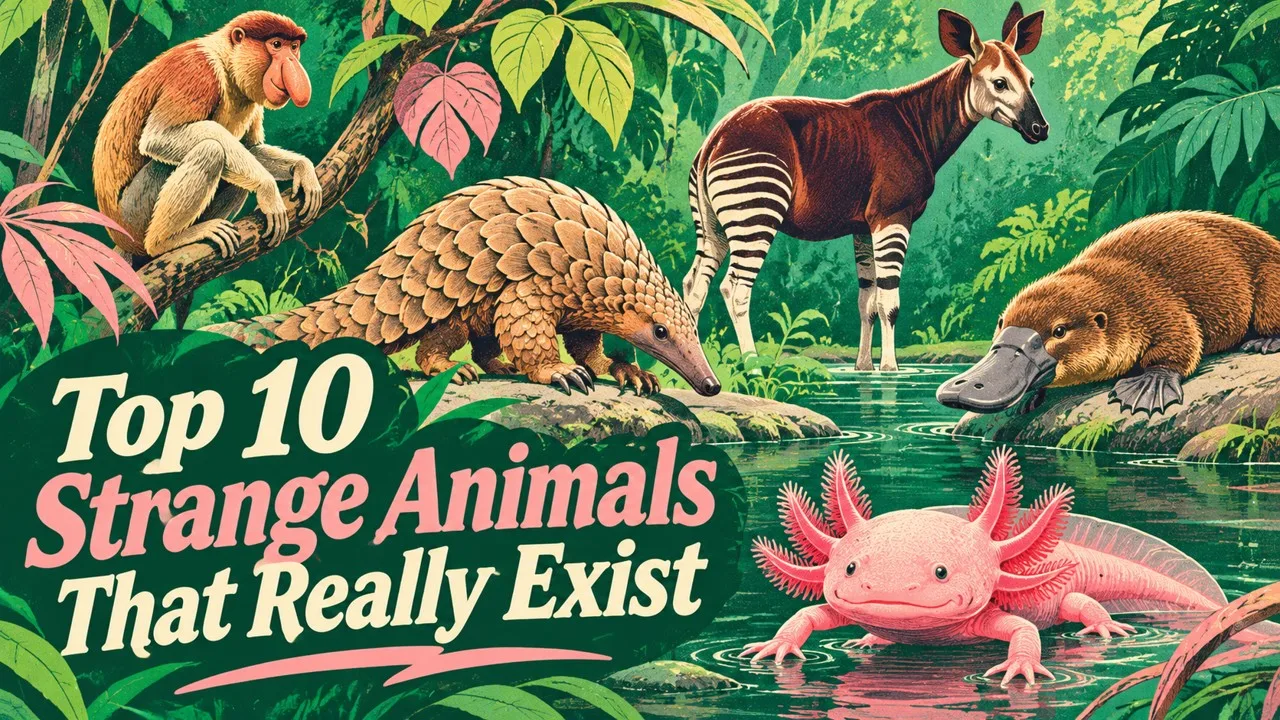
Some real animals look invented, from a lemur with a skeletal tapping finger and a mole with a star for a nose to frogs with see-through skin. Nature has produced some creatures so odd that people seeing them for the first time often assume they are fake. Their shapes, colors and habits seem designed for a fantasy film rather than the real world. Yet every one of them is a product of evolution, shaped by the particular challenges of the places they live.
Strange features often have practical purposes. A long finger can help find food hidden in wood, a sensitive nose can help an animal hunt in darkness, and transparent skin can help a frog avoid predators. What looks bizarre to us may be a brilliant solution to a problem in the wild.
The ten animals below are the aye-aye, the star-nosed mole, the pink fairy armadillo, the naked mole-rat, the saiga antelope, the shoebill, the leafy seadragon, the glass frog, the sea pig and the okapi. They come from rainforests, deserts, swamps, steppes and the deep sea.
Several of these animals are threatened by habitat loss, hunting or climate change. Their conservation status is noted where relevant, because learning about strange animals is also a reminder of how much biodiversity is at risk.
Each of these animals has been studied by scientists, and their unusual features are well documented. Some have become popular online, while others remain little known outside specialist circles.
Taken together, they show how varied life on Earth is, and how much remains to be discovered about the creatures that share the planet with us.
Many of the animals on this list were once the subject of disbelief. When the first specimens or descriptions reached scientists in Europe, some were thought to be hoaxes or misunderstandings, much like the platypus, which some naturalists in the late eighteenth century suspected had been stitched together from parts of different animals. Careful study later showed that these creatures were exactly as strange as they looked.
Key Facts
| # | Animal | Strange feature | Where it lives |
|---|---|---|---|
| 1 | Aye-aye | Long, thin middle finger used to find grubs | Madagascar |
| 2 | Star-nosed mole | Twenty-two fleshy tentacles on its nose | Eastern North America |
| 3 | Pink fairy armadillo | The smallest armadillo, with a pink shell | Central Argentina |
| 4 | Naked mole-rat | Hairless, long-lived and resistant to cancer | East Africa |
| 5 | Saiga antelope | A large, flexible nose | The steppes of Central Asia |
| 6 | Shoebill | An enormous, shoe-shaped bill | Swamps of East and Central Africa |
| 7 | Leafy seadragon | Leaf-like appendages for camouflage | Southern Australian coast |
| 8 | Glass frog | Transparent belly skin | Central and South America |
| 9 | Sea pig | A deep-sea sea cucumber with legs | Deep ocean floors worldwide |
| 10 | Okapi | A forest relative of the giraffe | Democratic Republic of the Congo |
1. A Lemur With a Tapping Finger
The aye-aye is a nocturnal lemur found only in Madagascar. It has large eyes, big ears, continuously growing front teeth like a rodent's and, most strikingly, a long, thin, bony middle finger on each hand [1].
The aye-aye uses this finger to tap on tree bark and listen for hollow spaces where insect larvae live. It then gnaws a hole with its teeth and uses the finger to pull out the grubs. This method of hunting, known as percussive foraging, is rare among mammals [1].
In some parts of Madagascar, the aye-aye has traditionally been regarded as a bad omen, and some have been killed on sight. Combined with habitat loss, this has made it an endangered species.
Related: Top 10 Real Species That Look Almost Unreal
2. A Nose Shaped Like a Star
The star-nosed mole lives in wet lowlands of eastern Canada and the northeastern United States. Its nose is surrounded by twenty-two pink, fleshy tentacles that form a star shape [2].
The star is one of the most sensitive touch organs known in any mammal. It is covered with tens of thousands of tiny sensory receptors, allowing the mole to identify food by touch in a fraction of a second. Research has found that it can identify and eat prey faster than almost any other mammal [2].
The mole also has the unusual ability to smell underwater. It blows small bubbles onto objects and then inhales them back, picking up scent molecules, a technique documented in scientific studies.
3. A Tiny Pink Armadillo
The pink fairy armadillo is the smallest species of armadillo, only about ten centimeters long. It has a pale pink shell on its back, silky white fur underneath and large claws for digging [3].
It lives in sandy plains and grasslands of central Argentina and spends most of its life underground, digging through soil like a mole. It is rarely seen, and scientists know relatively little about its behavior [3].
The pink color comes partly from blood vessels showing through the shell, which may help with temperature control. Because it is so rarely observed, its population size and conservation status are uncertain.
4. A Rodent That Rarely Ages
The naked mole-rat is a small, hairless rodent that lives in underground colonies in East Africa. It looks wrinkled and pink, with large front teeth that stick out from its lips [4].
Naked mole-rats live in colonies led by a single breeding queen, a social system more like that of ants and bees than other mammals. They can live for more than thirty years, far longer than other rodents of similar size, and rarely develop cancer [4].
They can also survive for many minutes without oxygen. A study in 2017 found that their bodies can switch to a different way of producing energy when oxygen is scarce. Scientists study them for clues about aging and disease.
Related: Top 10 Unsettling Facts About Nature
5. An Antelope With a Trunk-Like Nose
The saiga antelope lives on the dry steppes of Central Asia, especially in Kazakhstan. Its most noticeable feature is its large, drooping nose, which looks almost like a short trunk [5].
The nose helps filter dust from the air during summer migrations and warm cold air in winter. Saiga can travel long distances across open grasslands in large herds [5].
Saiga have suffered dramatic population crashes. In 2015, more than 200,000 died within weeks from a bacterial infection, likely triggered by unusual weather. Conservation efforts have helped populations recover, and in 2023 the species' status was improved from critically endangered to near threatened.
6. A Bird With a Shoe for a Bill
The shoebill is a large bird that lives in the swamps of East and Central Africa. It stands more than a meter tall and has a huge, broad bill shaped like a wooden shoe, with a sharp hook at the end [6].
Shoebills hunt by standing perfectly still for long periods, then lunging at prey such as lungfish, catfish and even small crocodiles. Their stillness and stare have made them popular in internet videos [6].
Shoebills communicate by clattering their bills loudly. They are classified as vulnerable, threatened by habitat loss, disturbance and capture for the wildlife trade.
7. A Fish Disguised as Seaweed
The leafy seadragon is a relative of the seahorse found off the southern and western coasts of Australia. Its body is covered with leaf-shaped extensions that make it look like a floating piece of seaweed [7].
The camouflage helps it hide from predators as it drifts among kelp and seagrass. It moves slowly, using tiny, nearly transparent fins, and feeds on small crustaceans sucked in through its tube-like snout [7].
Related: Top 10 Unusual Forms of Familiar Animals
As with seahorses, the male cares for the eggs, carrying them on the underside of his tail until they hatch. The leafy seadragon is the marine emblem of the state of South Australia and is protected by law.
8. A Frog You Can See Through
Glass frogs are small frogs that live in the rainforests of Central and South America. Many species have transparent skin on their bellies, so their hearts, livers and digestive organs can be seen from below [8].
A study published in 2022 found that some glass frogs become even more transparent when sleeping. They hide most of their red blood cells in their liver, removing color from the rest of the body. Scientists are studying how they do this without blood clotting [8].
The transparency is thought to help them avoid predators by making them harder to see against leaves. Male glass frogs often guard their eggs, which are laid on leaves above streams.
9. A Pig That Walks the Seafloor
Sea pigs are deep-sea sea cucumbers belonging to the genus Scotoplanes. They live on the ocean floor at depths of more than a thousand meters, in many parts of the world [9].
They have plump, pinkish bodies and walk on enlarged tube feet that look like legs. They also have tentacles near their mouths that they use to feed on organic material in the mud. Sea pigs can be found in large groups, sometimes numbering hundreds [9].
Little was known about sea pigs until deep-sea exploration became more advanced. They play an important role in recycling nutrients on the seafloor, and they have become popular as an example of the strange creatures of the deep.
10. A Giraffe With Zebra Legs
The okapi lives in the dense rainforests of the Democratic Republic of the Congo. It has a reddish brown body, white stripes on its legs like a zebra and a long neck, though shorter than a giraffe's [10].
Related: Top 10 Amazing Animals of the Amazon Rainforest
Despite its stripes, the okapi is the giraffe's closest living relative. It has a very long, flexible tongue that it uses to strip leaves from branches and even clean its own ears [10].
The okapi was known to local peoples for a long time, but it was not formally described by Western scientists until the early twentieth century. It is now endangered, threatened by habitat loss, hunting and conflict in its range.
Conclusion
These animals show the extraordinary variety of life on Earth. Each strange feature has a purpose, helping the animal find food, avoid predators or survive harsh conditions.
They also remind us how much remains to be discovered. Some of these animals were unknown to science until relatively recently, and new species are still being found, especially in deep oceans and remote forests.
Many strange animals are vulnerable to human activity. Protecting their habitats is essential if future generations are to see them in the wild, not just in pictures.
Zoos, aquariums and research centers play a part by studying these species and supporting conservation programs. Learning about unusual animals can also inspire people to care about biodiversity more broadly.
Photographs and videos shared online have made several of these animals famous in recent years. That attention can help conservation, but it can also fuel demand for illegal pets, which is why experts encourage people to enjoy strange animals from a respectful distance.
- ^ [1] Accounts of the aye-aye. Wikipedia: aye-aye Wikipedia: lemur
- ^ [2] Accounts of the star-nosed mole. Wikipedia: star-nosed mole Wikipedia: Eimer's organ
- ^ [3] Accounts of the pink fairy armadillo. Wikipedia: pink fairy armadillo Wikipedia: armadillo
- ^ [4] Accounts of the naked mole-rat. Wikipedia: naked mole-rat Wikipedia: eusociality
- ^ [5] Accounts of the saiga antelope. Wikipedia: saiga antelope Wikipedia: Kazakhstan
- ^ [6] Accounts of the shoebill. Wikipedia: shoebill Wikipedia: lungfish
- ^ [7] Accounts of the leafy seadragon. Wikipedia: leafy seadragon Wikipedia: Syngnathidae
- ^ [8] Accounts of glass frogs. Wikipedia: glass frog Wikipedia: camouflage
- ^ [9] Accounts of sea pigs. Wikipedia: Scotoplanes Wikipedia: sea cucumber
- ^ [10] Accounts of the okapi. Wikipedia: okapi Wikipedia: Giraffidae




















Discussion
Log in with