






 By
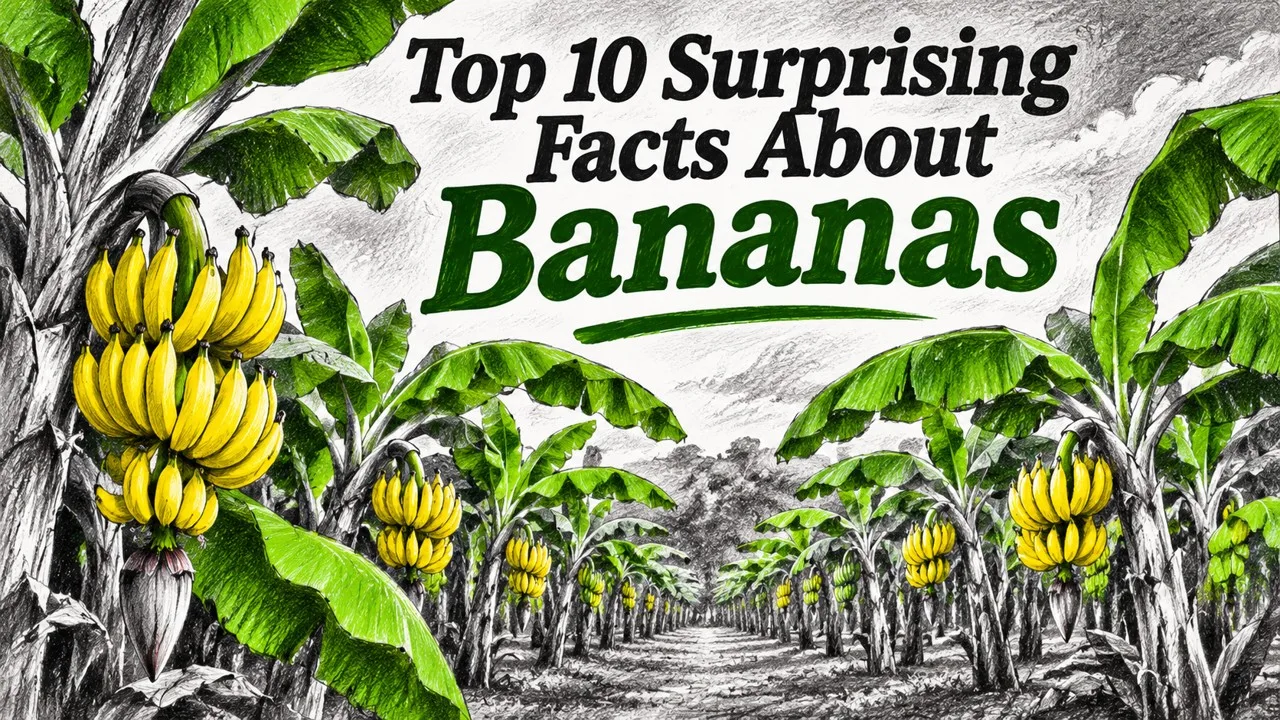
Bananas grow on giant herbs, are botanically berries, are slightly radioactive and are mostly clones. Ten surprising facts about the world's favorite fruit. Bananas are among the most popular fruits on Earth. They are cheap, easy to peel and available almost everywhere, from corner shops in cold northern cities to markets in the tropics. Billions of them are eaten every year.
Because they are so familiar, it is easy to assume that there is nothing surprising about bananas. Yet the fruit has a remarkable biology, a long history and a darker past than many people realize.
The bananas sold in most supermarkets are almost all genetically identical, which makes them vulnerable to disease. The industry that grows them has shaped the politics of entire countries, and scientists have studied everything from their mild radioactivity to the slipperiness of their peels.
Bananas are also far more varied than the familiar yellow fruit suggests. Around the world, people grow hundreds of types, including red bananas, tiny finger bananas and starchy cooking bananas that are boiled, fried or mashed like potatoes.
The ten facts below cover the banana's botany, its origins, the threat of disease, its role in history and some of the odd scientific questions it has raised. Where facts are debated or uncertain, that is noted.
Together, they show that the humble banana is far more interesting than it looks, and that its future is not as secure as its abundance in shops might suggest.
They also show how closely the fate of a single crop can be tied to science, trade and politics, and how a fruit eaten casually by millions has shaped the lives of people across the tropics.
Key Facts
| # | Topic | Detail | Where |
|---|---|---|---|
| 1 | Botany | The banana plant is not a tree | Tropical Asia and the Pacific |
| 2 | Origins | Domesticated thousands of years ago | Papua New Guinea |
| 3 | Wild species | Hard seeds make them hard to eat | Southeast Asia |
| 4 | Gros Michel | Panama disease destroyed it | Central America and the Caribbean |
| 5 | Cavendish | A new disease strain threatens them | Asia, Africa and Latin America |
| 6 | Potassium | Natural radiation in fruit | Worldwide |
| 7 | Banana republics | Fruit companies and politics | Central America and Colombia |
| 8 | Ethylene | Ripening is controlled after shipping | Importing countries |
| 9 | Friction research | A study that won an Ig Nobel Prize | Japan |
| 10 | Cooking bananas | Eaten as a main meal | East Africa |
1. It Grows on a Giant Herb
Banana plants can grow several meters tall and look like trees, but they are not trees at all. They do not have woody trunks. Instead, the stem is made of tightly packed leaf bases, and the plant is classified as a giant herbaceous flowering plant [1].
After a banana plant produces a bunch of fruit, the stem dies back, and new shoots grow from the underground base to replace it. Farmers cut down the old stem after harvest to make room for the new growth [1].
Botanically speaking, the banana fruit is a berry, because it develops from a single flower with one ovary and contains seeds, at least in wild varieties. Strawberries, by contrast, are not true berries in the botanical sense.
Related: Top 10 Surprising Facts About Bananas
2. It Was First Grown in New Guinea
Bananas are native to Southeast Asia and the western Pacific. Archaeological evidence from the Kuk Swamp in the highlands of Papua New Guinea suggests that people there were cultivating bananas around seven thousand years ago, among the earliest evidence of agriculture in the region [2].
From there, bananas spread across Asia, the Pacific islands and eventually to Africa, possibly carried by traders and settlers crossing the Indian Ocean. Arab traders later helped spread bananas around the Mediterranean [2].
Portuguese and Spanish colonists brought bananas to the Americas in the sixteenth century, where they became an important crop on plantations in the Caribbean and Central and South America.
3. Wild Bananas Are Full of Seeds
The bananas sold in shops have only tiny, undeveloped seeds that are barely noticeable. Wild bananas are very different. Many are packed with large, hard seeds, which make them difficult to eat [3].
The seedless bananas that people grow today are the result of natural mutations and hybridization between wild species, which were then selected by early farmers. These bananas develop fruit without fertilization, a process known as parthenocarpy [3].
Because they lack viable seeds, cultivated bananas must be grown from cuttings or shoots taken from existing plants. This makes it easy to produce many identical plants but difficult to breed new varieties.
4. The Old Favorite Was Wiped Out
Until the mid-twentieth century, the most popular banana in international trade was a variety called Gros Michel. It was large, sweet and robust enough to survive long journeys by ship, and some people say it had a richer flavor than today's bananas [4].
In the early twentieth century, a soil fungus causing a disease known as Panama disease began to destroy Gros Michel plantations in Central America and the Caribbean. The fungus spread through soil and water, and there was no effective treatment [4].
By the 1950s and 1960s, the export industry had largely switched to the Cavendish banana, which was resistant to that strain of the disease. Gros Michel is still grown in some places, but it is no longer a major export variety.
Related: Top 25 Interesting Facts About the Solar System
5. Most Bananas Are Clones
Today, the vast majority of bananas sold in international trade are of the Cavendish type. Because they are grown from cuttings, Cavendish bananas are essentially clones, with very little genetic variation between them [5].
This lack of diversity makes them vulnerable. A new strain of the Panama disease fungus, known as Tropical Race 4, can infect Cavendish bananas, and it has spread from Asia to parts of Africa, the Middle East and Latin America [5].
Scientists are working on solutions, including breeding resistant varieties, using genetic modification and improving farm practices to limit the spread. Many experts warn that the banana industry needs to diversify to avoid repeating the fate of Gros Michel.
6. They Are Slightly Radioactive
Bananas contain potassium, an essential nutrient. A tiny fraction of natural potassium is a radioactive isotope called potassium-40, which means that bananas are very slightly radioactive [6].
The radiation from eating a banana is extremely small and poses no danger to health. In fact, the body regulates the amount of potassium it contains, so eating bananas does not cause radioactivity to build up [6].
Some people have used the banana equivalent dose as an informal way to explain radiation exposure to the public, comparing other sources of radiation to the dose from eating a banana. Scientists note that the comparison is a rough illustration rather than a precise measure.
7. They Gave Their Name to a Political Term
In 1904, the American writer O. Henry used the phrase banana republic to describe a fictional Central American country. The term came to describe small countries whose economies depended on a single export and whose politics were heavily influenced by foreign companies [7].
In the early twentieth century, American companies such as the United Fruit Company controlled vast plantations, railways and ports in Central America and the Caribbean. They wielded great influence over local governments [7].
Related: Top 25 Interesting Facts About the Universe
The industry's history includes serious episodes of violence. In 1928, Colombian troops fired on striking banana workers in an event known as the Banana Massacre, and in 1954, a coup backed by the United States government overthrew Guatemala's elected president after he moved to redistribute unused land, including land owned by United Fruit.
8. They Ripen in Special Rooms
Bananas sold in shops are usually picked while still green and hard. This allows them to survive long journeys by ship without spoiling. When they arrive at their destination, they are often stored in special ripening rooms [8].
In these rooms, the bananas are exposed to ethylene, a natural plant hormone that triggers ripening. Temperature and humidity are carefully controlled so the fruit reaches shops at the right stage [8].
Bananas also release ethylene themselves as they ripen. That is why placing a banana next to other fruit, such as avocados or pears, can speed up their ripening at home.
9. Their Peels Really Are Slippery
Slipping on a banana peel is a classic comedy gag, and it turns out to have a basis in fact. In 2014, a team of Japanese researchers measured the friction of banana peels underfoot and found that they were indeed very slippery [9].
The researchers found that when a banana peel is stepped on, a gel-like substance is released from the inside of the peel, acting as a lubricant. The friction was much lower than on many other surfaces [9].
The study won an Ig Nobel Prize, awarded for research that first makes people laugh and then makes them think. The scientists suggested that their findings could help in understanding lubrication in human joints.
10. In Some Countries, They Are a Staple Food
In many parts of the world, bananas are not a snack or dessert but a staple food. Cooking bananas and plantains are starchy and are boiled, fried, steamed or mashed, playing a role similar to potatoes or rice [10].
Related: Top 10 Mythical Creatures in World Mythology - That Inspired Myths Across Civilizations (unchanged)
In parts of East Africa, especially Uganda, a type of cooking banana known as matooke is a central part of the diet. East African highland bananas are grown in large amounts and eaten at almost every meal in some communities [10].
Most bananas grown worldwide are eaten locally rather than exported. For millions of people, they are a vital source of food and income, making the health of banana crops a matter of food security.
Conclusion
Bananas are far more interesting than their familiar appearance suggests. They grow on giant herbs, are botanically berries and are mostly clones of a single variety.
Their history includes ancient farming in New Guinea, the rise and fall of the Gros Michel and the troubling influence of fruit companies in Central America. Today, disease once again threatens the bananas that fill supermarket shelves.
For many people, bananas are more than a convenient snack. They are a staple food and a source of livelihood, which makes protecting them an important challenge.
The next time you peel a banana, it may be worth remembering the long journey and complex history behind it.
It is a reminder that even the most familiar foods carry stories worth knowing.
Researchers, farmers and governments are now working together to protect the crop. Gene banks preserve hundreds of banana varieties, and breeding programs in several countries are trying to develop new types that resist disease while still tasting good and shipping well. Consumers can help too, by being open to trying different kinds of bananas when they appear in shops and markets.
- ^ [1] Accounts of the banana. Wikipedia: banana Wikipedia: Musa (genus)
- ^ [2] Accounts of banana origins. Wikipedia: Kuk Swamp Wikipedia: Musa acuminata
- ^ [3] Accounts of seedless bananas. Wikipedia: parthenocarpy Wikipedia: banana cultivar groups
- ^ [4] Accounts of the Gros Michel. Wikipedia: Gros Michel banana Wikipedia: Panama disease
- ^ [5] Accounts of the Cavendish. Wikipedia: Cavendish banana Wikipedia: monoculture
- ^ [6] Accounts of banana radioactivity. Wikipedia: banana equivalent dose Wikipedia: potassium-40
- ^ [7] Accounts of banana republics. Wikipedia: banana republic Wikipedia: United Fruit Company
- ^ [8] Accounts of banana ripening. Wikipedia: ethylene as a plant hormone Wikipedia: ripening
- ^ [9] Accounts of the banana peel study. Wikipedia: Ig Nobel Prize Wikipedia: friction
- ^ [10] Accounts of cooking bananas. Wikipedia: East African Highland bananas Wikipedia: plantain






















Discussion
Log in with