




 By
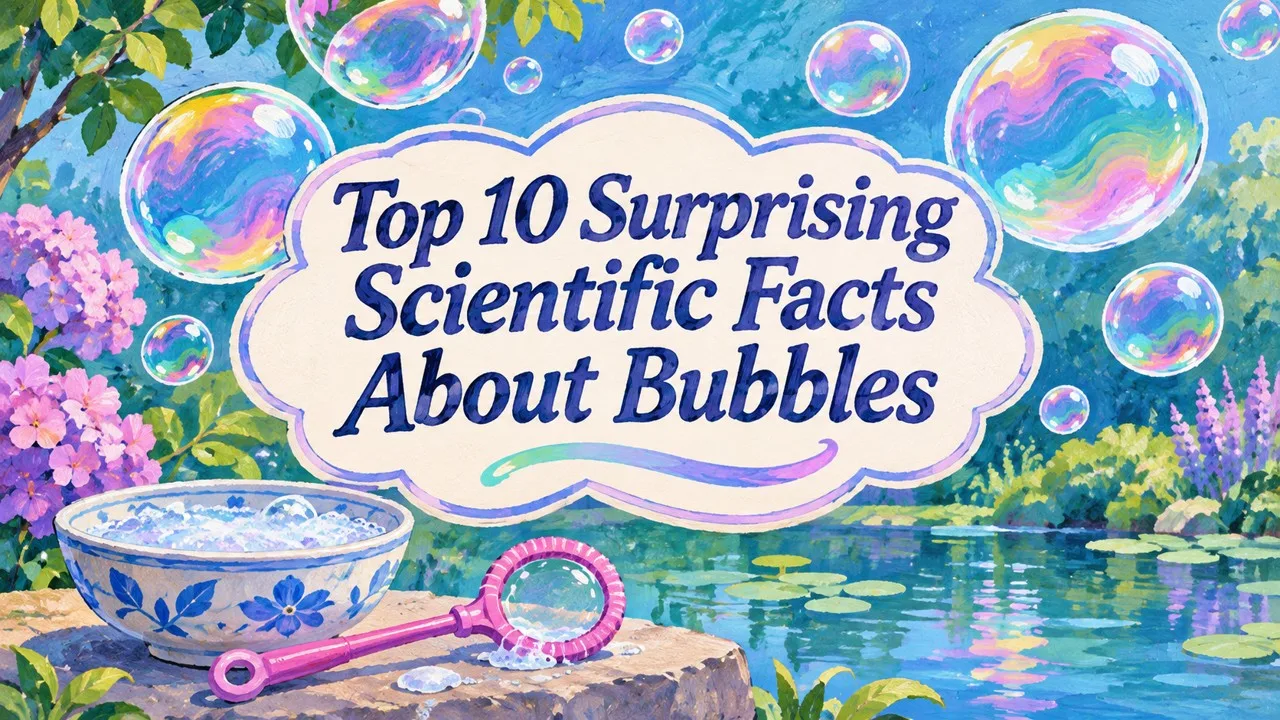
From champagne and Guinness to whale hunting, ice cores and particle physics, bubbles reveal surprising science. Ten facts about these fragile spheres. A bubble is simply a pocket of gas surrounded by liquid or a thin film, yet it brings together surface tension, pressure, light and chemistry in a single fragile object. Bubbles have puzzled and delighted scientists for centuries, from Isaac Newton, who studied the colors of soap films, to modern researchers using high-speed cameras.
They appear far beyond the bath and the playground. Bubbles shape the taste of drinks, help predators hunt, record the history of the atmosphere and once revealed the paths of subatomic particles.
Some bubbles last for only a fraction of a second, while others have stayed trapped in ice for hundreds of thousands of years. Their behavior can be gentle or surprisingly violent.
These ten facts explore the science of bubbles in physics, biology, climate research and everyday life.
Key Facts
| # | Bubble type | Key science | Where it matters |
|---|---|---|---|
| 1 | Soap bubbles | Thin-film interference | Toys, optics and coatings |
| 2 | Soap films and foams | Plateau's laws | Mathematics and materials |
| 3 | Champagne bubbles | Nucleation on tiny fibers | Wine and drinks |
| 4 | Pistol shrimp | Cavitation | Marine biology |
| 5 | Sonoluminescence | Sound-driven bubble collapse | Physics research |
| 6 | Humpback whale bubble nets | Cooperative hunting | Ocean ecology |
| 7 | Ice core bubbles | Trapped atmosphere | Climate science |
| 8 | Weaire-Phelan structure | Minimal surface area | Architecture and mathematics |
| 9 | Guinness stout bubbles | Fluid circulation | Brewing |
| 10 | Bubble chambers | Particle detection | Physics laboratories |
1. Colors That Signal the End
The swirling colors of a soap bubble come not from pigment but from light waves. Light reflects from both the outer and inner surfaces of the thin film, and the two reflections interfere with each other, strengthening some colors and canceling others [1].
The colors depend on the thickness of the film, which is often less than a thousandth of a millimeter. As gravity drains liquid downward and water evaporates, the film thins and the colors shift [1].
Just before a bubble bursts, parts of the film can become so thin that they reflect almost no visible light and appear black. Adding glycerin or sugar to bubble mixture slows evaporation and helps bubbles last longer. The same interference effect produces the colors of oil slicks on wet roads and is used in anti-reflective coatings on camera lenses and eyeglasses. Isaac Newton described the colored rings of thin films in his book Opticks, published in 1704.
2. Geometric Laws of Foam
In the nineteenth century, the Belgian physicist Joseph Plateau studied soap films and described rules that govern how they meet. He found that films always meet in threes along an edge, at angles of 120 degrees [2].
Those edges in turn meet in fours at a point, at an angle of about 109.5 degrees. These rules, known as Plateau's laws, were later proved mathematically, in 1976, by the mathematician Jean Taylor [2].
Plateau carried out much of this work after losing his sight, relying on assistants and family members to describe his experiments. His blindness has often been linked to an earlier experiment in which he stared at the Sun, although the cause is uncertain. He published his findings in a major book on the statics of liquids in 1873. Soap films naturally find the smallest surface area for a given boundary, so mathematicians still use them to explore problems of minimal surfaces.
Related: Top 25 Interesting Facts About the Solar System
3. Where Champagne Bubbles Come From
Champagne and other sparkling drinks contain dissolved carbon dioxide. When a bottle is opened, the gas begins to escape, but bubbles need a starting point, called a nucleation site, to form [3].
Research led by the physicist Gerard Liger-Belair at the University of Reims found that many bubbles form on tiny cellulose fibers stuck to the glass, which trap pockets of gas. Some glasses are etched at the bottom to create extra nucleation sites [3].
When bubbles reach the surface and burst, they throw tiny droplets into the air, carrying aroma compounds to the drinker's nose. Liger-Belair has estimated that a single glass can release around a million bubbles. Temperature affects the fizz, and pouring champagne down the side of a tilted glass helps keep more carbon dioxide in the drink. The fine bubbles also help release aromas, which is why the team studies them with high-speed cameras.
4. A Shrimp That Snaps a Bubble
Pistol shrimp have one enlarged claw that snaps shut so quickly that it shoots out a jet of water. The jet creates a low-pressure cavitation bubble, which then collapses violently [4].
The collapse produces a loud snap, which can stun or kill small prey. Researchers have recorded the bubble's collapse briefly producing extremely high temperatures and even a faint flash of light [4].
Colonies of pistol shrimp are so loud that their crackling can interfere with sonar and underwater communication. Cavitation bubbles can also damage ship propellers and pumps, which engineers design carefully to avoid. The snapping shrimp, as they are also called, live in warm coastal waters around the world, often sheltering in burrows or among corals. Some species share their burrows with goby fish, which act as lookouts for the nearly blind shrimp.
5. Light From Collapsing Bubbles
In 1934, researchers at the University of Cologne in Germany found that intense sound waves in water could produce faint flashes of light. The phenomenon became known as sonoluminescence [5].
In 1989, scientists learned to trap a single bubble in a flask of liquid using sound waves. As the bubble expands and collapses with each sound cycle, it emits regular pulses of light lasting only trillionths of a second [5].
Related: Top 25 Interesting Facts About the Universe
The gas inside the collapsing bubble is compressed so strongly that it heats to thousands of degrees. Exactly how the light is produced is still debated, and the phenomenon remains an active area of research. Some researchers once speculated that collapsing bubbles might be used to produce nuclear fusion, but claims of bubble fusion published in the early 2000s were not confirmed and became the subject of controversy.
6. Bubble Nets Used by Whales
Humpback whales use bubbles as hunting tools. A whale or group of whales swims in a spiral beneath a school of fish or krill, releasing air from their blowholes [6].
The rising bubbles form a curtain or net that traps the prey in a tight ball. The whales then lunge upward through the center with their mouths open, swallowing large amounts of food at once [6].
Bubble-net feeding has been studied especially in Alaska, where groups of humpbacks appear to coordinate their roles. Some whales seem to specialize in blowing bubbles while others use calls that may help herd the prey. Humpbacks also use other bubble techniques, such as releasing clouds of bubbles. Researchers in Hawaii and Alaska have attached cameras and sensors to whales to record exactly how the nets are formed and how whales cooperate.
7. Ancient Air in Ice
When snow falls on ice sheets in Antarctica and Greenland, it gradually compacts into ice. As it does, small bubbles of air become sealed inside [7].
By drilling deep cores and analyzing those bubbles, scientists can measure the composition of the atmosphere in the distant past. A core drilled at Dome C in Antarctica extends back around 800,000 years [7].
The records show that carbon dioxide levels rose and fell between roughly 180 and 300 parts per million during ice age cycles. Modern levels, now above 420 parts per million, are higher than at any time recorded in the ice. Air bubbles also allow scientists to study other gases such as methane, while the ice itself records past temperatures through its chemistry. Researchers have continued drilling in Antarctica in search of ice more than a million years old.
Related: Top 10 Mythical Creatures in World Mythology - That Inspired Myths Across Civilizations (unchanged)
8. The Most Efficient Foam
In 1887, the physicist Lord Kelvin asked how space could be divided into cells of equal volume with the least possible surface area, like an ideal foam. He proposed a structure based on fourteen-sided shapes [8].
For more than a century, Kelvin's solution was thought to be the best. In 1993, the physicists Denis Weaire and Robert Phelan of Trinity College Dublin found a structure using two types of cells that had slightly less surface area [8].
Whether even better arrangements exist has not been proved. The Weaire-Phelan structure inspired the bubble-like facade of the Beijing National Aquatics Center, known as the Water Cube, built for the 2008 Olympic Games. The building's outer walls were covered with air-filled cushions made of a plastic film, which let in daylight and helped insulate the pools. The venue was later adapted for curling at the 2022 Winter Olympics and nicknamed the Ice Cube.
9. Bubbles That Seem to Sink
In a freshly poured glass of Guinness, bubbles can appear to move downward. This happens because the stout contains small nitrogen bubbles, which rise more slowly than carbon dioxide bubbles [9].
Bubbles in the center of the glass rise and drag liquid upward, while liquid near the glass walls flows downward, carrying the small bubbles with it. Researchers have shown that the shape of the glass affects the effect [9].
To recreate the creamy head of draft stout in cans, Guinness introduced a widget, a small plastic capsule filled with pressurized gas, which releases a burst of bubbles when the can is opened. The widget was introduced in Guinness cans in 1989, and versions later appeared in bottles. Pubs pour draft stout with a mixture of nitrogen and carbon dioxide, and the traditional two-part pour allows the head to settle.
10. Tracks of Invisible Particles
In 1952, the American physicist Donald Glaser invented the bubble chamber, a tank of superheated liquid that boils easily. When charged particles pass through it, they leave trails of tiny bubbles that can be photographed [10].
Related: Top 25 Weird Facts About Left-Handed People
Bubble chambers allowed physicists to see and measure particle interactions in great detail. Glaser received the Nobel Prize in Physics in 1960 for the invention [10].
A popular story claims that he was inspired by bubbles in a glass of beer, but that account is disputed. At CERN, a large bubble chamber called Gargamelle provided evidence in 1973 for weak neutral currents, an important result in particle physics. Bubble chambers were widely used in the 1960s and 1970s, but electronic detectors later replaced them because they could record far more events. Some bubble chambers are now used in searches for dark matter.
Conclusion
Bubbles may seem trivial, but they play roles in nature, technology and research. Their behavior depends on a delicate balance of forces, which can change in an instant.
Studying bubbles has helped scientists understand light, foams and fluid flow, and has given them a way to read the atmosphere of the past.
Bubbles are also found in industry, medicine and food production, from making plastics and bread to imaging the body.
The next time you see a bubble, it is worth remembering how much science is packed into that fragile sphere.
- ^ [1] Accounts of soap bubbles. Wikipedia: Soap bubble Wikipedia: Thin-film interference
- ^ [2] Accounts of Plateau's laws. Wikipedia: Plateau's laws Wikipedia: Joseph Plateau
- ^ [3] Accounts of champagne bubbles. Wikipedia: Champagne Wikipedia: nucleation
- ^ [4] Accounts of pistol shrimp. Wikipedia: Pistol shrimp Wikipedia: cavitation
- ^ [5] Accounts of sonoluminescence. Wikipedia: Sonoluminescence Wikipedia: ultrasound
- ^ [6] Accounts of bubble-net feeding. Wikipedia: Bubble-net feeding Wikipedia: Humpback whale
- ^ [7] Accounts of ice cores. Wikipedia: Ice core Wikipedia: EPICA
- ^ [8] Accounts of the Weaire-Phelan structure. Wikipedia: Weaire-Phelan structure Wikipedia: Beijing National Aquatics Center
- ^ [9] Accounts of Guinness. Wikipedia: Guinness Wikipedia: Widget (beer)
- ^ [10] Accounts of bubble chambers. Wikipedia: Bubble chamber Wikipedia: Donald A. Glaser






















Discussion
Log in with