









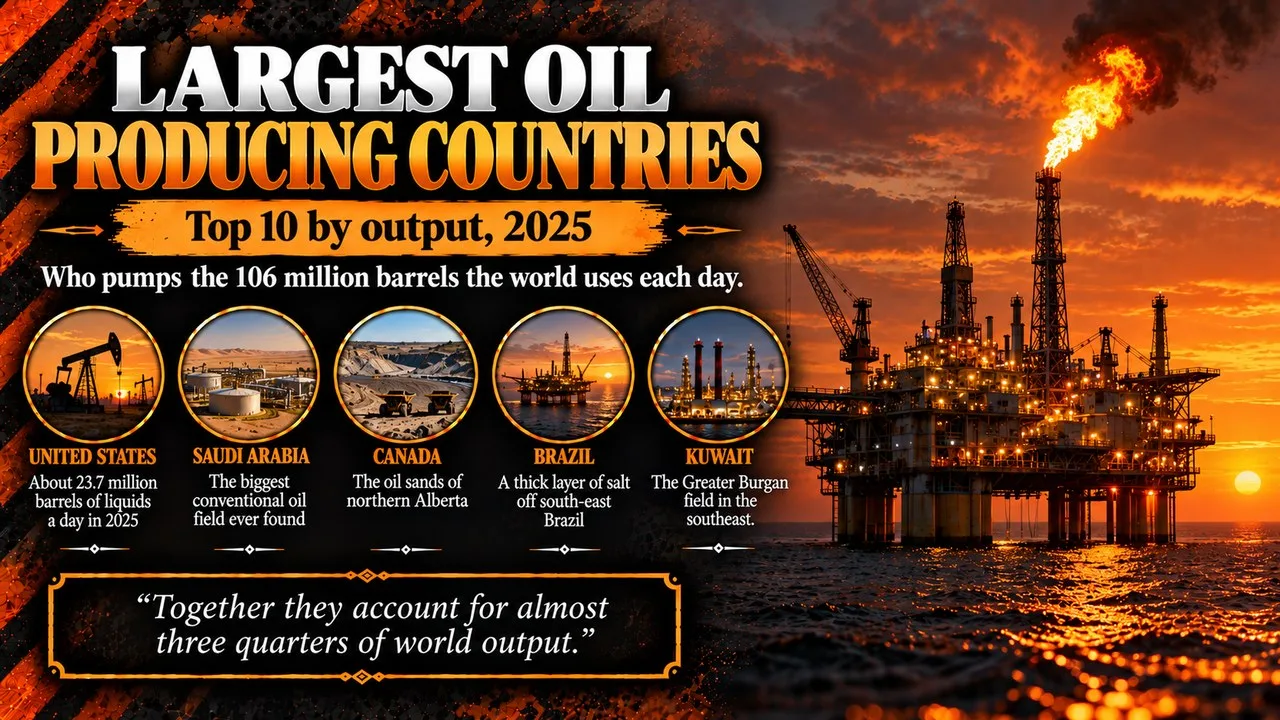
The largest oil producing countries are led by the United States, which pumps over twice as much as Saudi Arabia, with Russia, Canada and China next.
This Finepedia guide, written in October 2026, ranks the ten countries that produced the most oil in 2025. Together they account for almost three quarters of world output, which reached about 106 million barrels a day. For more on the world's nations and what lies beneath them, see the Finepedia guides Top 10 Countries with Most Natural Resources in the World and Largest Countries in the World: Top 10 by Area.
How We Chose These
We used annual figures for 2025 from the US Energy Information Administration (EIA), the most complete country-by-country source, and checked them against Worldometer and other tables built on the same data. The figures cover total petroleum and other liquids, meaning crude oil plus natural gas liquids, biofuels and refinery gains, given in million barrels per day (mb/d). That wider measure is why the United States leads by such a margin. Output can shift quickly with prices, quotas and conflicts, so treat these as figures for 2025, as of October 2026. Older lists that placed Venezuela and Mexico in the top ten are now out of date: both have slipped well down the table.
The 10 Largest Oil Producers at a Glance
| Rank | Country | Output in 2025 (mb/d) | Share of world | Key region or field |
|---|---|---|---|---|
| 1 | United States | 23.7 | 22.3% | Permian Basin |
| 2 | Saudi Arabia | 11.2 | 10.6% | Ghawar |
| 3 | Russia | 10.5 | 9.9% | Western Siberia |
| 4 | Canada | 6.3 | 5.9% | Alberta oil sands |
| 5 | China | 5.4 | 5.1% | Daqing and offshore fields |
| 6 | Iran | 4.8 | 4.5% | Khuzestan |
| 7 | Brazil | 4.7 | 4.4% | Offshore pre-salt |
| 8 | Iraq | 4.5 | 4.2% | Rumaila and Kirkuk |
| 9 | United Arab Emirates | 4.3 | 4.1% | Abu Dhabi |
| 10 | Kuwait | 2.8 | 2.6% | Burgan |
1. The United States Pumps More Oil Than Any Country in History
The United States produced about 23.7 million barrels of liquids a day in 2025, more than a fifth of the world total. Its output has more than doubled since the late 2000s, driven by drilling in shale rock using horizontal wells and hydraulic fracturing.
Key Facts
- Output in 2025: about 23.7 mb/d (EIA)
- Share of world: about 22 percent
- Main region: the Permian Basin of west Texas and New Mexico
- Record: in 2023 it became the biggest crude producer of any nation ever
Did You Know?
Even with this huge output, the United States still imports some crude oil, because many of its refineries are built to process heavier grades than the light oil that comes from shale. It also exports large volumes of crude and fuels.
2. Saudi Arabia Is Home to the World's Biggest Oil Field
Saudi Arabia produced about 11.2 million barrels a day in 2025. Almost all of it comes from the state-owned company Saudi Aramco, and its largest field, Ghawar, is the biggest conventional oil field ever found.
Key Facts
- Output in 2025: about 11.2 mb/d
- Giant field: Ghawar, about 280 km long and 30 km wide
- First commercial oil: 1938, at the Dammam No. 7 well
- OPEC: a founding member in 1960
Why It Matters
Saudi Arabia keeps a large amount of spare capacity, so it can raise or cut output faster than most producers. That makes its choices, usually made with other OPEC+ members, closely watched by markets around the world.
3. Russia Draws Most of Its Oil From Siberia
Russia produced about 10.5 million barrels a day in 2025, almost the same as the year before. Most of its oil comes from Western Siberia, a vast region of forests and wetlands east of the Ural Mountains.
Key Facts
- Output in 2025: about 10.5 mb/d
- Main region: Western Siberia
- Famous field: Samotlor, one of the largest ever found in the country
- Group: a leading member of the OPEC+ alliance since 2016
Did You Know?
Russia is not a member of OPEC itself, but since 2016 it has worked with the group on output targets through the wider OPEC+ arrangement. Oil and gas sales make up a large share of the Russian state budget.
4. Canada Sits on Huge Oil Sands
Canada produced about 6.3 million barrels a day in 2025, the most of any country outside the top three. Most of it comes from the oil sands of northern Alberta, where thick, heavy bitumen is mined or heated underground so it can flow.
Key Facts
- Output in 2025: about 6.3 mb/d
- Main source: the Alberta oil sands
- Reserves: the third-largest proven oil reserves in the world
- Main buyer: the United States
Why It Matters
Canada's reserves are surpassed only by those of Venezuela and Saudi Arabia, thanks largely to its oil sands. The Trans Mountain pipeline expansion, which opened in 2024, has given Canadian producers more access to buyers across the Pacific.
5. China Is a Big Producer and an Even Bigger Buyer
China produced about 5.4 million barrels a day in 2025, yet it uses far more oil than it pumps. No country imports more crude oil, buying from Russia, Saudi Arabia, Iraq and many others.
Key Facts
- Output in 2025: about 5.4 mb/d
- Historic field: Daqing in Heilongjiang, found in 1959
- Second big field: Shengli, producing since the 1960s
- Growth area: offshore fields in the Bohai Sea and South China Sea
Did You Know?
Discoveries such as Daqing and Shengli turned China into an oil exporter by the 1970s. Rapid economic growth later reversed that, and since the 1990s the country has relied more and more on imported oil.
6. Iran Was the First Oil Country of the Middle East
Iran produced about 4.8 million barrels a day in 2025, mostly from fields in the southwestern province of Khuzestan. It holds some of the largest oil and gas reserves on Earth.
Key Facts
- Output in 2025: about 4.8 mb/d
- First discovery: 26 May 1908, at Masjed Soleyman
- Company formed: Anglo-Persian Oil Company, 1909
- OPEC: a founding member in 1960
Why It Matters
The 1908 discovery was the first major oil find in the Middle East and led to the creation of the company that later became BP. Iran's output and exports have risen and fallen over the decades with international sanctions and the deals that eased them.
7. Brazil's Deep-Sea Oil Is Booming
Brazil produced about 4.7 million barrels a day in 2025, up nearly 9 percent on the year before, the fastest growth in the top ten. It moved up to seventh place, passing Iraq.
Key Facts
- Output in 2025: about 4.7 mb/d
- Main source: pre-salt fields deep below the Atlantic seabed
- Key company: Petrobras, created in 1953
- Rank change: up from eighth in 2024
Did You Know?
The pre-salt fields lie under kilometres of water, rock and a thick layer of salt off south-east Brazil, near Rio de Janeiro and Santos. Their discovery in the mid-2000s turned Brazil into one of the fastest-growing oil producers in the world.
8. Iraq's Oil Story Began With a Gusher Near Kirkuk
Iraq produced about 4.5 million barrels a day in 2025, a small fall on 2024. Most of its oil comes from giant fields in the south near Basra, led by Rumaila, with more from the north around Kirkuk.
Key Facts
- Output in 2025: about 4.5 mb/d
- First big strike: Baba Gurgur, near Kirkuk, 14 October 1927
- Largest field: Rumaila, near Basra
- OPEC: founded in Baghdad in September 1960
Why It Matters
Oil provides nearly all of Iraq's export earnings and most government revenue, so its output shapes the whole economy. OPEC was set up in Baghdad by five countries: Iraq, Iran, Saudi Arabia, Kuwait and Venezuela.
9. The United Arab Emirates Relies on Abu Dhabi
The United Arab Emirates produced about 4.3 million barrels a day in 2025. Almost all of it comes from Abu Dhabi, the largest of the seven emirates, through its state company ADNOC.
Key Facts
- Output in 2025: about 4.3 mb/d
- Main emirate: Abu Dhabi
- State company: Abu Dhabi National Oil Company (ADNOC), founded in 1971
- First exports: 1962, from Das Island
Did You Know?
Oil wealth helped turn the UAE from a small pearling and trading region into one of the richest countries in the Gulf. Dubai, by contrast, now earns far more from trade, tourism and finance than from oil.
10. Kuwait Holds One of the Largest Fields Ever Found
Kuwait produced about 2.8 million barrels a day in 2025, a large total for a country of only about 5 million people. Much of it comes from the Greater Burgan field in the southeast.
Key Facts
- Output in 2025: about 2.8 mb/d
- Giant field: Burgan, discovered in 1938
- Ranking: Burgan is often called the world's second-largest oil field
- OPEC: a founding member in 1960
Why It Matters
Oil makes up the great bulk of Kuwait's exports and state income. In 1991, retreating Iraqi forces set more than 600 Kuwaiti oil wells on fire, and it took about eight months to put them all out.
Frequently Asked Questions
Which country produces the most oil in the world?
The United States has been the largest oil producer since 2018, and in 2025 it pumped about 23.7 million barrels of liquids a day, according to the EIA. Saudi Arabia and Russia follow, each with about half of that amount.
Which countries just missed the top ten?
Kazakhstan, Norway, Qatar and Mexico came next in 2025, each producing roughly 1.9 to 2.2 million barrels a day. Kazakhstan grew fastest among them, by about 13 percent, while Mexico's output fell by about 7 percent.
Conclusion
The world's top oil producers stretch from the shale fields of Texas to the deserts of the Gulf and the deep waters off Brazil. Their output shapes fuel prices, national budgets and global politics, and the order can change from year to year. For more on the wealth hidden under the ground, read the Finepedia guides Top 10 Countries with Most Natural Resources in the World and Largest Countries in the World: Top 10 by Area.
- US Energy Information Administration, International Energy Statistics: total petroleum and other liquids production by country, 2024 and 2025 (accessed October 2026).
- Worldometer, Oil Production by Country, based on EIA data (accessed October 2026).
- US Energy Information Administration, Frequently Asked Questions: What countries are the top producers and consumers of oil? (accessed October 2026).
- OPEC, Brief History of OPEC (accessed October 2026).
- Wikipedia (accessed October 2026): Ghawar Field, OPEC, and Petroleum industry articles on the United States, Saudi Arabia, Russia, Canada, China, Iran, Brazil and Iraq.
- 10 Most Today, 10 Largest Oil Producing Countries, 10mosttoday.com (topic reference).






























Discussion
Log in with