









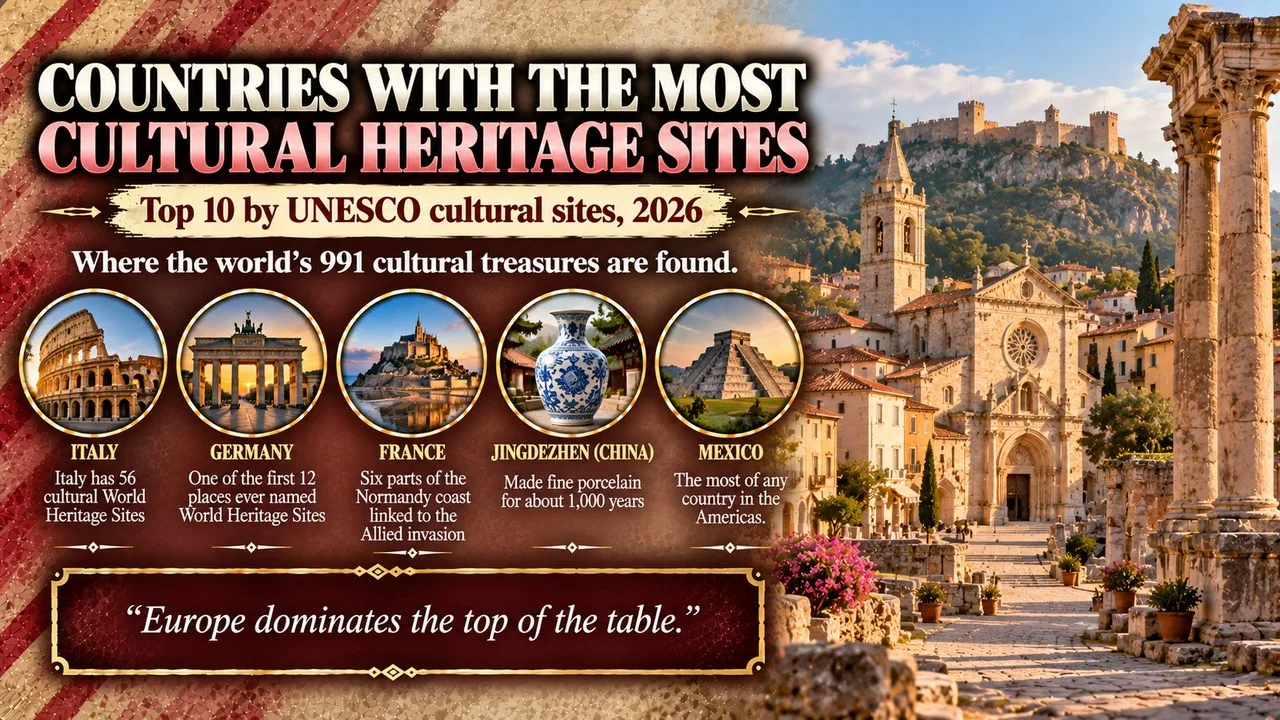
Italy leads the countries with the most cultural heritage sites, with 56 on UNESCO's World Heritage List as of October 2026, ahead of Germany and France.
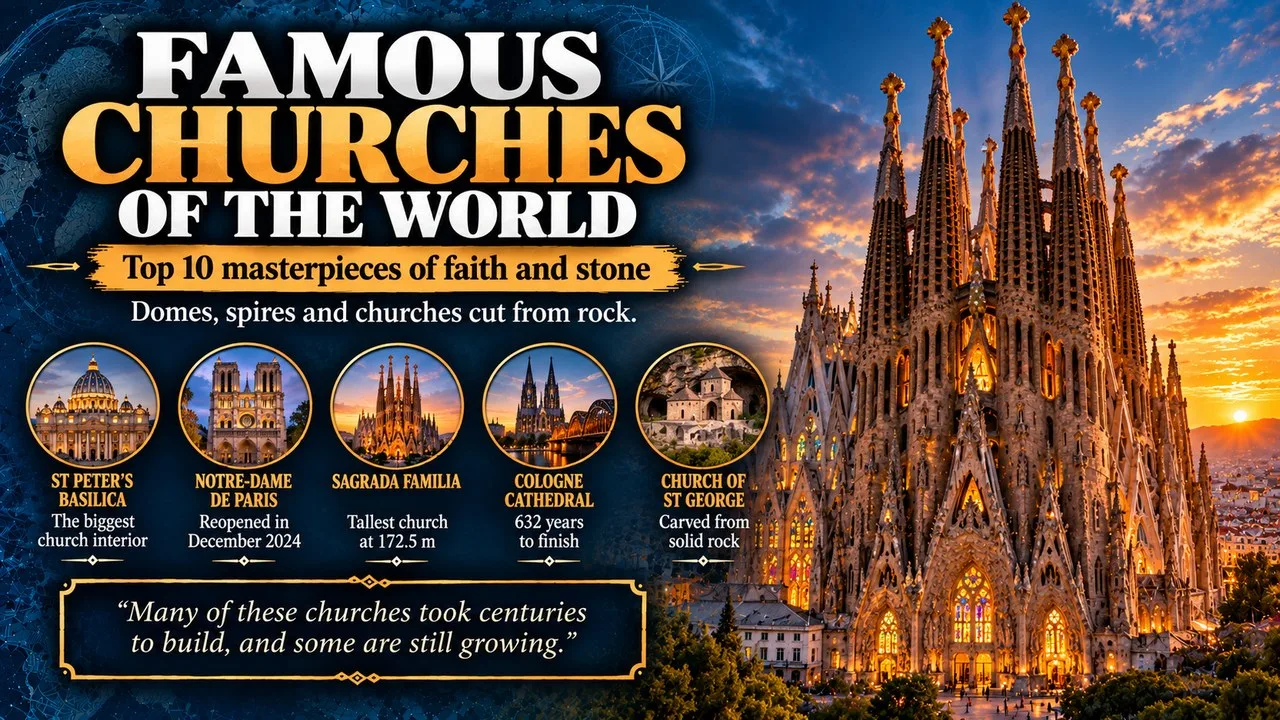
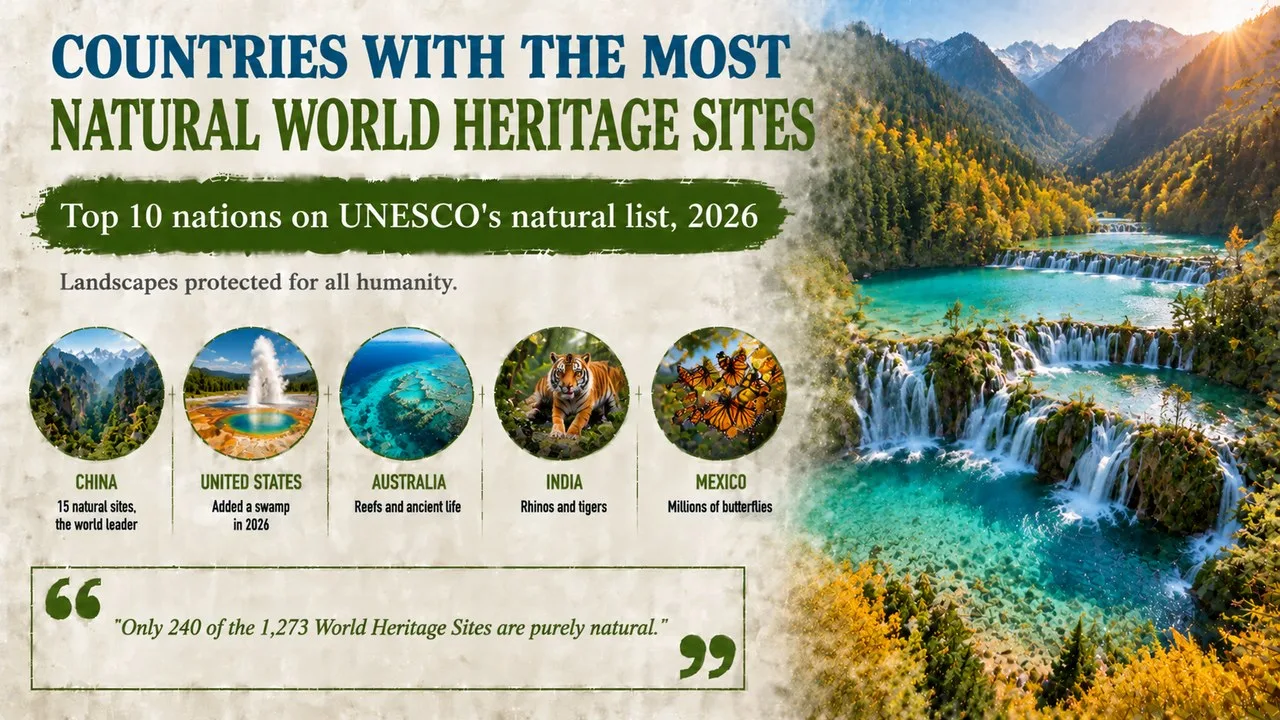
This Finepedia guide, written in October 2026, ranks the ten countries with the most World Heritage Sites listed for their cultural value, using UNESCO's own records after the 48th session of the World Heritage Committee in Busan, South Korea, in July 2026. That meeting added 25 new places to the list, 19 of them cultural, bringing the total to 1,273 sites in 173 countries. Of those, 991 are cultural, 240 are natural and 42 are mixed. For the other side of the story, see the Finepedia guides Countries With the Most Natural World Heritage Sites: Top 10 and Famous Churches of the World: Top 10.
How We Chose These
We counted every site that UNESCO classes as cultural and linked each one to the countries it covers, using the World Heritage Centre's public data file as it stood in October 2026. A site that crosses a border, such as the Roman frontier walls or the Struve Geodetic Arc, counts once for each country that shares it, which is the method UNESCO uses on its country pages. Natural and mixed sites are left out, even where they hold famous ruins. We checked the totals against UNESCO's country pages and the session report, and against Wikipedia's country lists. Where two countries have the same number, we list them together and give them the same rank.
The 10 Countries With the Most Cultural Heritage Sites at a Glance
| Rank | Country | Cultural sites | All World Heritage Sites | First cultural listing |
|---|---|---|---|---|
| 1 | Italy | 56 | 62 | 1979 |
| 2 | Germany | 52 | 55 | 1978 |
| 3 | France | 47 | 56 | 1979 |
| 4 | Spain | 44 | 50 | 1984 |
| 5 | China | 42 | 61 | 1987 |
| 6 | India | 37 | 45 | 1983 |
| 7 | United Kingdom | 29 | 35 | 1986 |
| 8= | Iran | 28 | 30 | 1979 |
| 8= | Mexico | 28 | 36 | 1987 |
| 10= | Japan and Russia | 22 each | 27 and 33 | 1993 and 1990 |
1. Italy Has More Cultural Sites Than Any Other Country
Italy has 56 cultural World Heritage Sites and 62 in all, the highest count of both kinds anywhere. Its first entry, in 1979, was the rock art of Valcamonica in Lombardy, where people carved well over 100,000 figures into stone across thousands of years. Since then it has grown to take in Rome, Florence, Venice, Pompeii and the cathedral square of Pisa.
Key Facts
- Cultural sites: 56 of 62
- First cultural listing: Rock Drawings in Valcamonica, 1979
- Newest cultural site: ten town theatres of Central Italy, added in 2026
- Shared sites: five, including the historic centre of Rome, shared with the Holy See
Did You Know?
Italy's 2026 addition is a group of ten theatres in Emilia-Romagna, Marche and Umbria, built between the mid-1700s and the late 1800s. Towns paid for them through a shared model called the condominio, in which local families bought their own boxes and helped fund the building.
2. Germany Was There From the Very Start
Germany has 52 cultural sites out of 55 in total. Aachen Cathedral, the palace chapel begun by Charlemagne around 800, was one of the first 12 places ever named World Heritage Sites, in 1978. The German list now ranges from Cologne Cathedral and the Bauhaus buildings to the old Zollverein coal mine in Essen.
Key Facts
- Cultural sites: 52 of 55
- First cultural listing: Aachen Cathedral, 1978
- Recent addition: Ludwig II's Bavarian palaces, including Neuschwanstein, in 2025
- Shared sites: nine, more than any other country in the top ten
Why It Matters
Germany's count is boosted by sites it shares with its many neighbours, such as the Roman frontier walls, the lakeside pile dwellings of the Alps and several old European spa towns. Even without those shared entries, it would still rank in the top five.
3. France Added the D-Day Beaches in 2026
France has 47 cultural sites among its 56 World Heritage Sites, and it gained two new cultural entries in Busan, more than any other country in this list. One covers six parts of the Normandy coast linked to the Allied invasion on 6 June 1944, from Utah and Omaha to Sword Beach and Pointe du Hoc. The other groups eight hilltop fortresses of Languedoc, including Carcassonne and Montségur, built or rebuilt by the French crown during the 1200s and 1300s.
Key Facts
- Cultural sites: 47 of 56
- First cultural listings: five in 1979, among them Versailles, Chartres and Mont-Saint-Michel
- Newest cultural sites: D-Day beaches and the Languedoc fortresses, both 2026
- Recent addition: the standing stones of Carnac, in 2025
Did You Know?
The cave paintings of the Vézère Valley, which include Lascaux, were among France's first five sites in 1979. Some of the painted animals there are around 17,000 years old.
4. Spain Mixes Moorish Palaces With Gaudí
Spain has 44 cultural sites out of 50 in total. Its first five came in 1984: the Alhambra in Granada, the historic centre of Córdoba with its great mosque-cathedral, the royal monastery of El Escorial near Madrid, Burgos Cathedral and the buildings of Antoni Gaudí in and around Barcelona.
Key Facts
- Cultural sites: 44 of 50
- First cultural listings: five, all in 1984
- Famous entries: the Alhambra, Sagrada Família and other Gaudí works, Santiago de Compostela
- Shared sites: two
Why It Matters
Spain shows how one country can hold many layers of history in a small space. Roman bridges, Islamic palaces, Gothic cathedrals and modern architecture all sit on its list and that variety helps draw tens of millions of visitors each year.
5. China Has the Largest Cultural List in Asia
China has 42 cultural sites, while its total of 61 is the second highest in the world, just one behind Italy. Its first five cultural entries in 1987 were the Great Wall, the imperial palaces in Beijing and Shenyang, the Mogao Caves near Dunhuang, the tomb of the first Qin emperor with its army of clay soldiers, and the Peking Man fossil site at Zhoukoudian.
Key Facts
- Cultural sites: 42 of 61
- First cultural listings: five, all in 1987
- Newest cultural site: the porcelain-making sites of Jingdezhen, 2026
- Recent addition: the Xixia imperial tombs, 2025
Did You Know?
Jingdezhen, in Jiangxi province, made fine porcelain for about 1,000 years, from the 10th to the 19th century. Its kilns supplied the imperial court and sent huge numbers of pieces abroad, which is partly why porcelain is still called china in English.
6. India's List Runs From Ajanta to Sarnath
India has 37 cultural sites among 45 in total, the most in South Asia. Its first four, all named in 1983, were the painted Buddhist caves of Ajanta, the rock-cut temples of Ellora, the Red Fort of Agra and the Taj Mahal. Recent additions include the forts of the Maratha rulers in 2025 and, in 2026, the remains at Sarnath near Varanasi, where, by tradition, the Buddha gave his first sermon.
Key Facts
- Cultural sites: 37 of 45
- First cultural listings: four, all in 1983
- Newest cultural site: Ancient Buddhist Site of Sarnath, 2026
- Recent addition: Maratha Military Landscapes, a group of forts, 2025
Why It Matters
India's list mixes temples, mosques, tombs, forts, railways and whole cities, such as Jaipur and Ahmedabad. Its growth reflects a steady push by the country to have more of its history recognised, with a new site added in most recent years.
7. The United Kingdom Is Home to Stonehenge and Ironbridge
The United Kingdom has 29 cultural sites out of 35, a list that includes several British overseas territories. Its first five came in 1986: Stonehenge and Avebury, Durham Castle and Cathedral, the Welsh castles of King Edward I, Fountains Abbey and Studley Royal, and Ironbridge Gorge in Shropshire, home of the first bridge built of iron.
Key Facts
- Cultural sites: 29 of 35
- First cultural listings: five, all in 1986
- Famous entries: Tower of London, Westminster Palace and Abbey, the city of Bath
- Shared sites: three, including Hadrian's Wall as part of the Roman frontiers
Did You Know?
The iron bridge that gives Ironbridge Gorge its name opened in 1781 and still stands. Many people see the valley as a birthplace of the Industrial Revolution, because coke-fired iron making was developed nearby at Coalbrookdale.
8. Iran Holds 28 Cultural Sites, All Its Own
Iran has 28 cultural sites among 30 in total, and unlike every other country in this ranking, none of them is shared with a neighbour. Its first three, in 1979, were Persepolis, the ceremonial capital of the Achaemenid kings, the great square of Isfahan and the ziggurat of Chogha Zanbil. In 2026 it added Alamut Castle and six related forts in the Alborz Mountains.
Key Facts
- Cultural sites: 28 of 30, joint eighth with Mexico
- First cultural listings: three, all in 1979
- Newest cultural site: Alamut Castle and Related Fortifications, 2026
- Recent addition: Stone Age cave sites in the Khorramabad Valley, 2025
Why It Matters
Iran's list covers more than 5,000 years, from early towns and cave shelters to Persian gardens, bazaars and mosques. It has the most cultural sites of any country in western Asia and ranks among the leaders in the world despite having only two natural sites.
9. Mexico Leads the Americas
Mexico also has 28 cultural sites, out of 36 in total, the most of any country in the Americas. Its first five, named in 1987, included the ancient cities of Teotihuacan and Palenque, the historic centres of Puebla and Oaxaca, and the centre of Mexico City, which Spanish colonists laid out over the remains of the Aztec capital Tenochtitlan, together with the canals of Xochimilco.
Key Facts
- Cultural sites: 28 of 36, joint eighth with Iran
- First cultural listings: five, all in 1987
- Famous entries: Chichen Itza, Teotihuacan, the historic centre of Guanajuato
- Recent addition: the Wixárika pilgrim route to Wirikuta, 2025
Did You Know?
Mexico's 2025 entry follows a route of sacred places that the Wixárika (Huichol) people still walk each year, linking their home in the western mountains to the desert of Wirikuta in San Luis Potosí.
10. Japan and Russia Share Tenth Place
Japan and Russia each have 22 cultural sites. Japan's first two, in 1993, were the old Buddhist temples around Horyu-ji, among the oldest wooden buildings in the world, and the white castle of Himeji. Russia's list began in 1990 with the centre of Saint Petersburg, the Kremlin and Red Square in Moscow, and the wooden churches of Kizhi on Lake Onega.
Key Facts
- Cultural sites: 22 each; Japan has 27 sites in all and Russia 33
- Japan's newest cultural site: the old capitals at Asuka and Fujiwara, 2026
- Russia's newest cultural site: the cave paintings of Shulgan-Tash, 2025
- Next in line: Türkiye with 20 and Greece with 18
Why It Matters
Asuka and Fujiwara, in the south of the Nara Basin, were capitals from the late 6th to the early 8th century, before Nara itself. Their palaces, temples and burial mounds show how Japan first built a central state, which makes the 2026 addition important for the country's early history.
Frequently Asked Questions
What is the difference between a cultural and a natural site?
A cultural site is listed for what people made, such as buildings, towns, monuments or landscapes shaped by human work. A natural site is listed for its landforms, wildlife or plants. Mixed sites meet both tests, so they are counted in neither group here.
How does a place become a World Heritage Site?
A country first puts the place on its own waiting list, then sends a full proposal to UNESCO. Expert bodies study it, and the 21-member World Heritage Committee makes the final decision at its yearly meeting, which was held in Busan in July 2026.
Conclusion
The countries with the most cultural heritage sites are led by Italy, Germany and France, with Spain, China and India close behind. Europe dominates the top of the table, but China, India, Iran and Mexico show how much of the world's shared history lies elsewhere. With new places added every year, the order can change after each meeting of the committee. For more, read the Finepedia guides Countries With the Most Natural World Heritage Sites: Top 10 and Famous Churches of the World: Top 10.
- UNESCO World Heritage Centre, World Heritage List public data file (1,273 properties), accessed October 2026.
- UNESCO, UNESCO World Heritage: 25 new sites inscribed, 28 July 2026.
- UNESCO World Heritage Centre, New Inscribed Properties (48COM) and country pages for each of the eleven countries, accessed October 2026.
- Wikipedia (accessed October 2026): World Heritage Site, and the lists of World Heritage Sites in each country.
- 10 Most Today, 10 Countries With Most Cultural Heritage Sites, 10mosttoday.com (topic reference).



























Discussion
Log in with