








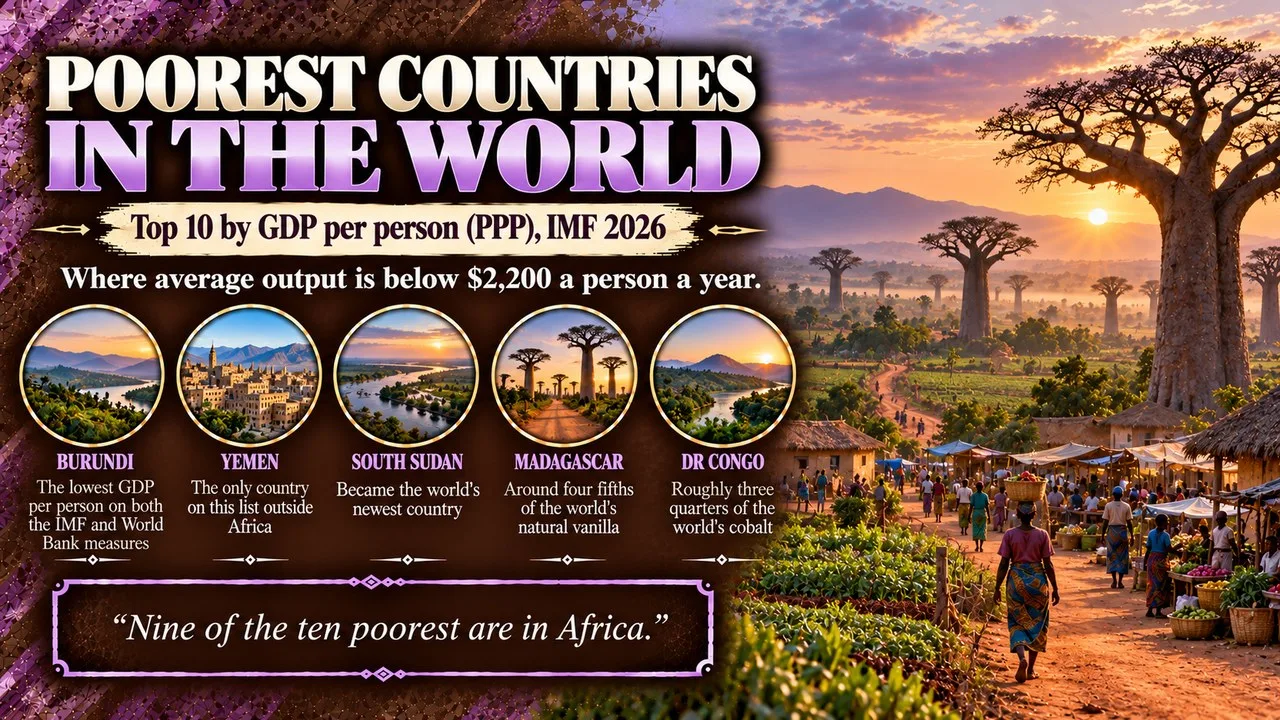
Burundi heads this ranking of poorest countries in the world in 2026, with output of about $1,036 a person, and nine of the ten poorest are in Africa.
This Finepedia guide, written in October 2026, ranks the ten countries with the lowest gross domestic product (GDP) per person, adjusted for what money buys locally. It uses the International Monetary Fund's estimates for 2026 from its October 2026 World Economic Outlook and checks them against the World Bank's figures for 2025, released earlier in October. On the World Bank's numbers, the world average is about $25,700 a person, so people in these countries produce less than a tenth of that. For the opposite end of the scale, see the Finepedia guides Top 10 Richest Countries in the World 2026: GDP Rankings Explained and Most Populous Countries in the World: Top 10.
How We Chose These
We ranked countries by GDP per person at purchasing power parity (PPP), which converts each economy's output into international dollars so that a dollar buys roughly the same basket of goods everywhere. This is the measure most often used to compare living standards. The IMF's 2026 figures are estimates and may be revised. The World Bank has no 2025 figure for Yemen, South Sudan, Afghanistan or Eritrea, so we followed the IMF order and show the World Bank number where it exists. Afghanistan, for which the IMF also gives no estimate, may well belong on the list. GDP per person is an average. It does not show how income is shared, how much work happens outside the official economy, or how people fare on health and schooling.
The 10 Poorest Countries at a Glance
| Rank | Country | IMF 2026 (PPP, per person) | World Bank 2025 (PPP, per person) | Population 2025 |
|---|---|---|---|---|
| 1 | Burundi | $1,036 | $1,248 | 14.4 million |
| 2 | Yemen | $1,571 | no figure | 41.8 million |
| 3 | South Sudan | $1,582 | no figure | 12.2 million |
| 4 | Mozambique | $1,721 | $1,698 | 35.6 million |
| 5 | Malawi | $1,819 | $1,899 | 22.2 million |
| 6 | Somalia | $1,976 | $1,643 | 19.7 million |
| 7 | Liberia | $2,113 | $1,981 | 5.7 million |
| 8 | Madagascar | $2,124 | $1,952 | 32.7 million |
| 9 | DR Congo | $2,138 | $1,920 | 112.8 million |
| 10 | Central African Republic | $2,170 | $1,314 | 5.5 million |
1. Burundi Has the Lowest Income per Person
Burundi, a small landlocked country in the Great Lakes region of East Africa, has the lowest GDP per person on both the IMF and World Bank measures. The IMF puts its 2026 figure at about $1,036, roughly one twenty-fifth of the world average. At market exchange rates the World Bank gives a 2025 figure of only about $234 a person. Most of its 14.4 million people grow food on small family plots, and coffee and tea earn much of its export income.
Key Facts
- GDP per person (IMF, 2026, PPP): about $1,036
- Population (2025): about 14.4 million
- Capital: Gitega, with Bujumbura as the largest city
- Main exports: coffee, tea and gold
Did You Know?
Burundi is one of the most densely settled countries in Africa, with well over 500 people per square kilometre. With little spare land, plots are often divided again and again between children, which makes farming harder over time.
2. Yemen Has Been Hit Hard by War
Yemen, at the southern tip of the Arabian Peninsula, is the only country on this list outside Africa. Fighting that began in 2014 split the country between rival authorities, cut oil exports and damaged ports, roads and hospitals. The IMF estimates its output at about $1,571 a person in 2026, and the United Nations ranks the crisis there among the largest humanitarian emergencies anywhere.
Key Facts
- GDP per person (IMF, 2026, PPP): about $1,571
- Population (2025): about 41.8 million, the second largest in this list
- Capital: Sanaa, under the constitution
- Before the war: oil and gas provided most export earnings
Why It Matters
Yemen buys most of its food from abroad, so the war, a weak currency and high shipping costs quickly raise prices for families. Large amounts of money sent home by Yemenis working in Saudi Arabia and other Gulf states help many households get by.
3. South Sudan Depends Almost Entirely on Oil
South Sudan became the world's newest country when it gained independence from Sudan on 9 July 2011. Oil makes up nearly all of its exports and most government income, but it has to send its crude to the sea through a pipeline across Sudan. War in Sudan since 2023 has disrupted that route, which hit South Sudan's earnings hard. The IMF estimates output at about $1,582 a person in 2026.
Key Facts
- GDP per person (IMF, 2026, PPP): about $1,582
- Population (2025): about 12.2 million
- Capital: Juba
- Independence: 9 July 2011
Did You Know?
Within three years of independence, South Sudan was drawn into a civil war that lasted from 2013 until a peace deal in 2018. The country also hosts hundreds of thousands of people who have fled the fighting in Sudan.
4. Mozambique Is Rich in Gas but Poor in Income
Mozambique stretches along about 2,500 km of the Indian Ocean coast in south-east Africa. It has some of the largest natural gas finds in Africa, off the northern province of Cabo Delgado, but violence in that region since 2017 has slowed the big export projects. The IMF estimates output at about $1,721 a person in 2026, while the World Bank gives a very similar figure for 2025.
Key Facts
- GDP per person (IMF, 2026, PPP): about $1,721
- Population (2025): about 35.6 million
- Capital: Maputo
- Main exports: aluminium, coal, natural gas and farm goods such as cashews
Why It Matters
Mozambique is very exposed to storms. Cyclone Idai in 2019 flooded large areas around the port city of Beira, and stronger cyclones can wipe out years of progress for farming families who live near the coast and rivers.
5. Malawi Lives From Farming and Tobacco
Malawi is a narrow, landlocked country in south-east Africa, and Lake Malawi, one of the largest lakes on the continent, covers about a fifth of its area. Most people farm small plots of maize, and tobacco has long been the main export. The IMF estimates output at about $1,819 a person in 2026, and the World Bank's 2025 figure is close to that.
Key Facts
- GDP per person (IMF, 2026, PPP): about $1,819
- Population (2025): about 22.2 million
- Capital: Lilongwe
- Main exports: tobacco, tea, sugar and coffee
Did You Know?
Lake Malawi holds more kinds of fish than any other lake in the world, many of them colourful cichlids found nowhere else. Fishing in the lake provides food and jobs for many families along its shores.
6. Somalia Relies on Livestock and Money From Abroad
Somalia, on the Horn of Africa, has the longest coastline of any country on the African mainland. Herding is the heart of its economy, and camels, goats and sheep are shipped across the Red Sea to buyers in the Gulf. Money sent home by Somalis living abroad is one of the largest sources of income for the whole economy. The IMF estimates output at about $1,976 a person in 2026.
Key Facts
- GDP per person (IMF, 2026, PPP): about $1,976
- Population (2025): about 19.7 million
- Capital: Mogadishu
- Main exports: livestock, gold and sesame
Why It Matters
Long periods of conflict and repeated droughts have made life very hard for herders and farmers. Even so, Somalia's mobile money services are among the most widely used in Africa, and they help families receive money quickly from relatives abroad.
7. Liberia Is Africa's Oldest Republic
Liberia, on the west coast of Africa, was founded by freed Black Americans with help from an American society, and it declared independence in 1847. Two civil wars between 1989 and 2003 and an Ebola outbreak in 2014 to 2016 set its economy back badly. Iron ore, gold and rubber are its main earners today, and the IMF estimates output at about $2,113 a person in 2026.
Key Facts
- GDP per person (IMF, 2026, PPP): about $2,113
- Population (2025): about 5.7 million
- Capital: Monrovia
- Main exports: gold, iron ore and rubber
Did You Know?
More of the world's cargo ships fly the Liberian flag than almost any other, because many foreign owners register their vessels there. That brings the government fees, even though the ships rarely visit its ports.
8. Madagascar Grows Most of the World's Vanilla
Madagascar, the fourth-largest island in the world, lies in the Indian Ocean off south-east Africa. It produces around four fifths of the world's natural vanilla, but prices swing sharply from year to year, and most of its people still grow rice for their own use. The IMF estimates output at about $2,124 a person in 2026.
Key Facts
- GDP per person (IMF, 2026, PPP): about $2,124
- Population (2025): about 32.7 million
- Capital: Antananarivo
- Main exports: vanilla, nickel, cobalt and cloves
Why It Matters
Most of Madagascar's plants and animals, including all its lemurs, live nowhere else on Earth. Many farmers clear forest to plant crops, so reducing poverty is closely linked to saving the island's wildlife.
9. DR Congo Holds Vast Mineral Wealth
DR Congo is Africa's second-largest country by area and has about 113 million people, by far the biggest population in this list. It mines roughly three quarters of the world's cobalt, a metal used in batteries, and is one of the largest copper producers. Yet fighting in the east and weak roads keep most people poor, and the IMF estimates output at about $2,138 a person in 2026.
Key Facts
- GDP per person (IMF, 2026, PPP): about $2,138
- Population (2025): about 112.8 million
- Capital: Kinshasa
- Main exports: copper and cobalt
Did You Know?
The Congo rainforest, much of which lies in the country, is the second-largest tropical forest in the world after the Amazon. The Congo River, which flows through it, is the deepest river on Earth.
10. Central African Republic Completes the List
The Central African Republic is a landlocked country of about 5.5 million people at the heart of the continent. It has diamonds, gold, timber and good farmland, but conflict since 2013 has made it hard to use them. On the IMF's estimate of about $2,170 a person in 2026 it is tenth, while the World Bank's 2025 figure of about $1,314 puts it second poorest.
Key Facts
- GDP per person (IMF, 2026, PPP): about $2,170
- Population (2025): about 5.5 million
- Capital: Bangui
- Main exports: timber, gold and diamonds
Why It Matters
The gap between the two estimates shows how hard it is to measure economies where data are patchy and much trade happens informally. Niger, at about $2,211 on the IMF's figures, is just outside the top ten, followed by Sudan.
Frequently Asked Questions
Why are most of the poorest countries in Africa?
There is no single cause. Many of these countries have suffered long conflicts, rely on a few farm or mineral exports whose prices rise and fall, and lack roads, power and schools. Several are also landlocked, which raises the cost of trade.
What does PPP mean?
Purchasing power parity adjusts each country's income for local prices. A meal or a bus ride costs much less in Malawi than in London, so PPP gives a fairer idea of what people can actually buy than a simple exchange-rate comparison.
Conclusion
Led by Burundi, Yemen and South Sudan, these poorest countries in the world have very different stories, from war and drought to falling crop prices. What they share is output of only about $1,000 to $2,200 a person each year, a small fraction of the world average. Many of them are rich in land, minerals or young workers, which gives hope for change. To compare them with the other end of the scale, read the Finepedia guides Top 10 Richest Countries in the World 2026: GDP Rankings Explained and Most Populous Countries in the World: Top 10.
- International Monetary Fund, World Economic Outlook database, October 2026: GDP per capita, PPP (PPPPC), as compiled on Wikipedia, accessed October 2026.
- World Bank, World Development Indicators: GDP per capita, PPP (NY.GDP.PCAP.PP.CD), GDP per capita (NY.GDP.PCAP.CD) and population (SP.POP.TOTL), updated 8 October 2026.
- World Bank, country profiles and income groups for the ten countries, accessed October 2026.
- Wikipedia (accessed October 2026): List of countries by GDP (PPP) per capita, and the Economy articles for each of the ten countries.
- 10 Most Today, 10 Poorest Countries In The World, 10mosttoday.com (topic reference).




























Discussion
Log in with