



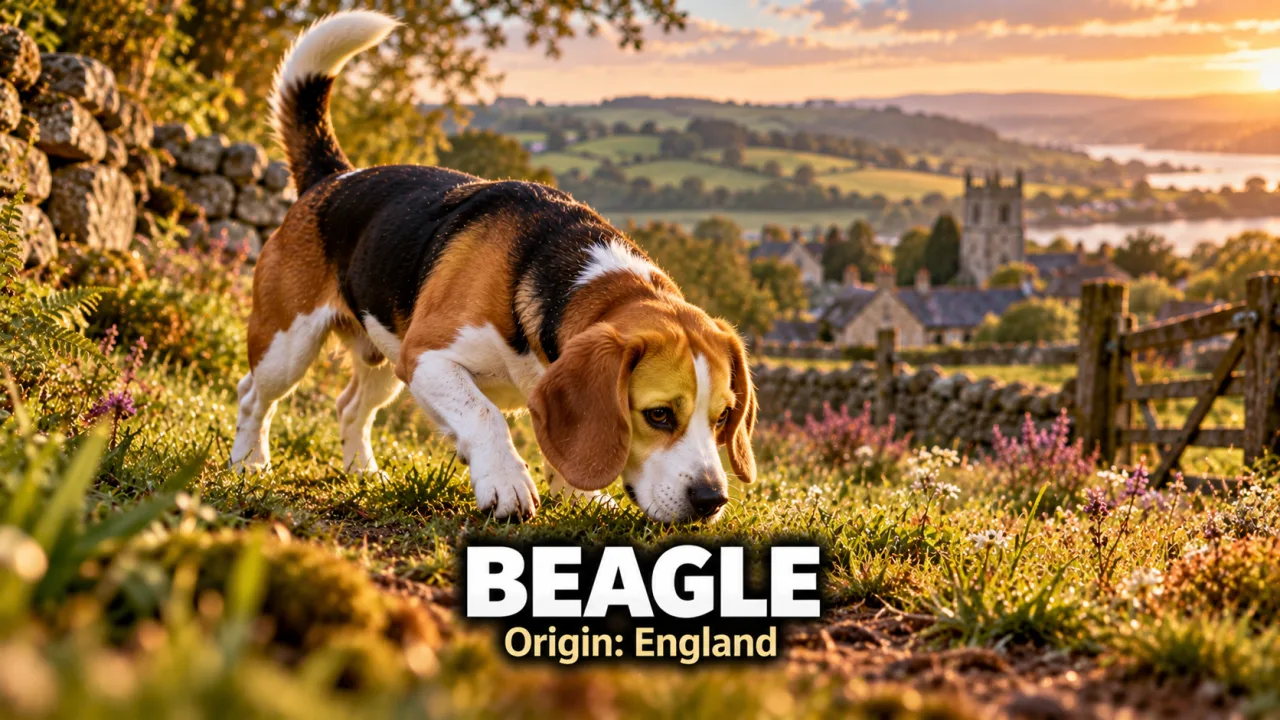




The Border Collie is a medium-sized British herding dog of the collie type. It comes from the region along the Anglo-Scottish border and descends from the traditional sheepdogs once found all over the British Isles.[1] It is kept mainly as a sheep-herding dog or as a companion, it competes with great success in sheepdog trials, and some have claimed it is the most intelligent dog breed.[1]
The FCI classifies the Border Collie as a sheepdog "with working trial" and describes it as "tenacious, hard-working, of great tractability".[2][3] It ranked 26th among American Kennel Club registrations in 2025.[4] A Border Collie named Chaser learned the names of more than 1,000 objects in a well-known scientific study.[7]
This profile is part of Finepedia's Dog Breeds of the World guide, which covers every major dog family from ancient times to today.
Key Facts
| Attribute | Details |
|---|---|
| Origin | Great Britain (Anglo-Scottish border) |
| Purpose (FCI) | Sheepdog |
| FCI classification | Group 1 (Sheepdogs and Cattle Dogs), Section 1 Sheepdogs, with working trial, standard No. 297 |
| FCI definitive acceptance | 27 September 1977 |
| Height | FCI ideal: males 53 cm, females slightly less, other standards: males 48 to 56 cm, females 46 to 53 cm |
| Coat | Moderately long or smooth, with a dense double coat |
| Colours | Many permitted, white should never predominate (FCI) |
| Median lifespan | 13.1 years (UK, 2024 study) |
| Temperament | Keen, alert, responsive and intelligent, never nervous or aggressive (FCI) |
| Popularity | No. 26 in the US (AKC, 2025) |
Name
The Border Collie descends from landrace collies, a type found widely in the British Isles. The breed takes its name from its probable place of origin along the Anglo-Scottish border. The word "collie" has its origin in the Scots language, although the "collie" or "colley" type is first mentioned towards the end of the 19th century.[1]
In 1915 James Reid, Secretary of the International Sheep Dog Society (ISDS), first used the term "border collie". He used it to distinguish dogs registered by the ISDS from the Kennel Club's collie, the Scotch Collie including the Rough and Smooth Collies. Those dogs came from the same working stock but had developed a different, standardised look after entering the show ring in 1860 and being mixed with other breeds.[1]
History
Old Hemp
Many Border Collies today trace back to a dog known as Old Hemp. A tricolour dog, he was born in Northumberland, England, in September 1893 and died in May 1901. Adam Telfer bred him from Roy, a black and tan dog, and Meg, a black-coated, strong-eyed bitch.[1]
Hemp was a quiet, powerful dog that sheep responded to easily. Many shepherds used him at stud, and his working style became the Border Collie style. He is believed to have sired as many as 200 pups, and all purebred Border Collies alive today can trace a line back to him.[1]
Wiston Cap
Wiston Cap, born on 28 September 1963, is the dog shown on the ISDS badge in the breed's typical herding pose. He was a popular stud dog, and his bloodline appears in most modern lines. W. S. Hetherington bred him, and John Richardson trained and handled him. He sired three Supreme Champions and was grandsire of three more, including E. W. Edwards' Bill, who won the championship twice.[1]
Sheepdog trials
The first recorded sheepdog trials took place at Bala in North Wales in 1873. Trials let farmers and shepherds judge possible mates for their working dogs, but they have also become a sport with competitors from outside farming.[1]
New Zealand and Australia
Collies were listed as imports to New Zealand as early as 1858, though the type was not specified. In the late 1890s James Lilico of Christchurch imported several working dogs from the United Kingdom. Among them was Hindhope Jed, a black, tan and white bitch born in Hindhope, Scotland, in 1895, who had won three trials at home.[1]
In 1901 the King and McLeod stud at Canonbar, near Nyngan in New South Wales, brought Hindhope Jed to Australia, where she did well at sheepdog trials.[1] The New Zealand Heading Dog was later developed from Border Collies.[1]
Recognition
The FCI definitively accepted the breed on 27 September 1977.[2] The AKC recognised it in 1995 after it had spent more than 50 years in the Miscellaneous Class. Most Border Collie groups, such as the United States Border Collie Club, protested, fearing the emphasis on working skills would be lost.[1]
Description
General appearance
The FCI standard calls for a well-proportioned dog with a smooth outline "showing quality, gracefulness and perfect balance", with enough substance to suggest endurance. The body is athletic and slightly longer than the height at the withers.[3]
Size
| Standard | Males | Females |
|---|---|---|
| FCI ideal height | 53 cm | Slightly less |
| Typical kennel club range | 48 to 56 cm | 46 to 53 cm |
Sources: FCI standard and Wikipedia.[1][3]
Head, eyes and ears
The skull is fairly broad with a very distinct stop, and the muzzle tapers to the nose. The nose is black, brown in brown or chocolate dogs and slate in blues.[3] The eyes are oval and brown, but in merles one or both may be fully or partly blue, and the expression should be "mild, keen, alert and intelligent".[3] Eye colour varies from brown to green, and odd-coloured eyes (heterochromia) usually occur in merles.[1] The FCI standard asks for ears carried erect or semi-erect. In practice, ears may be fully erect, fully dropped or semi-erect.[1][3]
Tail and movement
The tail is moderately long, set low and has an upward swirl at the end. It may rise in excitement but should never be carried over the back.[3] The FCI describes the gait as "free, smooth and tireless, with minimum lift of feet", suggesting the ability to move "with great stealth and speed".[3]
Coat and colour
The FCI allows two coat varieties, moderately long and smooth. Both have a dense, medium-textured topcoat over a soft, dense undercoat that gives good weather resistance. The longer coat forms a mane, breeching and brush.[3]
| Frequency | Colours |
|---|---|
| Most common | Black and white |
| Seen regularly | Black tricolour, liver and white, red tricolour |
| Less frequent | Blue, lilac, red merle, blue merle, brindle, Australian red (also called ee red or gold) |
Some Border Collies have single-colour coats. The FCI allows a variety of colours but says white should never predominate.[1][3]
Working dogs and show dogs
The American Border Collie Association considers appearance irrelevant and judges a working Border Collie by its attitude and ability.[1] Some handlers avoid mostly white dogs because of an unfounded belief that sheep will not respect them.[1] Show-bred dogs look more alike because they must closely match breed standards. In recognition of the breed's working origin, scars and broken teeth from work are not counted against a Border Collie in the show ring.[1]
Temperament and intelligence
The FCI standard describes the Border Collie as "tenacious, hard-working, of great tractability" and "keen, alert, responsive and intelligent". It must be neither nervous nor aggressive, and aggressive or overly shy dogs are disqualified.[3]
Chaser
In 2011 John Pilley and Alliston Reid of Wofford College reported that Chaser, a Border Collie, had learned the names of 1,022 objects over three years of intensive training. She could also infer the name of a new object by exclusion and sort objects into categories.[7]
Other Border Collies have also been studied for their word learning. Rico was studied for recognising up to 200 objects by name, and Betsy was found to have a vocabulary of over 300 words.[1]
FIDO research
The Georgia Institute of Technology's FIDO (Facilitating Interactions for Dogs with Occupations) project fitted a Border Collie named Sky with a sensor she could activate to "speak" in audible English to her handler. One aim is to let service dogs warn of danger or summon help if their handler is incapacitated.[1]
Uses
Livestock work
Working Border Collies take direction by voice and by whistle at long distances. They herd sheep, cattle, free-range poultry, pigs and ostriches. They are also used to clear unwanted wild birds from airport runways, golf courses and other areas.[1]
The ISDS sheepdog trial
The original test of a Border Collie's breeding quality is the ISDS sheepdog trial. In it, a dog and handler gather livestock and move them quietly around a course.[1]
| Trial level | Course |
|---|---|
| National (England, Ireland, Scotland and Wales) | 400 yards |
| International qualifying | 400 yards |
| International final day | 800 yards, with a "double fetch" |
In the international "double fetch", the dog gathers 10 sheep from 800 yards away and brings them to the centre of the field. It is then sent in another direction to gather 10 more from the same distance. Five of the 20 sheep wear collars. After a triangular drive the dog must separate the five collared sheep in a "shedding ring" and pen them.[1]
The trials are run by:
- the International Sheep Dog Society in the UK;
- the USBCHA in the United States;
- the Canadian Border Collie Association in Canada;
- the South African Sheepdog Association in South Africa.[1]
Dog sports
Border Collies are among the most popular breeds in agility. They also excel at:
- competitive obedience
- flyball
- disc dog
- tracking
- herding events
- dog dancing.[1]
They dominate some agility jump heights so thoroughly that English competitions often include "ABC" classes, for "Anything But Collies".[1]
Search and rescue
Their keen sense of smell and high drive make them easily motivated tracking dogs. In Britain, Border Collies work as mountain rescue search dogs, particularly on large hillsides and avalanche debris.[1]
Health and lifespan
Lifespan
A 2024 UK study of 584,734 dogs found a median life expectancy of 13.1 years for the Border Collie, from 12,917 dogs. That is above the purebred median of 12.7 years and the crossbreed median of 12.0 years.[5][6] A 2022 English study of veterinary records found a life expectancy of 12.1 years.[1] In a 2004 Kennel Club survey, the leading causes of death were cancer (23.6 percent), old age (17.9 percent) and cerebral vascular conditions (9.4 percent).[1]
Inherited conditions
| Condition | Notes |
|---|---|
| Collie eye anomaly | Autosomal recessive, caused by a mutation in the NHEJ1 gene |
| Neuronal ceroid lipofuscinosis (NCL) | Rare, limited to show lines, affected dogs rarely live beyond two years, DNA test available |
| Trapped neutrophil syndrome (TNS) | Immune deficiency from neutrophils trapped in bone marrow, widespread in the breed, DNA test available |
| MDR1 mutation | Sensitivity to drugs such as ivermectin and doramectin, frequency 1 to 4.8 percent depending on country |
| Deafness | Pigment-associated congenital deafness, and adult-onset hearing loss between one and eight years of age |
| Border Collie collapse | Episodes linked to intense, exciting exercise, cause unknown |
Sources: Wikipedia.[1]
The mutations causing NCL and TNS were both identified in Alan Wilton's laboratory at the University of New South Wales.[1] A UK study of clinical records found that Border Collies had the highest prevalence of hepatic neoplasia (liver tumours), at 2.67 times the risk of other breeds.[1]
Less common problems are as follows:
- juvenile cataracts
- osteochondritis
- hypothyroidism
- diabetes mellitus
- canine cyclic neutropenia.[1]
Care
Border Collies are bred for long days of work. Their speed, stamina and trainability suit them to herding and demanding sports.[1][3] Dogs carrying the MDR1 mutation can suffer neurotoxicosis from drugs such as ivermectin and doramectin at doses that are safe for other dogs.[1]
Registries
| Country | Main registry and notes |
|---|---|
| United Kingdom | The Royal Kennel Club registers Border Collies like other breeds, the ISDS registers only dogs with proven herding ability |
| United States | The American Border Collie Association registers about 20,000 dogs a year and delists conformation champions (vote of 2003), AKC recognition 1995 |
| Canada | The Canadian Border Collie Association, recognised by Agriculture Canada, registration based on herding lineage |
| Australia | ANKC affiliates register between 2,011 and 2,701 pedigreed Border Collies a year since 1986 |
| South Africa | South African Sheepdog Association |
Sources: Wikipedia.[1]
Popularity
The AKC ranked the Border Collie 26th in 2025.[4] In the UK, Royal Kennel Club registrations fell from 2,095 in 2016 to 1,292 in 2025.[8]
Notable Border Collies
- Chaser, who learned the names of 1,022 objects.[7]
- Shep and Meg, companions of the BBC Blue Peter presenters John Noakes and Matt Baker.[1]
- Jean, the "Vitagraph Dog", an early canine film star trained by Laurence Trimble.[1]
- Messi, who played Snoop in Anatomy of a Fall and won the 2023 Palm Dog award at Cannes.[1]
Related breeds
The Border Collie shares its working ancestry with the Rough Collie and Smooth Collie, which developed a standardised show type after 1860.[1] The New Zealand Heading Dog was developed from Border Collies.[1]
See also
- Dog Breeds of the World: Ancient to Modern Guide
- German Shepherd Dog
- Labrador Retriever
- Rough Collie
- Australian Shepherd
- ^ [1] "Border Collie". Wikipedia. https://en.wikipedia.org/wiki/Border_Collie
- ^ [2] "Border Collie (297)". FCI Breeds Nomenclature, Federation Cynologique Internationale. https://www.fci.be/en/nomenclature/BORDER-COLLIE-297.html
- ^ [3] "FCI-Standard No. 297: Border Collie". Federation Cynologique Internationale. https://www.fci.be/Nomenclature/Standards/297g01-en.pdf
- ^ [4] "The Most Popular Dog Breeds of 2025". American Kennel Club. https://www.akc.org/expert-advice/dog-breeds/most-popular-dog-breeds-2025/
- ^ [5] McMillan K. M. et al. "Longevity of companion dog breeds: those at risk from early death". Scientific Reports, 2024. https://www.nature.com/articles/s41598-023-50458-w
- ^ [6] "Life expectancy of breeds table, 2024". Dogs Trust. https://www.dogstrust.org.uk/downloads/life-expectancy-breeds-table-2024.pdf
- ^ [7] Pilley J. W. and Reid A. K. "Border collie comprehends object names as verbal referents". Behavioural Processes, 2011. https://doi.org/10.1016/j.beproc.2010.11.007
- ^ [8] "Pastoral breeds: 10-year registration statistics". The Royal Kennel Club. https://www.royalkennelclub.com/media/qiwna0nw/10-yearly-breeds-stats-pastoral.pdf


























Discussion
Log in with