









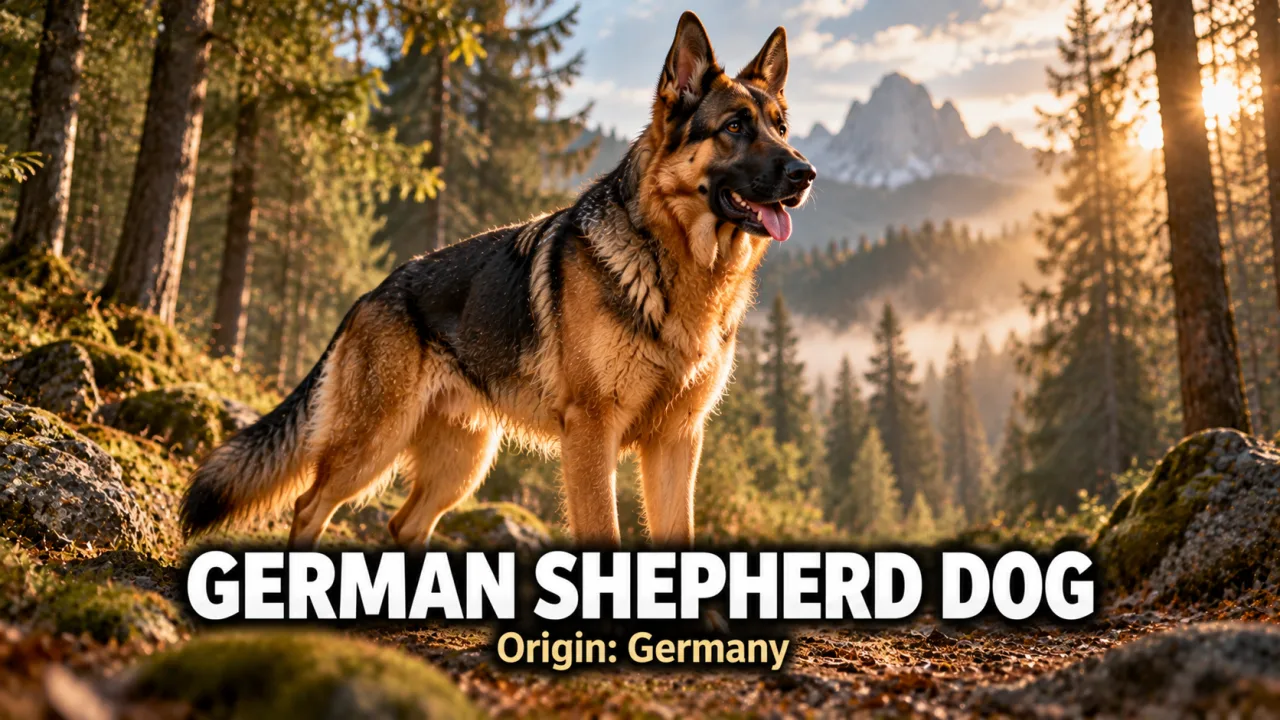
The German Shepherd Dog (Deutscher Schäferhund), known in Britain for decades as the Alsatian, is a medium to large German working dog known for its intelligent and obedient nature.[1] Max von Stephanitz developed it from 1899 using traditional German herding dogs, and it gained international recognition after the First World War.[1][3]
The breed was created to herd sheep. It has since been used for disability assistance, search and rescue, police work and warfare, and is widely kept as a companion.[1] The FCI describes it as a "versatile working, herding and service dog", and it is among the most frequently registered breeds in the world.[1][3] In 2025 it ranked 4th among American Kennel Club registrations.[4]
This profile is part of Finepedia's Dog Breeds of the World guide, which covers every major dog family from ancient times to today.
Key Facts
| Attribute | Details |
|---|---|
| Other names | Deutscher Schäferhund; Alsatian (UK) |
| Origin | Germany |
| Purpose (FCI) | Versatile working, herding and service dog |
| FCI classification | Group 1 (Sheepdogs and Cattle Dogs), Section 1 Sheepdogs, with working trial; standard No. 166 |
| FCI definitive acceptance | 1 January 1955 |
| Height (FCI) | Males 60 to 65 cm; females 55 to 60 cm |
| Weight (FCI) | Males 30 to 40 kg; females 22 to 32 kg |
| Coat | Double coat or long double coat, both with undercoat |
| Median lifespan | 11.3 years (UK, 2024 study); 10.3 years (UK VetCompass, 2017) |
| Popularity | No. 4 in the US (AKC, 2025) |
History
Herding dogs of the 1890s
In the 1890s, German shepherds bred their dogs locally for the skills needed to herd sheep and guard flocks, such as intelligence, speed, strength and a keen sense of smell. The resulting dogs varied greatly in appearance and ability from one area to another.[1]
The Phylax Society was founded in 1891 to standardise Germany's native breeds. It broke up after three years, split between members who wanted dogs bred only for work and those who also wanted them bred for looks.[1] Max von Stephanitz, a former cavalry captain and former student of the Berlin Veterinary College, had been a member and firmly believed dogs should be bred for work.[1]
Horand von Grafrath and the SV
In 1899 von Stephanitz saw a dog named Hektor Linksrhein at a dog show. Impressed by its strength, intelligence and loyalty, he bought it at once and renamed it Horand von Grafrath.[1] He then founded the Verein für Deutsche Schäferhunde (SV), the Society for the German Shepherd Dog. Horand was declared the first German Shepherd Dog and became the first dog entered in the society's register.[1]
According to the FCI standard, the SV was established at its first general meeting in Frankfurt am Main on 20 September 1899, following proposals by A. Meyer and von Stephanitz. The breed was developed from the central and southern German herding dogs of the time, "with the ultimate objective of creating a working dog inclined to high achievements".[3] The SV, based in Augsburg, remains responsible for the breed standard.[3]
Horand became the centre of the breeding programme and was mated with dogs from Thuringia, Franconia and Württemberg. His most prolific son was Hektor von Schwaben. Inbreeding among Horand's descendants produced Beowulf, whose progeny link all German Shepherds genetically.[1]
The name "Alsatian"
Von Stephanitz named the breed Deutscher Schäferhund, "German Shepherd Dog". After the First World War, there were fears that the word "German" would harm the breed's popularity in countries that had fought Germany. The UK Kennel Club renamed it the "Alsatian Wolf Dog", after the French region of Alsace.[1]
Breeders later had "wolf dog" dropped, fearing it would suggest a wolf hybrid. Campaigns led British kennel clubs to allow registration as German Shepherds again in 1977. The word "Alsatian" stayed in brackets in the Kennel Club's formal breed name until 2010.[1]
International spread
When the UK Kennel Club accepted registrations in 1919, 54 German Shepherds were registered. By 1926 the figure had passed 8,000. Returning soldiers spoke highly of the breed, and the film dogs Rin Tin Tin and Strongheart made it more popular still.[1]
In the United States, the first registered German Shepherd was Queen of Switzerland. Poor breeding among her offspring helped cause a decline in the late 1920s.[1] The breed gained a reputation as a dangerous dog kept by gangsters and bootleggers, and Australia briefly banned imports in 1929.[1] Popularity rose again after Sieger Pfeffer von Bern became AKC Grand Victor in 1937 and 1938. It fell after the Second World War because of anti-German feeling, then climbed gradually, and by 1993 the breed was the third most popular in the US.[1]
Association with Nazi Germany
In the first half of the 20th century, the breed was strongly associated with Imperial and Nazi Germany, which valued it as a supposedly ancient Germanic dog close to the wolf. Adolf Hitler acquired a German Shepherd in 1921 and later kept several more, including Blondi.[1]
Description
Size and proportions
The FCI standard describes the German Shepherd as "medium-size, slightly elongated, powerful and well-muscled, with dry bone and firm overall structure". The body is about 10 to 17 percent longer than the height at the withers.[3]
| Measure | Males | Females |
|---|---|---|
| Height at withers | 60 to 65 cm | 55 to 60 cm |
| Weight | 30 to 40 kg | 22 to 32 kg |
Source: FCI standard No. 166.[3] The AKC standard does not set a weight range.[1] German Shepherds can sprint at up to 48 km/h (30 mph).[1]
Head, ears and tail
The head is wedge-shaped and about 40 percent of the height at the withers in length, with the skull and foreface equal in length. The nose must be black, and the dog must have a full set of 42 teeth with a scissor bite.[3] The eyes are medium-sized, almond-shaped and as dark as possible. The ears are medium-sized, erect and pointed; tipped or drooping ears are faults.[3]
The tail reaches at least to the hock and hangs in a gentle curve. In excitement or movement it rises, but not above the horizontal, and surgical corrections are forbidden.[3]
Coat
The FCI recognises two varieties, the double coat and the long double coat, both with undercoat.[3] The FCI accepted the long-haired type in 2010 as "variety b", with the short-haired type as "variety a". Because the long-hair gene is recessive, long-haired dogs are rarer.[1]
The standard double coat has dense, harsh, close-fitting guard hair. The long double coat is long, soft and not close-fitting, with tufts on the ears and legs and a bushy tail.[3] The German and UK clubs show long-coated dogs separately, while the AKC considers a long coat a fault.[1]
Colour
| Standard | Colour rules |
|---|---|
| FCI | Black with reddish-brown, brown or yellow to light grey markings; solid black; grey with darker shading; black saddle and mask. White is not allowed |
| Common colours | Black and tan, black and red |
| Rarer colours | Sable, solid black, white, liver, silver, blue, panda |
Sources: FCI standard and Wikipedia.[1][3] Most standards accept black and sable. Blue and liver are serious faults, and all-white dogs are disqualified from conformation shows.[1]
Related varieties
- The East European Shepherd was bred in the former Soviet Union to be larger and more cold-resistant.
- The King Shepherd and the Shiloh Shepherd are American varieties.[1]
Temperament
The FCI standard requires a dog that is well balanced with strong nerves, "self-assured, absolutely natural and (except for a stimulated situation) good-natured as well as attentive and willing to please".[3] It must have the instinct, resilience and self-assurance to work as a companion, guard, protection, service and herding dog.[3] German Shepherds are moderately active, willing to learn and eager to have a purpose. Their curiosity suits roles such as guarding and search work. They are highly intelligent, obedient and protective of their owners, but they are not quick to befriend strangers. They can become overprotective of family and territory if not socialised properly.[1]
The breed is known for being easy to train and for performing tasks and following instructions well.[1]
Uses
Police and military
German Shepherds are especially well known for police work, including:
- tracking criminals
- patrolling troubled areas
- detecting and holding suspects.[1]
Thousands have served with the military, usually as scouts warning soldiers of enemies, booby traps or other hazards. In the Second World War they were used as messenger, rescue and personal guard dogs. Military groups have also trained them to parachute from aircraft.[1] A Mexican German Shepherd named Zuyaqui is regarded as the dog that seized the most drugs in Mexican police and military history, and his preserved body is displayed at the Sedena "Narco Museum".[1]
Scent work
The breed's keen sense of smell and ability to ignore distractions suit it to:
- search and rescue
- cadaver searches
- detection of narcotics, explosives, accelerants and mines.[1]
Guide dogs
When formal guide dog training began in Switzerland in the 1920s under Dorothy Eustis, all the dogs were German Shepherd females.[1] Labradors and Golden Retrievers are now used more widely. In 2013 about 15 percent of the dogs trained by Guide Dogs of America were German Shepherds.[1]
Herding
German Shepherds still tend sheep grazing next to gardens and crop fields, patrolling the boundaries to keep the flock out of the crops. In Germany and elsewhere these skills are tested in HGH (Herdengebrauchshund) herding utility dog trials.[1]
Health and lifespan
Lifespan
| Study | Result |
|---|---|
| UK, 2024 (McMillan et al.) | Median 11.3 years, from 19,908 dogs; purebreds overall 12.7, crossbreeds 12.0 |
| UK VetCompass, 2017 (O'Neill et al.) | Median 10.3 years |
| UK veterinary records, 2022 | 10.16 years, against 11.23 overall |
| Sweden, 2005 (insurance data) | 51 percent died by age 10, against 35 percent overall |
Sources: McMillan et al., Dogs Trust, O'Neill et al. and Wikipedia.[1][5][6][7]
VetCompass study
A 2017 UK VetCompass study of dogs in primary veterinary care found that German Shepherds fell from 3.5 percent of the annual birth cohort in 2005 to 2.2 percent in 2013.[7]
| Most common disorders | Prevalence |
|---|---|
| Otitis externa | 7.89 percent |
| Osteoarthritis | 5.54 percent |
| Diarrhoea | 5.24 percent |
| Overweight or obesity | 5.18 percent |
| Aggression | 4.76 percent |
The most common causes of death were musculoskeletal disorders (16.3 percent) and inability to stand (14.9 percent). Aggression was more common in males than females.[7]
Inherited and other conditions
- Hip and elbow dysplasia: a North American study of more than a million hip and 250,000 elbow scans found rates of 18.9 and 17.8 percent. The Orthopedic Foundation for Animals reports 19.1 percent affected by hip dysplasia.[1]
- Degenerative spinal stenosis: a small University of Zurich study found it in 45 percent of police working dogs.[1]
- Degenerative myelopathy, caused by an SOD1 mutation: a small UK study found 16 percent of young asymptomatic dogs homozygous and 38 percent carriers.[1]
- Exocrine pancreatic insufficiency, estimated to affect 1 percent of UK German Shepherds; von Willebrand disease is also tested for.[1]
- Haemangiosarcoma: a 2025 VetCompass study found 6.35 times the odds of diagnosis compared with crossbreeds.[1]
- Pituitary dwarfism: an autosomal recessive disorder caused by a mutation in the LHX3 gene; untreated dogs usually live 3 to 5 years.[1]
Controversies
Critics say the modern breed has strayed from von Stephanitz's view that German Shepherds should be bred first for intelligence and working ability.[1] The UK Kennel Club has disputed with breed clubs over soundness in show lines, some of which have an extremely roached (sloping) topline that causes poor hind movement.[1]
The BBC documentary Pedigree Dogs Exposed said critics described such dogs as "half dog, half frog". The Kennel Club called soundness "the fundamental issue of the breed's essential conformation and movement" and decided to retrain judges to penalise affected dogs.[1]
Popularity
The AKC ranked the German Shepherd Dog 4th in 2025.[4] In the UK, Royal Kennel Club registrations were 7,751 in 2016, reached 8,568 in 2021 and then fell to 4,817 in 2024 and 4,278 in 2025.[8]
In popular culture
- Strongheart became one of the earliest canine film stars in 1921, followed by Rin Tin Tin in 1922; both have stars on the Hollywood Walk of Fame.[1]
- Ace the Bat-Hound appeared in Batman comics from 1955.[1]
- Rex was the star of the Austrian police drama Inspector Rex.[1]
- Kántor, a celebrated Hungarian police dog of the 1950s and early 1960s, inspired novels and a 1975 television series that made the German Shepherd Hungary's most popular breed.[1]
See also
- Dog Breeds of the World: Ancient to Modern Guide
- Border Collie
- Labrador Retriever
- Akita
- Belgian Shepherd
- ^ [1] "German Shepherd". Wikipedia. https://en.wikipedia.org/wiki/German_Shepherd
- [2] "German Shepherd Dog (166)". FCI Breeds Nomenclature, Federation Cynologique Internationale. https://www.fci.be/en/nomenclature/GERMAN-SHEPHERD-DOG-166.html
- ^ [3] "FCI-Standard No. 166: Deutscher Schäferhund (German Shepherd Dog)". Federation Cynologique Internationale. https://www.fci.be/Nomenclature/Standards/166g01-en.pdf
- ^ [4] "The Most Popular Dog Breeds of 2025". American Kennel Club. https://www.akc.org/expert-advice/dog-breeds/most-popular-dog-breeds-2025/
- ^ [5] McMillan K. M. et al. "Longevity of companion dog breeds: those at risk from early death". Scientific Reports, 2024. https://www.nature.com/articles/s41598-023-50458-w
- ^ [6] "Life expectancy of breeds table, 2024". Dogs Trust. https://www.dogstrust.org.uk/downloads/life-expectancy-breeds-table-2024.pdf
- ^ [7] O'Neill D. G. et al. "Demography and disorders of German Shepherd Dogs under primary veterinary care in the UK". Canine Genetics and Epidemiology, 2017. https://pmc.ncbi.nlm.nih.gov/articles/PMC5532765/
- ^ [8] "Pastoral breeds: 10-year registration statistics". The Royal Kennel Club. https://www.royalkennelclub.com/media/qiwna0nw/10-yearly-breeds-stats-pastoral.pdf




























Discussion
Log in with