







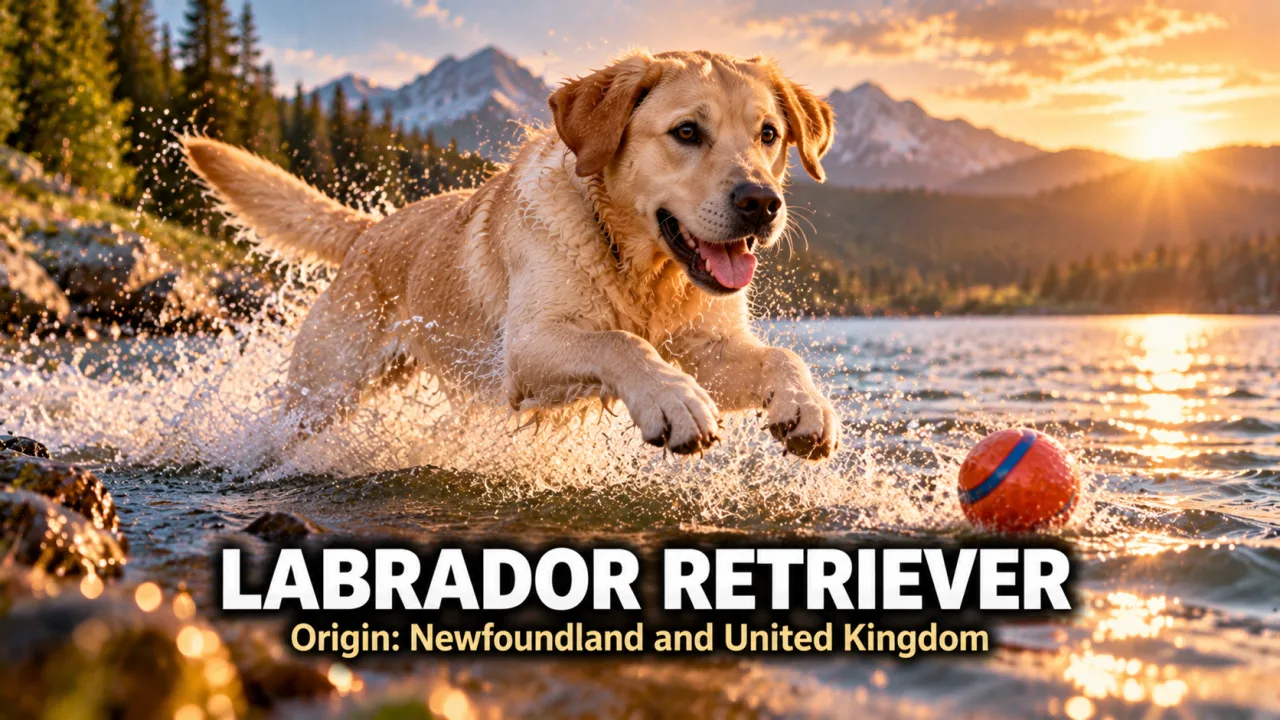
The Labrador Retriever, usually shortened to Labrador or Lab, is a British gun dog breed developed in the nineteenth century from water dogs brought over from Newfoundland. It was bred to retrieve shot waterfowl and game on land and in cold water, and it has since become one of the most widely kept dogs in the world.[1][2]
Labradors are medium-large, strongly built dogs with a short, dense, water-resistant coat and a thick "otter" tail. The breed is recognised in three solid colours: black, yellow and chocolate.[2][3] Its even temper, eagerness to work and strong appetite for food rewards make it easy to train, which is why it dominates the world of guide dogs, assistance dogs and detection dogs while also being a favourite family pet.[1][6]
The Labrador was the most registered breed in the United States for 31 consecutive years, until the French Bulldog overtook it in 2022. In 2025 it ranked second with the American Kennel Club and remained first with the Royal Kennel Club in the United Kingdom.[9][10][11]
This profile is part of Finepedia's Dog Breeds of the World guide, which covers every major dog family from ancient times to today.
Key Facts
| Attribute | Details |
|---|---|
| Other names | Labrador, Lab |
| Origin | United Kingdom, from St. John's water dogs of Newfoundland |
| Original purpose | Retrieving waterfowl and game for hunters |
| FCI classification | Group 8 (Retrievers, Flushing Dogs, Water Dogs), Section 1 Retrievers, with working trial; standard No. 122 |
| AKC group | Sporting Group |
| Kennel Club recognition | 1903 (UK); AKC 1917; FCI definitive acceptance 1954 |
| Height (AKC) | Males 57 to 62 cm (22.5 to 24.5 in); females 55 to 60 cm (21.5 to 23.5 in) |
| Height (FCI and UK) | Males about 56 to 57 cm; females about 54 to 56 cm |
| Weight (AKC) | Males 29 to 36 kg (65 to 80 lb); females 25 to 32 kg (55 to 70 lb) |
| Coat | Short, dense, straight outer coat over a weather-resistant undercoat |
| Colours | Black, yellow (cream to fox red), chocolate (liver) |
| Median lifespan | About 12 years (UK VetCompass study); chocolates about 10.7 years |
| Temperament | Friendly, outgoing, even-tempered, eager to please |
| Popularity | No. 2 in the US (AKC, 2025); No. 1 in the UK (Royal Kennel Club, 2025) |
History
The St. John's water dog
The Labrador's story begins not in Labrador but on the island of Newfoundland. From the 1700s, European settlers there kept a medium-sized, short-coated black water dog, now known as the St. John's water dog or Lesser Newfoundland. Fishermen used these dogs to haul nets, fetch lines and retrieve fish that slipped off hooks in the icy North Atlantic.[1][5] The dogs had to be strong swimmers, tolerant of cold water and willing to work closely with people, and those traits passed directly into the modern Labrador.
The St. John's dog is often confused with the much larger Newfoundland breed. Early nineteenth-century writers used the names loosely. The sportsman Colonel Peter Hawker drew a distinction in the 1846 edition of his Instructions to Young Sportsmen, describing the "proper Labrador" as no larger than an English Pointer, usually black, long in the head, deep in the chest and short and smooth in coat, and carrying its tail lower than the Newfoundland.[1] The St. John's water dog itself died out in Newfoundland during the twentieth century. Dog taxes and sheep-protection laws in Newfoundland, and Britain's strict quarantine rules from 1885, sharply reduced breeding and exports, so the Labrador and the other retriever breeds descended from it are its main legacy.
The Earls of Malmesbury and the Dukes of Buccleuch
From around the 1830s, ships trading salt cod between Newfoundland and the port of Poole in Dorset brought St. John's dogs to England.[1][13] Wealthy sporting families quickly saw their value as retrievers on shooting estates.
The 2nd Earl of Malmesbury was among the first to keep and breed these dogs, valuing them for waterfowling on his estate near Poole. In Scotland, the 5th Duke of Buccleuch, his brother Lord John Scott, and their uncle the 10th Earl of Home imported dogs of the same type and built their own kennels.[1] The 3rd Earl of Malmesbury continued his father's line and is generally credited with popularising the name "Labrador" for the dogs.
The two lines came together in the 1880s. The 3rd Earl of Malmesbury gave two of his dogs, Buccleuch Avon and Buccleuch Ned, to the 6th Duke of Buccleuch. They were bred to females descended from the Duke's and the Earl of Home's original imports, and their offspring are regarded as the foundation of all modern Labradors.[1] A dog called Malmesbury Tramp is also cited by breed historians as one of the tap roots of the breed.[3]
Kennel Club recognition
By 1870 the name Labrador Retriever was in common use in England.[1] Liver (chocolate) puppies were recorded at the Buccleuch kennels in 1892, and the first registered yellow Labrador, Ben of Hyde, was born in 1899 at the kennels of Major C. J. Radclyffe.[1]
The Kennel Club in London recognised the Labrador Retriever as a separate breed in 1903. A dedicated Labrador Retriever Club followed in 1916, and the Yellow Labrador Club was founded in 1925.[1][3] Field trials were the breed's early showcase, and Labradors soon dominated retriever competitions in Britain.
AKC recognition in 1917
The American Kennel Club registered its first Labrador Retriever in 1917.[1][2] Interest in the United States grew during the 1920s and 1930s, when wealthy American sportsmen imported British dogs and gamekeepers to run shooting estates on the East Coast. The Labrador Retriever Club, the breed's AKC parent club, was incorporated in New York in October 1931, and its founder Franklin B. Lord's dog Boli of Blake became the first American champion Labrador in 1933.[14] After the Second World War the breed spread from the shooting field into ordinary homes, and its rise in popularity continued for decades.
The FCI, the international federation of national kennel clubs, accepted the breed on a definitive basis in 1954. Its standard, No. 122, lists Great Britain as the country of origin and places the Labrador in Group 8 with a working trial requirement.[3][4]
Description
Size and build
The Labrador is a medium-large dog with a balanced, athletic frame. The body should be about as long from the withers to the base of the tail as the dog is tall at the withers, giving a square, compact outline.[1]
Size standards differ slightly between registries. The AKC asks for males of 57 to 62 cm (22.5 to 24.5 in) and females of 55 to 60 cm (21.5 to 23.5 in), with working weights of roughly 29 to 36 kg for males and 25 to 32 kg for females.[1][2] The FCI and British standards prefer a tighter, slightly smaller range: an ideal height of 56 to 57 cm for males and 54 to 56 cm for females.[3]
Real-world dogs are close to these figures. In a UK study of more than 33,000 Labradors under veterinary care, the average adult weight was 33.0 kg, with males averaging 35.2 kg and females 30.4 kg.[5]
Head, tail and other features
The head is broad with a defined stop and a muzzle of medium length that is strong but not snipy. The eyes are brown or hazel and should give a kind, alert expression. The ears hang close to the head, set a little above the eye line.[1][2]
Two features are described by both the Kennel Club and the AKC as distinctive of the breed: the coat and the tail. The tail is thick at the base, tapers toward the tip and is covered all round with short dense hair, giving the rounded "otter tail" that acts as a rudder in water.[1][3] The feet are compact, with well-arched toes and webbing between them that helps with swimming.[1]
Coat
The Labrador has a double coat. A short, straight and dense outer coat lies over a soft, weather-resistant undercoat. The coat feels slightly hard and has a natural oiliness that sheds water, which allowed working dogs to retrieve from cold lakes and marshes in winter without becoming chilled.[1][2] The coat should never be long, wavy or feathered.
Colours
Only three colours are accepted for registration and showing: solid black, yellow and chocolate.[2][3] Yellow covers a wide range, from pale cream that looks almost white to a deep fox red. Chocolate ranges from light to dark brown and was originally called liver. A small white spot on the chest is permitted.[3]
Puppies of all three colours can appear in the same litter. In the UK VetCompass study, black was the most common colour (44.6 percent of dogs with a recorded colour), followed by yellow (27.8 percent) and chocolate (23.8 percent).[5] Colours such as "silver", "charcoal" and "champagne" are sometimes advertised by breeders, but they are not accepted in the breed standard.
Genetics of yellow, chocolate and black
Labrador coat colour is a classic example of two genes interacting, a pattern geneticists call epistasis.
The first gene is MC1R, known as the E locus. It controls whether a dog's hair can contain black pigment (eumelanin) at all. A dog needs at least one working E allele to produce dark pigment in its coat. A dog that inherits two copies of the recessive e allele (e/e) cannot put eumelanin into its hair and produces only red-yellow pigment (phaeomelanin), so it is yellow whatever its other genes say.[7][8]
The second gene is TYRP1, known as the B locus. It decides whether dark pigment is black or brown. The dominant B allele gives full black. Two copies of the recessive b allele (b/b) dilute black to brown, which produces a chocolate coat.[7]
Putting the two together:
| Coat colour | E locus (MC1R) | B locus (TYRP1) | Nose and pads |
|---|---|---|---|
| Black | E/E or E/e | B/B or B/b | Black |
| Chocolate | E/E or E/e | b/b | Brown |
| Yellow (dark points) | e/e | B/B or B/b | Black |
| Yellow (brown points, "Dudley") | e/e | b/b | Brown |
Because both colour-changing alleles are recessive, two black parents that each carry e and b can produce black, chocolate and yellow puppies in a single litter. Brown points on a yellow dog appear when it is b/b, since the B locus still acts on skin pigment even though it cannot affect the yellow coat.[7] Other genes, including Agouti and the canine beta-defensin gene CBD103 (the K locus), also play a part in pigmentation, but the E and B loci explain nearly all colour variation seen in Labradors.[1][8]
Show versus working lines
Over the last century, breeders selecting for the show ring and those selecting for field trials and hunting have pulled the Labrador in two directions. The split is clear enough that many people treat the two types almost as different dogs, although they remain one registered breed.[1]
| Feature | Show (bench) type | Working (field) type |
|---|---|---|
| Build | Heavier, more solid, deeper chest | Lighter, leaner, longer legs |
| Head | Broader skull, shorter muzzle | Narrower skull, longer muzzle |
| Coat | Often thicker and denser | Usually shorter and less profuse |
| Tail | Thick, classic otter tail | Often thinner |
| Energy | Calmer, more relaxed at home | Very high drive and stamina |
| Typical role | Conformation shows, family pets | Field trials, hunting, detection work |
In North America the field type is sometimes called "American" and the show type "English". These labels are misleading, since both types are bred in both countries and every Labrador traces back to British stock.[1] For pet owners, the practical difference is energy: a dog from intense field-trial lines usually needs much more exercise and mental work than a dog from show lines.
Temperament
The breed standards describe the ideal Labrador as kindly, outgoing and tractable, with an eager-to-please nature and no trace of aggression or excessive shyness.[2][3] The AKC notes that the true Labrador temperament is as much a hallmark of the breed as its otter tail.[1]
In practice, most Labradors are sociable with people of all ages, tolerant of children and generally relaxed around other dogs. That friendliness means they usually make poor guard dogs, though many will bark to announce visitors.
Labradors are intelligent and highly trainable, but they are also energetic. Young dogs in particular can be boisterous, mouthy and prone to chewing, and the breed matures slowly, often keeping puppy-like behaviour until two or three years of age. Without enough physical and mental activity, a bored Labrador may dig, chew or become destructive.[1]
Two instincts stand out. The first is a love of carrying things: Labradors were bred with a "soft mouth" so they could bring back birds without damaging them, and many will happily carry toys, shoes or sticks around the house.[1] The second is a love of water, which comes straight from their St. John's ancestors.
A third trait is a powerful interest in food. Research has linked part of this to a gene variant (see Health and lifespan below). It makes Labradors very responsive to food rewards in training, but it also makes them prone to scavenging and weight gain.[6]
Uses
Gun dog
The Labrador's original job is still one of its main ones. As a retriever, it waits quietly beside a hunter, marks where shot birds fall, then fetches them on command from land or water. Its soft mouth, webbed feet, waterproof coat and strong rudder-like tail all reflect this work.[1] Labradors dominate retriever field trials and hunt tests in Britain, North America and Australia. Seven of the 13 "outstanding gundogs" named to the Australian National Kennel Council's hall of fame between 2000 and 2005 were Labradors.[1]
Guide and assistance dogs
The traits that make a good retriever, namely steadiness, willingness to work with a handler and a gentle mouth, also make a good guide dog. The Labrador and Labrador-Golden Retriever crosses are now the most common guide dogs in much of the world. An estimated 60 to 70 percent of guide dogs in the United States are Labradors.[1] A 2006 study comparing Labradors, Golden Retrievers, crosses of the two and German Shepherds found that Labradors and Labrador-Golden crosses had the highest success rates in guide dog training.[1]
Labradors are also widely used as assistance dogs for people with physical disabilities, epilepsy, diabetes and autism, and as therapy dogs in hospitals, schools and care homes. Trained assistance Labradors can open doors, pick up dropped objects, fetch phones, press emergency buttons and even help with cash machines.[1]
Assistance dog programmes have selected heavily for food-motivated, trainable dogs. A 2016 study found that the POMC gene deletion linked to appetite was far more common in Labradors bred as assistance dogs than in pet Labradors: its allele frequency was 45 percent in a group of assistance-dog breeding stock, compared with 12 percent in the general UK population.[6]
Detection
A keen nose, high drive to search for a reward and a friendly face that does not alarm the public make the Labrador a leading detection dog. Police forces, customs and border agencies, airports and armed forces use Labradors to find explosives, firearms, narcotics, cash, smuggled wildlife products and agricultural contraband.[1] Labradors have also been trained to detect counterfeit DVDs, bed bugs, invasive species and some human diseases.
In military service, Labradors were trained for explosive detection during the Second World War and served as tracker dogs in the Vietnam War, where they followed enemy trails and helped find injured or missing soldiers. They continue to serve today in bomb detection and search roles.[1]
Search and rescue
Labradors are common search and rescue dogs, working on collapsed buildings after earthquakes, in avalanches, in wilderness searches and in water rescue. Their stamina, ability to work in rubble and willingness to swim make them suited to disaster work.[1] In Italy, Labradors are among the breeds trained at the Italian School of Canine Lifeguards, alongside Newfoundlands, Golden Retrievers and Leonbergers, and they jump from boats and helicopters to help swimmers in trouble.[1]
Health and lifespan
Lifespan
The largest study of Labrador health to date is a 2018 VetCompass analysis led by the Royal Veterinary College and the University of Sydney. It examined the veterinary records of 33,320 Labradors under primary care in the UK, with detailed disorder and death data for a random sample of 2,074 dogs.[5]
| Measure | Finding |
|---|---|
| Median lifespan, all Labradors | 12.0 years |
| Median lifespan, black and yellow | 12.1 years |
| Median lifespan, chocolate | 10.7 years |
| Median lifespan, neutered dogs | 12.5 years |
| Median lifespan, entire dogs | 11.6 years |
| Most common causes of death | Musculoskeletal disorders (24.5%), cancer (21.1%) |
| Dogs with at least one disorder in a year | 61.6% |
Chocolate Labradors lived about 10 percent shorter lives than black or yellow dogs. Because chocolate is recessive, breeders who want chocolate puppies may draw from a narrower set of lines, which the authors suggested could concentrate genes linked to other disorders.[5] Other studies give similar figures: an Italian study published in 2024 found a life expectancy of 11 years for Labradors, compared with 10 years for dogs overall, and a 2005 Swedish insurance study found that 25 percent of Labradors had died by age ten, against 35 percent of all insured dogs.[1]
Common disorders
The VetCompass study found the most common problems recorded in Labradors in a single year were:[5]
| Disorder | Share of Labradors affected in one year |
|---|---|
| Otitis externa (ear inflammation) | 10.4% |
| Overweight or obesity | 8.8% |
| Degenerative joint disease (arthritis) | 5.5% |
| Lameness | 4.4% |
| Periodontal (dental) disease | 4.2% |
Coat colour mattered here too. Ear infections affected 12.8 percent of black dogs, 17.0 percent of yellow dogs and 23.4 percent of chocolate dogs. Pyo-traumatic dermatitis, often called a hot spot, was about four times as common in chocolates (4.0 percent) as in blacks (1.1 percent).[5] The breed's love of swimming may play a part in ear and skin trouble, since a coat or ear canal that stays damp gives bacteria and yeast a place to grow.
The POMC gene and obesity
Labradors are notorious for their appetite, and a 2016 study published in Cell Metabolism found a genetic reason. Researchers at the University of Cambridge identified a 14-base-pair deletion in the POMC gene, which helps the brain regulate hunger and energy use.[6]
The deletion disrupts the production of two signalling molecules, beta-MSH and beta-endorphin. In a cohort of 310 Labradors, each copy of the deletion was associated with about 1.9 kg of extra body weight, a higher body condition score and a measurably stronger drive for food. About 23 percent of UK Labradors carried at least one copy. Among other breeds tested, the variant was found only in the closely related Flat-Coated Retriever.[6]
Carriers can still be kept lean, but their owners need to be stricter about portion sizes and treats.
Inherited and joint conditions
Labradors are prone to several inherited or developmental conditions:[1][5]
- Hip dysplasia and elbow dysplasia, in which joints form abnormally and later develop arthritis. Many breed clubs require hip and elbow scoring of breeding dogs.
- Cranial cruciate ligament rupture, a common knee injury in active and overweight dogs.
- Progressive retinal atrophy, in particular the progressive rod-cone degeneration (PRCD) form, caused by a recessive mutation that can be screened for by DNA test.
- Hereditary cataracts, retinal dysplasia and corneal dystrophy.
- Exercise-induced collapse, an inherited condition in which some dogs become weak, wobbly and disoriented after short bursts of intense exercise.
- Chronic hepatitis and other liver diseases, to which the breed appears predisposed.
Responsible breeders use health screening, including hip and elbow scores, eye examinations and DNA tests for conditions such as PRCD and exercise-induced collapse, to reduce the risk of these problems in puppies.
Care, grooming and exercise
Grooming
The Labrador's short coat is easy to keep, but it sheds heavily. Most dogs drop their undercoat in two big moults a year, in spring and autumn, and shed lightly the rest of the time.[2] Brushing once or twice a week, and daily during a moult, keeps loose hair under control. Baths are only needed occasionally, since frequent washing strips the natural oils that make the coat water-resistant.
Because the breed is prone to ear infections, ears should be checked weekly and dried thoroughly after swimming. Nails need regular trimming, and teeth benefit from regular brushing or dental chews.
Exercise
Labradors are working dogs and need a lot of activity. Most adults are happiest with at least an hour of exercise a day, including off-lead running where it is safe, swimming and retrieving games.[2] Dogs from field lines often need more.
Mental exercise is just as important. Scent games, obedience training, puzzle feeders and dog sports such as agility, dock diving, obedience, rally and gun dog tests all suit the breed. Puppies should not be over-exercised while their joints are still growing, so long runs and repeated jumping are best avoided until the skeleton has matured.
Feeding and weight
Weight control is the most important part of Labrador care. Overweight dogs are more likely to develop arthritis and other joint problems, and a lifelong Purina study of 48 Labradors found that dogs fed 25 percent less than their littermates had a median lifespan of 13.0 years, against 11.2 years for their more freely fed pairs, a gain of 1.8 years.[15]
Practical steps include weighing food rather than scooping it, counting treats as part of the daily ration, using some of the daily food as training rewards and checking body condition regularly. Owners should be able to feel their dog's ribs easily under a thin layer of fat and see a visible waist from above.[5][6]
Training
Labradors respond best to positive, reward-based training, and their love of food and play makes them quick learners. Early socialisation with people, other dogs and new places, together with training in loose-lead walking and polite greetings, helps turn an exuberant puppy into a well-mannered adult.
Popularity
United States
The Labrador Retriever became the most registered breed with the American Kennel Club in 1991[16] and held the top position for 31 consecutive years. In 2022 the French Bulldog took the first spot, and the Labrador has been second every year since.[9][10]
| Year | AKC rank | Breed ranked No. 1 |
|---|---|---|
| 1991 to 2021 | 1 | Labrador Retriever |
| 2022 | 2 | French Bulldog |
| 2023 | 2 | French Bulldog |
| 2024 | 2 | French Bulldog |
| 2025 | 2 | French Bulldog |
AKC figures cover only purebred dogs that owners choose to register, so they do not include the many unregistered Labradors and Labrador crosses kept as pets.[10]
United Kingdom
In Britain the Labrador has been the most registered breed with the Kennel Club, now the Royal Kennel Club, for most of the past three decades. In 2025 it again topped the list with 29,919 registrations, well ahead of the Cocker Spaniel with 21,618 and the Golden Retriever with 9,976. Labrador numbers fell by about 12 percent from 34,141 in 2024, in line with a general drop in pedigree registrations after the pandemic boom.[11][12]
Worldwide
The Labrador is one of the most common pedigree breeds in Canada, Australia, New Zealand and much of Europe, and it is the most popular breed for assistance dog work in the United States, Australia and many other countries.[1] Labrador crosses, including the Labradoodle (Labrador and Poodle) and Goldador (Labrador and Golden Retriever), have also become popular.
Notable Labradors
Assistance dogs
- Endal, a British service dog who helped his owner, Gulf War veteran Allen Parton, after a brain injury. Endal could load a washing machine, use a cash machine card and put his owner into the recovery position after an accident. He won the PDSA Gold Medal and was named "Dog of the Millennium".[1]
- Sully, the service dog of US President George H. W. Bush in the last months of his life. A photograph of Sully lying beside Bush's casket in 2018 was widely shared, and he later joined the facility dog programme at Walter Reed National Military Medical Center in 2019.[1][18]
- Salty and Roselle, two guide dogs who led their blind owners down more than 70 floors of the World Trade Center on 11 September 2001. Both received the Dickin Medal, often called the animals' Victoria Cross.[1]
Military, police and rescue dogs
- Zanjeer, a Mumbai police detection dog who found weapons and explosives after the 1993 Bombay bombings, including more than 3,300 kg of RDX, 57 country-made bombs and hundreds of grenades and detonators.[1]
- Frida, a yellow Labrador search and rescue dog with the Mexican Navy who worked after the 2010 Haiti earthquake and became a national symbol of hope after the September 2017 earthquake in Mexico. The Navy credited her with saving 12 people and locating 43 bodies. She lived from 2009 to 2022.[1][17]
- Sarbi, an Australian special forces explosive detection dog who went missing in Afghanistan for about 14 months before being recovered safe in 2009.[1]
- Sadie and Sasha, British Army explosive detection dogs who received the Dickin Medal for service in Afghanistan. Sasha was killed in an ambush in 2008.[1]
- Lucky and Flo, twin black Labradors trained to sniff out counterfeit DVDs, who helped Malaysian authorities seize nearly two million fake discs in 2007.[1]
- Jake, an American search and rescue dog who worked at Ground Zero after the September 11 attacks and after Hurricane Katrina.[1]
Famous pets
- Buddy and Seamus, Labradors owned by US President Bill Clinton.[1]
- Konni, a black Labrador owned by Russian President Vladimir Putin.[1]
- Charlie and Bear, Labradors belonging to singer Celine Dion.[1]
In popular culture
The Labrador's friendly image has made it a regular in books, films and advertising.
- Marley & Me, journalist John Grogan's 2005 memoir about his unruly yellow Labrador, became a bestseller and was adapted into a 2008 film starring Owen Wilson and Jennifer Aniston.[1]
- The Incredible Journey (1961), Sheila Burnford's novel about three pets crossing the Canadian wilderness, features a young Labrador named Luath. It was filmed by Disney in 1963 and remade as Homeward Bound in 1993 with the dog renamed Shadow, a Golden Retriever.[19]
- The Andrex toilet paper puppy, a yellow Labrador, has appeared in British television advertising since 1972 and is one of the best-known advertising mascots in the UK.[20]
- Labradors appear often in children's books, television series and as cartoon dogs, and the breed is a common choice for films that need a calm, trainable dog.
See also
- Dog Breeds of the World: Ancient to Modern Guide
- Golden Retriever
- Flat-Coated Retriever
- Chesapeake Bay Retriever
- Newfoundland dog
- Guide dog
- ^ [1] "Labrador Retriever". Wikipedia. https://en.wikipedia.org/wiki/Labrador_Retriever
- ^ [2] "Labrador Retriever Dog Breed Information". American Kennel Club. https://www.akc.org/dog-breeds/labrador-retriever/
- ^ [3] "FCI-Standard No. 122: Labrador Retriever". Federation Cynologique Internationale. https://www.fci.be/en/Nomenclature/Standards/122g08-en.pdf
- ^ [4] "Labrador Retriever (122)". FCI Breeds Nomenclature, Federation Cynologique Internationale. https://www.fci.be/en/nomenclature/LABRADOR-RETRIEVER-122.html
- ^ [5] McGreevy P. D. et al. "Labrador retrievers under primary veterinary care in the UK: demography, mortality and disorders". Canine Genetics and Epidemiology, 2018 (VetCompass, Royal Veterinary College). https://cgejournal.biomedcentral.com/articles/10.1186/s40575-018-0064-x
- ^ [6] Raffan E. et al. "A Deletion in the Canine POMC Gene Is Associated with Weight and Appetite in Obesity-Prone Labrador Retriever Dogs". Cell Metabolism, 2016. https://pmc.ncbi.nlm.nih.gov/articles/PMC4873617/
- ^ [7] "Brown (B Locus/Chocolate/Liver)". Veterinary Genetics Laboratory, UC Davis. https://vgl.ucdavis.edu/test/brown-dog
- ^ [8] "MC1R including Mask, Grizzle, and Red/Cream (E Locus)". Veterinary Genetics Laboratory, UC Davis. https://vgl.ucdavis.edu/test/mc1r-dog
- ^ [9] "The Most Popular Dog Breeds of 2025". American Kennel Club. https://www.akc.org/expert-advice/dog-breeds/most-popular-dog-breeds-2025/
- ^ [10] "French Bulldog Remains America's Most Popular Pup for the Fourth Year". American Kennel Club press release, 18 March 2026. https://www.akc.org/press-releases/je-taime-once-again-french-bulldog-remains-americas-most-popular-pup-for-the-fourth-year
- ^ [11] "RKC registrations fall by over 15 per cent to just under 159,000". Our Dogs. https://www.ourdogs.co.uk/News/newsa.php?title=RKC_registrations_fall_by_over_15_per_cent_to_just_under_159%2C000
- ^ [12] "Quarterly Registration Statistics for the Gundog Group, 2024 and 2025". The Royal Kennel Club. https://www.royalkennelclub.com/media/bmdkrvo0/quarterly-breed-stats-gundogs.pdf
- ^ [13] "Labrador Retriever". The Canadian Encyclopedia. https://thecanadianencyclopedia.ca/en/article/labrador-retriever
- ^ [14] "Club History". The Labrador Retriever Club, Inc. https://thelabradorclub.com/club-history/
- ^ [15] Kealy R. D. et al. "Effects of diet restriction on life span and age-related changes in dogs". Journal of the American Veterinary Medical Association, 2002. https://pubmed.ncbi.nlm.nih.gov/11991408/
- ^ [16] "French Bulldog Knocks Labrador Retriever Out of Number One Spot, Ending 31-Year Stay at the Top". American Kennel Club. https://www.akc.org/press-releases/french-bulldog-knocks-labrador-retriever-number-one-spot-ending-31-year-stay-top/
- ^ [17] "Mexico's Frida, beloved rescue dog turned national icon, dies". Reuters, 15 November 2022. https://www.reuters.com/lifestyle/mexicos-frida-beloved-rescue-dog-turned-national-icon-dies-2022-11-16/
- ^ [18] "Bush Service Dog Joins Ranks at Walter Reed". U.S. Department of Defense. https://www.defense.gov/News/News-Stories/Article/Article/1770929/bush-service-dog-joins-ranks-at-walter-reed/
- ^ [19] "The Incredible Journey". Wikipedia. https://en.wikipedia.org/wiki/The_Incredible_Journey
- ^ [20] "History of Andrex". Andrex (Kimberly-Clark). https://www.andrex.co.uk/history-of-andrex




























Discussion
Log in with