



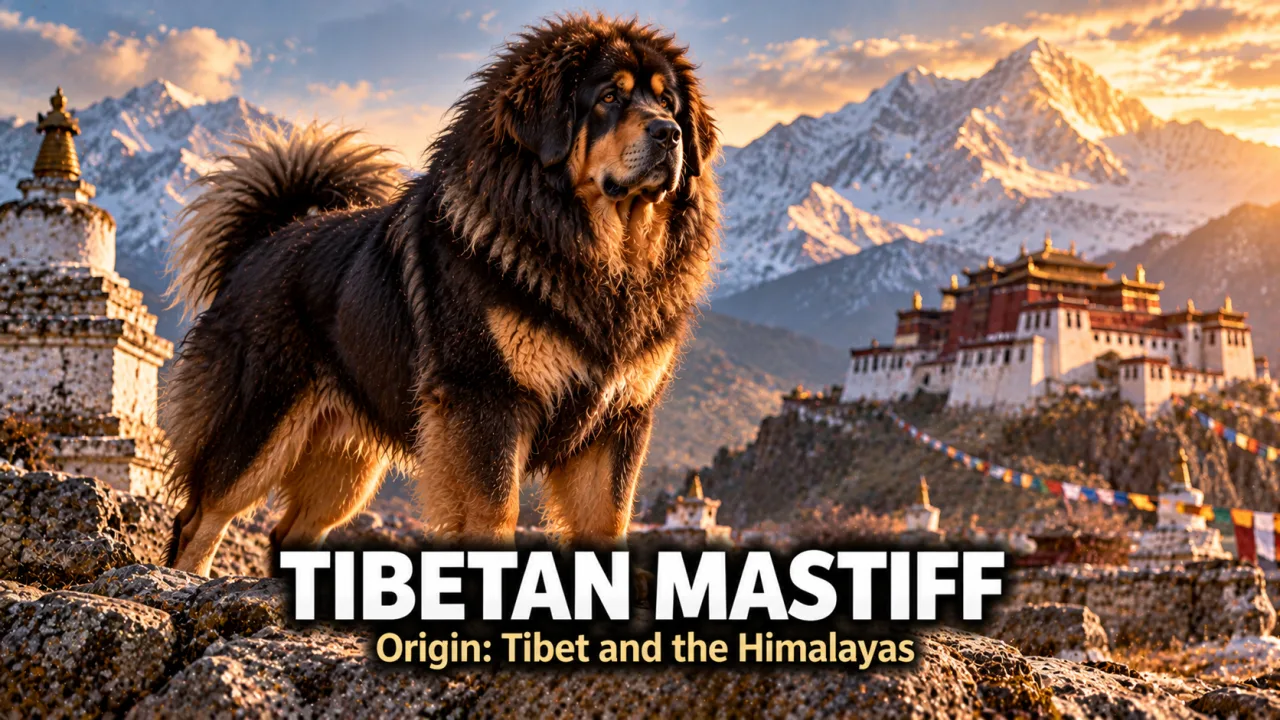
The Tibetan Mastiff, known in Tibetan as the Do Khyi, is a large dog breed from Tibet.[1][3] It was the working guardian of the nomadic herders of the Himalayas and a traditional guardian of Tibetan monasteries.[3] Its double coat is medium to long, depending on climate, and comes in colours from solid black and black and tan to shades of gold and red and a bluish grey.[1][3]
The breed is one of the few that still has a single heat cycle a year, a trait shared with wolves.[1] A 2020 genomic analysis found that it inherited a gene helping it cope with high altitude from an unknown wolf-like canid.[1] In 2011, a red Tibetan Mastiff named Big Splash was reported sold in China for about 1.5 million US dollars, then the highest price ever paid for a dog.[7]
This profile is part of Finepedia's Dog Breeds of the World guide, which covers every major dog family from ancient times to today.
Key Facts
| Attribute | Details |
|---|---|
| Other names | Do Khyi |
| Origin | Tibet (China) |
| Purpose (FCI) | Companion, watch and guard dog |
| FCI classification | Group 2, Section 2.2 Molossoid breeds, mountain type, without working trial; standard No. 230 |
| FCI definitive acceptance | 22 August 1961 |
| Height (FCI) | Males at least 66 cm; females at least 61 cm |
| Weight (AKC) | Males 40 to 70 kg; females 30 to 55 kg |
| Colours (FCI) | Black, blue, gold (rich fawn to deep red) and sable, with or without tan markings |
| Temperament (FCI) | Independent, protective, commands respect; most loyal to family and territory |
| Median lifespan | 13.3 years (UK, 2024 study, small sample of 117 dogs) |
| Popularity | No. 142 in the US (AKC, 2025) |
Name
Europeans who first came to Tibet used the term "mastiff" because it was applied to nearly all large dogs in the West.[1] Early Western visitors misnamed several Tibetan breeds in the same way. The Tibetan Terrier is not a terrier, and the Tibetan Spaniel is not a spaniel. A better name for the breed might be the Tibetan mountain dog or, to cover the landrace across its range, the Himalayan mountain dog.[1]
The FCI standard uses the Tibetan name Do Khyi alongside Tibetan Mastiff.[3]
History
Origins in the Himalayas
The Tibetan Mastiff was bred as a flock guardian at high altitude in the Himalayas and on the Tibetan Plateau.[1] Its first known role was protecting Buddhist monasteries and monks from animals such as bears, wolves and snow leopards.[1]
The FCI standard calls it "an ancient working breed of the nomad herders of the Himalaya". It notes that the breed has been surrounded by myth since antiquity, and that historical reports from Aristotle to Marco Polo, who travelled to Asia in 1271, praise its strength.[3] Even its bark "has been described as a unique and highly treasured feature of the breed".[3]
In 1872 Meer Izzut-oollah wrote:
- "The dogs of Tibet are twice the size of those seen in India, with large heads and hairy bodies. They are powerful animals... During the day they are kept chained up, and are let loose at night to guard their masters' house."[1]
Arrival in the West
According to the FCI standard:
- One of the first known Tibetan Mastiffs to reach the West was a male sent to Queen Victoria in 1847 by Lord Hardinge, then Viceroy of India.
- In the 1880s, Edward VII, then Prince of Wales, took two dogs back to England.
- An early recorded litter was born at the Berlin Zoo in 1898.[3]
By 1906 the breed was common enough in England to be shown at the Crystal Palace show, but it lost favour during the war years and nearly died out there.[1] Leading European dog writers of the past studied the breed closely, and some considered it the forefather of all large mountain and mastiff breeds.[3]
Modern popularity
The breed has grown in popularity worldwide since 1980.[1] As more breeders produced dogs, registries including the FCI and AKC recognised it.[1] The FCI definitively accepted it on 22 August 1961.[2] The breed competed for the first time at the Westminster Kennel Club Dog Show in 2008.[1]
After AKC recognition, the number of breeders rose sharply. Many puppies were highly inbred and of questionable quality.[1]
The Chinese status symbol
In the early 21st century, the Tibetan Mastiff became a luxury status symbol among China's newly wealthy.[7]
| Year | Reported sale or value (CBS News) |
|---|---|
| 2009 | More than 500,000 US dollars paid for a mastiff named "Yangzte No. 2" |
| 2010 | A mastiff valued at nearly 1.47 million US dollars |
| 2011 | About 1.5 million US dollars paid for Big Splash |
Big Splash, whose Chinese name is Hong Dong, was an 11-month-old red Tibetan Mastiff weighing about 180 pounds (82 kg) and still growing. CBS News reported that the buyer was a coal baron from northern China and that the breeder was Lu Liang, who called the dog a "perfect specimen".[7]
The boom did not last. By 2015, overbreeding and the breed's unsuitability as an urban pet had pushed prices for the best dogs in China down to about 2,000 US dollars. Lower-quality and crossbred dogs were being abandoned.[1]
Genetics and high-altitude adaptation
Relationship to other large breeds
A 2011 DNA study found a genetic relationship between the Tibetan Mastiff and the Great Pyrenees, Bernese Mountain Dog, Rottweiler and Saint Bernard. It suggested these large breeds are probably partly descended from the Tibetan Mastiff. A 2014 study added the Leonberger to the list of possible relatives.[1]
Adaptation to altitude
The Tibetan Mastiff adapted to the extreme highlands of the Tibetan Plateau very quickly compared with mammals such as the yak, Tibetan antelope, snow leopard and wild boar.[1] Higher haemoglobin levels than low-altitude dogs help it avoid hypoxia, or oxygen shortage.[1]
This ability came from prehistoric interbreeding. A 2020 genomic analysis found that a "ghost population" of an unknown wolf-like canid, deeply diverged from modern wolves and dogs, contributed the EPAS1 gene variant found in both Himalayan wolves and Tibetan dogs.[1]
Single heat cycle
The breed is one of the few primitive breeds that keeps a single oestrus a year instead of two, even at low altitude and in mild climates. This trait is also found in wild canids such as the wolf.[1] Because oestrus usually falls in late autumn, most Tibetan Mastiff puppies are born between December and January.[1]
Description
General appearance
The FCI standard describes a "powerful, heavy, well built" dog with good bone and a "solemn and earnest appearance". It combines "majestic strength, robustness and endurance" and is "fit to work in all climate conditions".[3] The breed matures slowly. Females reach their best at two to three years, and males at no less than four.[3]
Size
| Measure | Males | Females |
|---|---|---|
| Height at withers (FCI) | At least 66 cm | At least 61 cm |
| Weight (AKC) | 40 to 70 kg (90 to 150 lb) | 30 to 55 kg (70 to 120 lb) |
Sources: FCI standard and Wikipedia.[1][3]
Head
The head is broad, heavy and strong. In adults a wrinkle may run from above the eyes to the corner of the mouth.[3] The eyes are medium-sized, oval and any shade of brown, "the darker the better", with an "expression of dignity". The ears are medium-sized, triangular and pendant, hanging close to the head.[3]
Body, tail and movement
The neck is strong and arched and covered by a thick, upstanding mane, which is less pronounced in females. The chest is rather deep, with a heart-shaped ribcage.[3] The tail is medium length, well feathered and loosely curled over the back when the dog is alert or moving.[3] The gait is powerful "but always light and elastic", and the walk appears very deliberate.[3]
Coat and colour
The FCI standard values coat quality over quantity. The topcoat is harsh, thick and not too long, over a dense, woolly undercoat in cold weather that thins in warmer months. Males carry noticeably more coat than females, and the neck and shoulders form a mane.[3]
| FCI colour | Notes |
|---|---|
| Black | Rich black, with or without tan markings |
| Blue | With or without tan markings |
| Gold | From rich fawn to deep red |
| Sable | As pure as possible |
A white star on the chest and minimal white on the feet are allowed. Any other colour or combination is unacceptable.[3] As of 2014 some breeders had begun marketing white Tibetan Mastiffs.[1]
The coat is said to lack the strong smell of many large breeds and to shed dirt and odours. There is usually one heavy moult in late winter or early spring and sometimes a lighter one in late summer or early autumn.[1]
Lion Head and Tiger Head
Western standards treat the breed as one, but the Indian breed standard separates two varieties:
- the Lion Head, smaller, with very long hair from forehead to withers forming a ruff or mane;
- the Tiger Head, larger, with shorter hair.[1]
Temperament
The FCI standard sums up the breed's temperament as "Independent. Protective. Commands respect. Most loyal to his family and territory."[3]
As a guardian
As a flock guardian in Tibet and in the West, the Tibetan Mastiff uses the usual livestock guardian tactics. It barks and scent-marks the boundaries to warn predators away and avoid direct fights.[1]
Centuries of selective breeding have made it a nocturnal sentry that barks at unidentified sounds through the night. It often sleeps during the day and is more active and alert at night.[1]
As a family dog
Western-bred dogs are generally more easy-going but still somewhat aloof with strangers. A socialised dog can live comfortably in a spacious, fenced yard with a canine companion, but the breed is not suited to apartment living.[1]
Like all flock guardian breeds, the Tibetan Mastiff is intelligent and stubborn. Obedience training is recommended, though it is only mildly successful with some individuals. Socialisation is critical because of the breed's reserve with strangers and strong guarding instincts.[1] It can be an excellent family dog for owners who understand canine behaviour and will put in a great deal of time and training, but it is not recommended for novice owners.[1]
Health and lifespan
Lifespan
A 2024 UK study of 584,734 dogs found a median life expectancy of 13.3 years for the Tibetan Mastiff, from a small sample of 117 dogs.[5][6] Many breeders claim a life expectancy of 10 to 16 years, but these claims are unsubstantiated. Some lines produce long-lived dogs, while more closely inbred lines produce short-lived, unhealthy dogs.[1]
Conditions
The breed has fewer genetic health problems than many others.[1]
| Group | Conditions reported |
|---|---|
| Endocrine | Hypothyroidism; Addison's disease; Cushing's disease |
| Eyes | Entropion; ectropion; distichiasis; progressive retinal atrophy; cataracts |
| Skin and immune | Allergies and other skin problems; demodex |
| Mouth | Missing teeth; malocclusion |
| Other | Heart problems; seizures and epilepsy; small ear canals prone to infection; elbow and hip dysplasia |
Source: Wikipedia.[1]
Canine inherited demyelinative neuropathy
Canine inherited demyelinative neuropathy (CIDN) appeared in a prominent line in the early 1980s. Known carriers were bred extensively and sit behind many lines still being bred. Because it appears to be inherited as a simple recessive, continued inbreeding can still produce affected puppies.[1]
Thyroid testing
Hypothyroidism is fairly common, as in many large northern breeds, and periodic testing with a full thyroid panel is advised.[1] Many Tibetan Mastiffs have "low" thyroid values without any symptoms, so results must be judged against what is normal for the breed. Vets and owners differ on whether such dogs should be treated.[1]
Popularity
The AKC ranked the Tibetan Mastiff 142nd in 2025, making it one of the rarer breeds in the United States.[4]
In popular culture
- Max, the antagonist of the 1993 horror film Man's Best Friend, was played by at least five dogs.[1]
- The 2011 animated film The Tibetan Dog is about a Tibetan Mastiff.[1]
- Pema Tseden's 2011 film Old Dog follows a herder family whose mastiff is coveted for sale to wealthy buyers.[1]
- Bodi and Khampa in the animated film Rock Dog are Tibetan Mastiffs.[1]
- The Pokémon Mabosstiff is heavily based on the breed.[1]
See also
- Dog Breeds of the World: Ancient to Modern Guide
- Akita
- Siberian Husky
- Tibetan Terrier
- Lhasa Apso
- Tibetan Kyi Apso
- ^ [1] "Tibetan Mastiff". Wikipedia. https://en.wikipedia.org/wiki/Tibetan_Mastiff
- ^ [2] "Tibetan Mastiff (230)". FCI Breeds Nomenclature, Federation Cynologique Internationale. https://www.fci.be/en/nomenclature/TIBETAN-MASTIFF-230.html
- ^ [3] "FCI-Standard No. 230: Do-Khyi (Tibetan Mastiff)". Federation Cynologique Internationale. https://www.fci.be/Nomenclature/Standards/230g02-en.pdf
- ^ [4] "The Most Popular Dog Breeds of 2025". American Kennel Club. https://www.akc.org/expert-advice/dog-breeds/most-popular-dog-breeds-2025/
- ^ [5] McMillan K. M. et al. "Longevity of companion dog breeds: those at risk from early death". Scientific Reports, 2024. https://www.nature.com/articles/s41598-023-50458-w
- ^ [6] "Life expectancy of breeds table, 2024". Dogs Trust. https://www.dogstrust.org.uk/downloads/life-expectancy-breeds-table-2024.pdf
- ^ [7] Johnson B. "Tibetan Mastiff, 'Big Splash,' sells for $1.5 million, world's most expensive dog". CBS News, 16 March 2011. https://www.cbsnews.com/news/tibetan-mastiff-big-splash-sells-for-15-million-worlds-most-expensive-dog/























Discussion
Log in with