







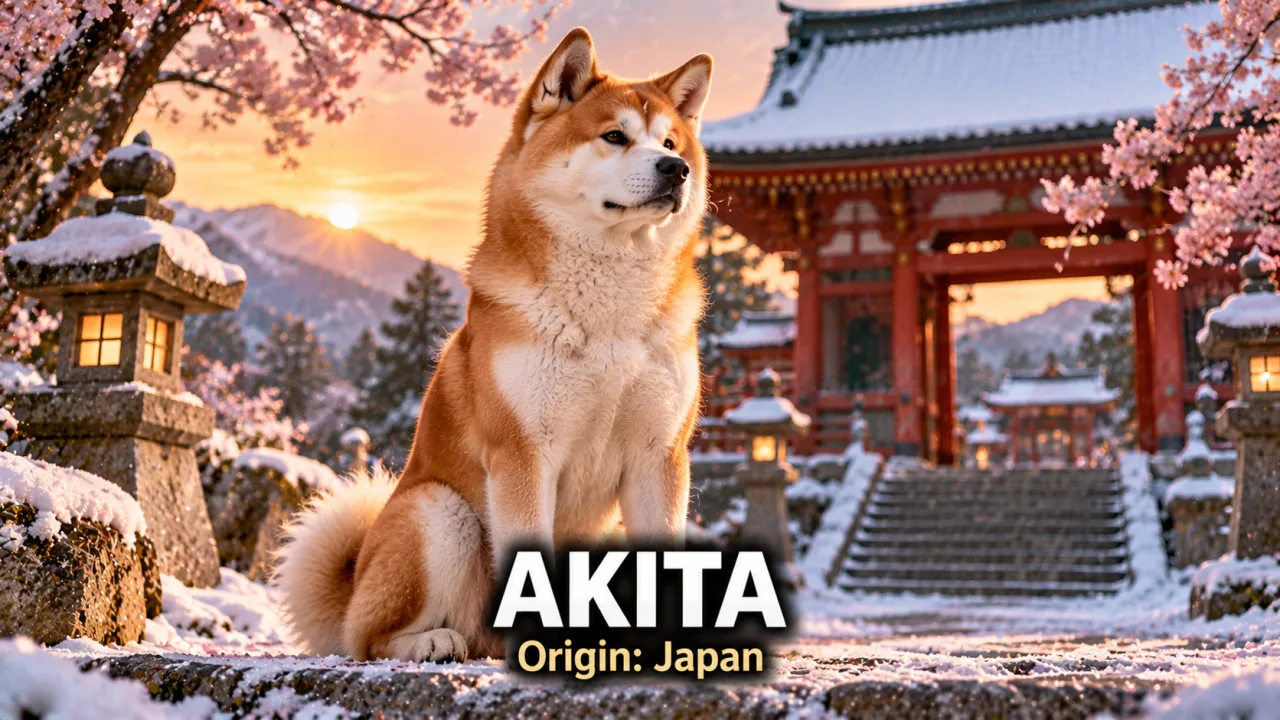
The Akita, or Akita Inu (秋田犬), is a large Japanese dog breed from the mountains of northern Japan. Like many northern spitz breeds, it has a short, thick double coat, small pricked ears and a tail curled over its back.[1][3] It traces its roots to the matagi dogs used by the traditional Matagi hunters of the Tōhoku region to track and hold large game such as the Asian black bear, wild boar and Japanese serow.[1]
The Akita became the first Japanese dog breed designated a natural monument, in 1931. The loyalty of one Akita, Hachikō, who waited at Tokyo's Shibuya Station for years after his owner's death, made the breed famous worldwide.[1][7]
After the Second World War the breed developed into two types. The FCI and most kennel clubs now treat the Japanese Akita and the larger American Akita as separate breeds.[1] In 2025 the AKC's Akita, the American type, ranked 62nd among breeds registered with the American Kennel Club.[4]
This profile is part of Finepedia's Dog Breeds of the World guide, which covers every major dog family from ancient times to today.
Key Facts
| Attribute | Details |
|---|---|
| Other names | Akita Inu; Akita-ken; formerly Ōdate dog |
| Origin | Japan (Akita Prefecture) |
| Purpose (FCI) | Companion dog; historically hunting, guarding and fighting |
| FCI classification | Group 5 (Spitz and primitive types), Section 5 Asian Spitz and related breeds, without working trial; standard No. 255 |
| FCI definitive acceptance | 13 March 1964 |
| Height (FCI) | Males 67 cm; females 61 cm (tolerance plus or minus 3 cm) |
| Coat | Harsh, straight outer coat over a soft, dense undercoat |
| Colours (FCI) | Red fawn, sesame, brindle and white; all except white with "urajiro" markings |
| Median lifespan | 11.4 years (UK, 2024 study) |
| Temperament | Composed, faithful, docile and receptive (FCI); reserved with strangers |
| Popularity | No. 62 in the US (AKC "Akita", 2025) |
Breed name and the two types
Outside Japan there was long debate over whether the Japanese and American types were one breed or two. In June 1999 the FCI split them, calling the American type the "Great Japanese Dog". In January 2006 it renamed the American type the American Akita. The UK Kennel Club, the Japan Kennel Club, the United Kennel Club and the national clubs of Australia and New Zealand also treat them as separate breeds. As of 2020 the AKC does too, and it no longer allows them to be bred together.[1] In some countries the American type is simply called the "Akita", and the issue is particularly sensitive in Japan.[1]
This article mainly describes the Japanese Akita of FCI standard No. 255, with notes on the American type.
History
Matagi and Ōdate dogs
Since ancient times, hunting dogs called matagi dogs, from the word for "hunter", were kept in the Tōhoku region. They hunted Asian black bears, Japanese serows, Japanese macaques and rabbits. The direct ancestor of the Akita was a guard and fighting dog kept by samurai and wealthy farmers around Ōdate, known as the Ōdate dog until 1931.[1]
During the Edo period (1603 to 1867), the Akita region was ruled by the Satake clan. The Satake family who kept Ōdate Castle is said to have encouraged dog fighting to build the fighting spirit of its retainers.[1]
The FCI standard explains that Japanese dogs were originally small to medium-sized, with no large breeds. From 1603, medium-sized bear-hunting dogs called Akita Matagis were used for fighting in the Akita region. From 1868 they were crossed with Tosas and Mastiffs, which made them bigger but cost them many spitz traits. Dog fighting was banned in 1908, but the breed was kept and improved as a large Japanese dog.[3]
A famous example of the larger type was Moku, a dog kept at the Jō'ō-ji temple in Ōdate in the late Edo period. Moku was born in the 1850s, survived the Boshin War and lived until about 1871 or 1872. He was said to stand about 85 cm at the shoulder, large enough to carry an adult on his back, and had erect ears, a curly tail and long sesame-coloured hair.[1]
Preservation and natural monument status
By the late Meiji period, dog fighting had driven breeders to cross pure Akitas with breeds such as the Tosa, and the original dog was close to extinction. In May 1927 Izumi Shigeie, mayor of Ōdate, founded the Akita Inu Hozonkai (AKIHO), the Akita Dog Preservation Society.[1]
In 1931 the Akita became the first domestic dog breed designated a natural monument of Japan.[1] The FCI standard notes that nine outstanding dogs received this status.[3] Registration began around 1934, and a breed standard was set in 1938.[1]
War and near-extinction
Akitas were used in the Russo-Japanese War to track prisoners of war and lost sailors.[1] During the Second World War, dogs were often killed for fur for military clothing. According to the FCI standard, police ordered the capture of all dogs except the German Shepherds used by the military, and some fanciers crossed their Akitas with German Shepherds to save them.[3]
By the end of the war the breed was greatly reduced and existed in three types: Matagi Akitas, fighting Akitas and Shepherd Akitas.[3] After the war, breeders crossed the remaining dogs back to matagi dogs to restore the original type. Among those responsible was Morie Sawataishi, whose work is a major reason the breed exists today.[1][3] The preservation society resumed shows in 1947.[1]
Dewa and Ichinoseki lines
The two most influential lines in the restoration were the Dewa and the Ichinoseki. The Dewa line, typified by Kongo-go of Eikichi Hiraizumi's Heirakudo Kennel, was popular at first and was stereotyped as the "German Shepherd" type. Japanese breeders came to feel it did not look like a Japanese dog and favoured the Ichinoseki or "Mastiff" line, whose most influential dog was Goromaru-go.[1] The FCI standard says fanciers worked to remove the traces of foreign breeds and succeeded in stabilising "the pure strain of large sized breed as known today".[3]
The divergence of the American Akita
After the war, Americans and Europeans kept the types that fell out of favour in Japan, especially Dewa-type dogs and dogs with black masks or pinto markings. Many US servicemen in occupied Japan brought Akitas home. The Japanese and American types began to diverge clearly in the 1960s and 1970s.[1]
The AKC admitted the Akita to its Miscellaneous Class in 1955 but did not approve a standard until 1972, when the breed moved to the Working Group. The AKC stopped registering Japanese imports in 1974 and only recognised the Japan Kennel Club's standards in 1992, which locked in the difference between the two types.[1]
Hachikō
Hachikō was born in Ōdate in 1923 and belonged to Professor Hidesaburō Ueno of the agriculture department of the Imperial University of Tokyo, now the University of Tokyo. He met his owner at Shibuya Station after work. Ueno died suddenly in 1925, but Hachikō kept going to the station for nearly ten years, until his own death on 8 March 1935.[7]
A bronze statue of Hachikō was unveiled at Shibuya Station in April 1934, while he was still alive. It was melted down for the war effort in 1944, and a replacement was erected in August 1948.[7] Hachikō's story helped bring the Akita to international attention.[1]
Helen Keller and the first Akitas in America
In 1937 Helen Keller travelled to Japan, became interested in the breed and was given the first Akitas to go to the United States. The first, Kamikaze-go, died of distemper at seven and a half months, a month after she returned home. His litter brother, Kenzan-go, was then sent to her, and she nicknamed him Go-Go. Keller later wrote: "The Akita dog has all the qualities that appeal to me – he is gentle, companionable and trusty."[1]
Description
General appearance
The FCI standard calls for a "large-sized dog, sturdily built, well balanced and with much substance", with "high nobility and dignity in modesty". Height to body length is 10:11, and females are slightly longer than males.[3]
Size
| Type and measure | Males | Females |
|---|---|---|
| Japanese Akita, height (FCI) | 67 cm (plus or minus 3 cm) | 61 cm (plus or minus 3 cm) |
| American type, typical height | 66 to 71 cm | 61 to 66 cm |
| American type, typical weight | 45 to 59 kg | 32 to 45 kg |
The Japanese type is smaller and lighter than the American.[1][3]
Head
The forehead is broad with a clear furrow and no wrinkles. The nose is large and black, and the muzzle moderately long and strong. The eyes are relatively small and almost triangular, dark brown, "the darker, the better". The ears are relatively small, thick, triangular and pricked, inclining forward.[3] The large head is often described as bear-like.[1]
Body and tail
The neck is thick and muscular, the back straight and strong and the chest deep. The tail is set high, thick and "carried vigorously curled over back". The feet are thick, round and tight, and are often described as cat-like.[1][3]
Coat and colour
The outer coat is harsh and straight over a soft, dense undercoat.[3]
| Type | Colours |
|---|---|
| Japanese Akita (FCI) | Red fawn, sesame (red fawn hairs with black tips), brindle and white; all except white must show urajiro |
| American Akita | All colours and patterns, including pinto and black masks |
Urajiro is a whitish coat on the sides of the muzzle, cheeks, underside of the jaw, neck, chest, body and tail and inside the legs.[3] In the Japanese Akita, a black mask, markings on a white ground and long, shaggy hair are disqualifying.[3]
A long-coated Akita, called moku, results from a recessive gene and appears only when both parents carry it. Its coat is longer, about 3 to 4 inches, and softer. The gene is thought to come from the Karafuto Ken, the Sakhalin sled dog.[1]
Temperament
The FCI standard describes the Akita's temperament as "composed, faithful, docile and receptive".[3] The breed is generally territorial and can be reserved with strangers. It is large, strong, independent and dominant, and some countries list it in breed-specific legislation as a dangerous dog.[1]
A Polish survey of five "ancient" breeds reported that:
- 59 percent of Akitas showed aggression towards other dogs and animals, the highest of the five breeds.
- 13 percent showed aggression towards people, the second highest.
- 70 percent of the aggression directed at people involved a visitor on the Akita's territory, which points to a defensive nature.
- Fewer than 10 percent showed separation anxiety, the lowest of the five.[1]
A Japanese study linked a variant of the AR gene with increased reported aggression in male Akitas but not females.[1]
Uses
Predecessors of the modern Akita hunted bear, wild boar and deer in Japan as late as 1957. They flushed boar and held it at bay until the hunter arrived.[1] Today the FCI lists the breed as a companion dog.[3] Akitas also work as therapy dogs and compete in conformation, obedience, tracking, agility and weight pulling.[1]
Health and lifespan
Lifespan
A 2024 UK study of 584,734 dogs found a median life expectancy of 11.4 years for the Akita, from 3,828 dogs. That compares with 12.7 years for purebreds overall and 12.0 years for crossbreeds.[5][6]
Autoimmune and endocrine conditions
The Akita is known for autoimmune diseases.[1]
| Group | Conditions |
|---|---|
| Autoimmune | Uveodermatologic (Vogt–Koyanagi–Harada-like) syndrome; autoimmune haemolytic anaemia; sebaceous adenitis; pemphigus foliaceus; systemic lupus erythematosus |
| Immune-mediated endocrine | Addison's disease; diabetes mellitus; autoimmune hypothyroidism |
| Other | Bloat and gastric dilatation-volvulus; microphthalmia; primary glaucoma; progressive retinal atrophy; hip and elbow dysplasia; von Willebrand disease; Cushing's syndrome |
Breed-specific features
Veterinary literature notes that Akitas can be sensitive to vaccines, drugs, insecticides, anaesthetics and tranquillisers. Like the Shiba Inu and other East Asian breeds, Akitas have high potassium levels in their red blood cells. Potassium can leak from these cells after blood is drawn and give a false reading of high blood potassium, a condition called pseudohyperkalaemia.[1]
Care
The thick double coat sheds seasonally and needs regular brushing.[1][3] Because of the breed's size, strength, territorial nature and possible aggression towards other dogs, owners need experience, secure fencing and early, steady socialisation.[1] Bloat and gastric dilatation-volvulus are among the conditions reported in the breed.[1]
Akita Inu Hozonkai
The Akita Inu Hozonkai, founded in Ōdate in 1927, remains the main Japanese body for the breed. It resumed shows in 1947, began its newsletter Akita Inu in 1949 and merged with the prefecture-wide Akita Inu Preservation Association in 1954. In 1967 it opened the Akita Dog Museum to mark its fiftieth anniversary.[1] It has since opened branches across Japan and overseas.[1]
Popularity
The AKC ranked its Akita, the American type, 62nd in 2025.[4] The breed reached the UK in 1937 with a Canadian import, but it was not widely known there until the early 1980s. It reached Australia in 1982 and New Zealand in 1986.[1]
See also
- Dog Breeds of the World: Ancient to Modern Guide
- Siberian Husky
- Tibetan Mastiff
- American Akita
- Shiba Inu
- Hachikō
- ^ [1] "Akita (dog breed)". Wikipedia. https://en.wikipedia.org/wiki/Akita_(dog_breed)
- [2] "Akita (255)". FCI Breeds Nomenclature, Federation Cynologique Internationale. https://www.fci.be/en/nomenclature/AKITA-255.html
- ^ [3] "FCI-Standard No. 255: Akita". Federation Cynologique Internationale. https://www.fci.be/Nomenclature/Standards/255g05-en.pdf
- ^ [4] "The Most Popular Dog Breeds of 2025". American Kennel Club. https://www.akc.org/expert-advice/dog-breeds/most-popular-dog-breeds-2025/
- ^ [5] McMillan K. M. et al. "Longevity of companion dog breeds: those at risk from early death". Scientific Reports, 2024. https://www.nature.com/articles/s41598-023-50458-w
- ^ [6] "Life expectancy of breeds table, 2024". Dogs Trust. https://www.dogstrust.org.uk/downloads/life-expectancy-breeds-table-2024.pdf
- ^ [7] "Hachiko: the story of a loyal dog". The University of Tokyo. https://www.u-tokyo.ac.jp/focus/en/features/z1304_00280.html

























Discussion
Log in with