









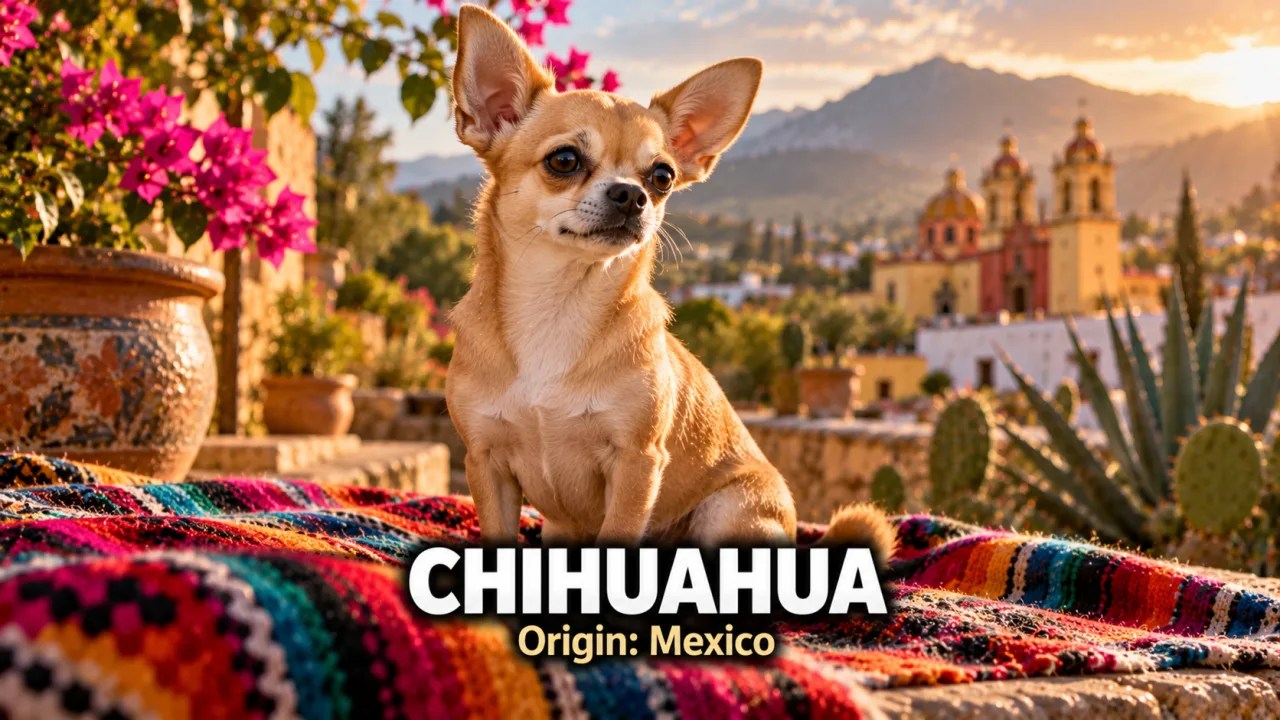
The Chihuahua, known in Spanish as the Chihuahueño, is a Mexican breed of toy dog and the smallest recognised dog breed in the world. It is kept mainly as a companion and is known for its compact body, large upright ears and rounded "apple" skull. The breed comes in a smooth-coated and a long-coated variety, and in almost any colour or pattern.[1][3]
The breed is named after Chihuahua, the largest state of Mexico. Genetic studies show that, unlike most modern breeds, which are mainly of European origin, it keeps a small share of the ancestry of the dogs that lived in the Americas before European contact.[1][3][9]
The Chihuahua is recognised by the Federation Cynologique Internationale (FCI) as standard No. 218 and by all major kennel clubs. In 2025 it ranked 24th among breeds registered with the American Kennel Club (AKC).[2][4]
This profile is part of Finepedia's Dog Breeds of the World guide, which covers every major dog family from ancient times to today.
Key Facts
| Attribute | Details |
|---|---|
| Other names | Chihuahueño |
| Origin | Mexico |
| Original purpose | Companion dog |
| FCI classification | Group 9 (Companion and Toy Dogs), Section 6 Chihuahueño, without working trial; standard No. 218 |
| FCI definitive acceptance | 4 December 1959 |
| AKC group | Toy Group |
| Weight (FCI) | 1 to 3 kg; ideal 1.5 to 2.5 kg |
| Weight (AKC) | Not exceeding 2.7 kg (6 lb) for showing |
| Height | Not set by standards; usually 15 to 23 cm (6 to 9 in) |
| Coat | Smooth (short and glossy) or long (fine and silky) |
| Colours | Any colour or combination except merle (FCI) |
| Median lifespan | 11.8 years (UK, 2024 study) |
| Temperament | Quick, alert, lively and very courageous (FCI standard) |
| Popularity | No. 24 in the US (AKC, 2025) |
History
Pre-Columbian dogs
DNA studies suggest that the first dogs reached the Americas from Siberia about 10,000 years ago and then lived in isolation from dogs elsewhere for about 9,000 years, until Europeans arrived. These pre-contact dogs carried a distinctive genetic signature that is now almost extinct.[1]
A 2020 study of ancient dog genomes, published in Science, found that this pre-colonial ancestry survives in two Mexican breeds. It makes up about 4 percent of the Chihuahua's ancestry and about 3 percent of the Xoloitzcuintli's. An earlier study from 2013 had suggested that the Chihuahua's pre-colonial ancestry might be as high as 70 percent, but the newer genome-based estimate is much lower.[1][9]
The Techichi
The FCI breed standard says the Chihuahua's ancestors may once have lived wild and been captured and domesticated by native peoples in the time of the Toltec civilisation. It records that images of a toy dog called the "Techichi", which lived in Tula, were used to decorate buildings in the town, and that these figures look very like the modern Chihuahua.[3]
Colonial records
In a letter written in 1520, Hernan Cortes reported that the Aztecs raised and sold little dogs as food. Colonial records from the early nineteenth century describe small, almost hairless dogs. One account says Spanish conquistadors in the sixteenth century found such dogs plentiful in the region later called Chihuahua.[1]
Recognition
The breed became fashionable in the state of Chihuahua in the late nineteenth century and takes its name from there.[7] The American Kennel Club registered its first Chihuahua in 1904. The dog was named Midget and belonged to H. Raynor of Texas.[1] The FCI accepted the breed definitively on 4 December 1959. Its standard is maintained in Spanish, the official language of the breed's country of origin, and the current version dates from 2019.[2][3]
In the United Kingdom, Kennel Club registrations rose gradually from 1955 to the mid-1970s, then slowly declined for about thirty years before climbing steeply from 2003 onward. The UK Kennel Club treats the smooth coat and long coat as separate varieties.[7]
Description
Size
Breed standards for the Chihuahua generally set a weight rather than a height. Most Chihuahuas stand between 15 and 23 cm (6 and 9 in) tall, although some grow to 30 to 38 cm (12 to 15 in).[1]
| Standard | Weight rule |
|---|---|
| FCI | 1 to 3 kg; ideal 1.5 to 2.5 kg; dogs under 1 kg or over 3 kg disqualified |
| American Kennel Club | Not exceeding 2.7 kg (6 lb) |
| The Kennel Club (UK) | 1.8 to 2.7 kg (4 to 6 lb) preferred |
Until 2009 the British standard said that "if two dogs are equally good in type, the more diminutive one is preferred". That clause was then removed.[1]
Pet Chihuahuas often weigh more than the show standard, sometimes over 4.5 kg (9.9 lb), especially if they have heavy bone or become overweight. That does not mean they are not purebred; it only means they would not meet the requirements for the show ring. A VetCompass study of 11,647 Chihuahuas under veterinary care in the UK in 2016 found a median adult weight of 3.4 kg, with individual dogs ranging from 0.8 to 9.8 kg.[1][7]
Chihuahuas do not breed true for size, and puppies from the same litter can grow up to very different sizes. Many breeders try to produce very small dogs, because those marketed as "teacup" or "tiny teacup" sell for higher prices. Larger breeding females, however, are less likely to have difficulty giving birth.[1]
Head
The head is the breed's defining feature. The FCI standard calls for a "well-rounded apple head" with a well-marked, deep stop, forming close to a 90-degree angle where the muzzle meets the skull. The muzzle is short and straight, broad at the base and tapering to the tip, and the nose may be any colour. The eyes are large, round and very expressive, ideally dark, though light eyes are allowed. The ears are large, upright and wide open, and at rest they tilt sideways at about 45 degrees.[1][3]
Many Chihuahuas have a molera, a soft spot on top of the skull similar to the fontanelle of a human baby. It can be hard to see but is easy to feel. The FCI standard lists an open fontanelle as a disqualifying fault.[1][3]
Dogs of the older "deer" type have a flatter head, wider-set eyes, larger ears and longer, slimmer legs. In AKC competition they may still be registered but are treated as departing from the standard, and the FCI standard disqualifies "deer type" dogs.[1][3]
Body and tail
The body is compact, a little longer than it is tall, though an almost square outline is preferred, especially in males. Bitches may be slightly longer in the body because of breeding. The back is short and firm, the chest broad and deep, and the belly clearly tucked up. The tail is set high and of moderate length. In motion it is carried high in a curve or a semicircle with the tip pointing towards the loin. It should never be carried between the hind legs.[3]
The feet are very small and oval, with toes well apart but not splayed. In movement the steps are long, springy and energetic.[3]
Coat and colours
The FCI standard describes two coat varieties:
- Smooth-haired: short, glossy and soft, lying close to the body. The coat may be a little longer on the neck and tail, and sparse hair on the throat and belly is allowed. Hairless dogs are not accepted.
- Long-haired: fine and silky, smooth or slightly wavy, with feathering on the ears, neck, legs, feet and tail, and ideally a neck ruff. A very long, billowing coat is not accepted.[3]
All colours and combinations are allowed except merle, a mottled pattern. In 2007 the UK Kennel Club also changed its standard to disqualify merle Chihuahuas, because of the health risks linked to the merle gene.[1][3]
Temperament
The FCI standard describes the Chihuahua as "quick, alert, lively and very courageous". Aggression and excessive shyness are both disqualifying faults in the show ring.[3]
Like many other small dogs, Chihuahuas can be more aggressive than average towards people and other dogs. The AKC does not recommend them for families with young children. They generally get along reasonably well with other dogs, though this varies with the other dog's breed.[1]
In the UK VetCompass study, aggression was the fifth most common disorder recorded, affecting 4.2 percent of Chihuahuas in a year, and males were more likely than females to be recorded as aggressive. The authors noted that the breed was going through a popularity boom. They warned that impulse purchases by people with little experience of dog care could lead to welfare problems.[7]
Health and lifespan
Lifespan
Lifespan estimates vary a great deal depending on the population studied:
| Study | Chihuahua | Comparison |
|---|---|---|
| UK, 2024 (Dogs Trust, 584,734 dogs) | 11.8 years median (10,788 dogs) | 12.7 purebreds; 12.0 crossbreeds |
| UK VetCompass, 2016 data | 8.2 years median age at death | Females 10.2 years; males 6.9 years |
| UK, 2022 veterinary records study | 7.91 years | 11.82 crossbreeds |
| Japan, 2018 pet cemetery data | 11.8 years | 15.1 crossbreeds; 13.7 overall |
| Italy, 2024 | 8.5 years | 10 years overall |
The VetCompass authors pointed out that their population was young and growing quickly, with a median age of only 2.8 years. That can pull down the measured age at death. The most common causes of death in that study were heart disease (18.8 percent), lower respiratory tract disorders (16.3 percent) and traumatic injury (13.8 percent).[5][6][7]
Common disorders
The VetCompass study found the following to be the most common specific disorders in UK Chihuahuas:[7]
| Disorder | Share of dogs affected in a year |
|---|---|
| Periodontal disease | 13.5% |
| Obesity | 5.9% |
| Retained deciduous (puppy) teeth | 5.7% |
| Anal sac impaction | 4.9% |
| Aggression | 4.2% |
The authors suggested that vets treating the breed would benefit from advanced training in anaesthesia and dentistry for very small dogs.[7]
Inherited conditions
The Chihuahua has a genetic predisposition to several neurological diseases. These include atlantoaxial instability, neuronal ceroid lipofuscinosis, congenital deafness, congenital hydrocephalus, muscular dystrophy, necrotising meningoencephalitis and neuroaxonal dystrophy. It also has a mild predisposition to congenital heart disease. A predisposition to medial patellar luxation, in which the kneecap slips out of place, is believed to be significant.[1]
Puppies and breeding
Toy-breed puppies such as Chihuahuas are prone to hypoglycaemia, low blood sugar, which is often brought on by getting too cold. Tiny dogs often have difficulty giving birth. A UK study found that dystocia, or obstructed labour, was 10.4 times more common in Chihuahua bitches than the average for all dogs.[1]
Care, grooming and exercise
Grooming
Smooth-coated Chihuahuas need little more than an occasional brush. Long-coated dogs need regular combing to keep the feathering on the ears, legs and tail free of tangles. Dental care is the most important routine task for the breed, given how common periodontal disease and retained puppy teeth are. Owners should brush the teeth regularly and have the mouth checked at each veterinary visit.[7]
Weight and exercise
Obesity was the second most common disorder in the VetCompass study. Because the breed is so small, even a few hundred grams of extra weight is a large share of body weight, so portion control matters. Chihuahuas are lively and enjoy short walks and play, but they tire more quickly than larger dogs.[7]
Safety
Traumatic injury was one of the three leading causes of death in UK Chihuahuas. Falls, being stepped on and encounters with larger dogs are real risks for such small animals. Puppies in particular need to be kept warm and fed regularly to avoid low blood sugar.[1][7]
Popularity
United States
The Chihuahua has long been one of the best-known toy breeds in the United States. It ranked 24th among AKC-registered breeds in 2025.[4]
United Kingdom
In the UK the Chihuahua was the 16th most commonly microchipped breed between 2004 and 2014. Its share of births among dogs seen by vets rose from 1.01 percent in 2005 to 5.35 percent in 2016, and the breed made up 3.46 percent of all dogs under veterinary care in the VetCompass study.[7]
Related breeds
The Chihuahua shares its remnant of pre-Columbian ancestry with the Xoloitzcuintli, the Mexican hairless dog.[1][8][9] Other very small breeds sometimes compared with it include the Russian Toy and the Prague Ratter.[1]
See also
- Dog Breeds of the World: Ancient to Modern Guide
- Xoloitzcuintli
- Russian Toy
- Prague Ratter
- Toy dog
- ^ [1] "Chihuahua (dog breed)". Wikipedia. https://en.wikipedia.org/wiki/Chihuahua_(dog)
- ^ [2] "Chihuahueño (218)". FCI Breeds Nomenclature, Federation Cynologique Internationale. https://www.fci.be/en/nomenclature/CHIHUAHUENO-218.html
- ^ [3] "FCI-Standard No. 218: Chihuahueño (Chihuahua)". Federation Cynologique Internationale, 2019. https://www.fci.be/Nomenclature/Standards/218g09-en.pdf
- ^ [4] "The Most Popular Dog Breeds of 2025". American Kennel Club. https://www.akc.org/expert-advice/dog-breeds/most-popular-dog-breeds-2025/
- ^ [5] McMillan K. M. et al. "Longevity of companion dog breeds: those at risk from early death". Scientific Reports, 2024. https://www.nature.com/articles/s41598-023-50458-w
- ^ [6] "Life expectancy of breeds table, 2024". Dogs Trust. https://www.dogstrust.org.uk/downloads/life-expectancy-breeds-table-2024.pdf
- ^ [7] O'Neill D. G. et al. "Demography and commonly recorded clinical conditions of Chihuahuas under primary veterinary care in the UK in 2016". BMC Veterinary Research, 2020. https://pmc.ncbi.nlm.nih.gov/articles/PMC7014602/
- ^ [8] "Xoloitzcuintli". Wikipedia. https://en.wikipedia.org/wiki/Xoloitzcuintle
- ^ [9] Bergstrom A. et al. "Origins and genetic legacy of prehistoric dogs". Science, 2020. https://doi.org/10.1126/science.aba9572





























Discussion
Log in with