











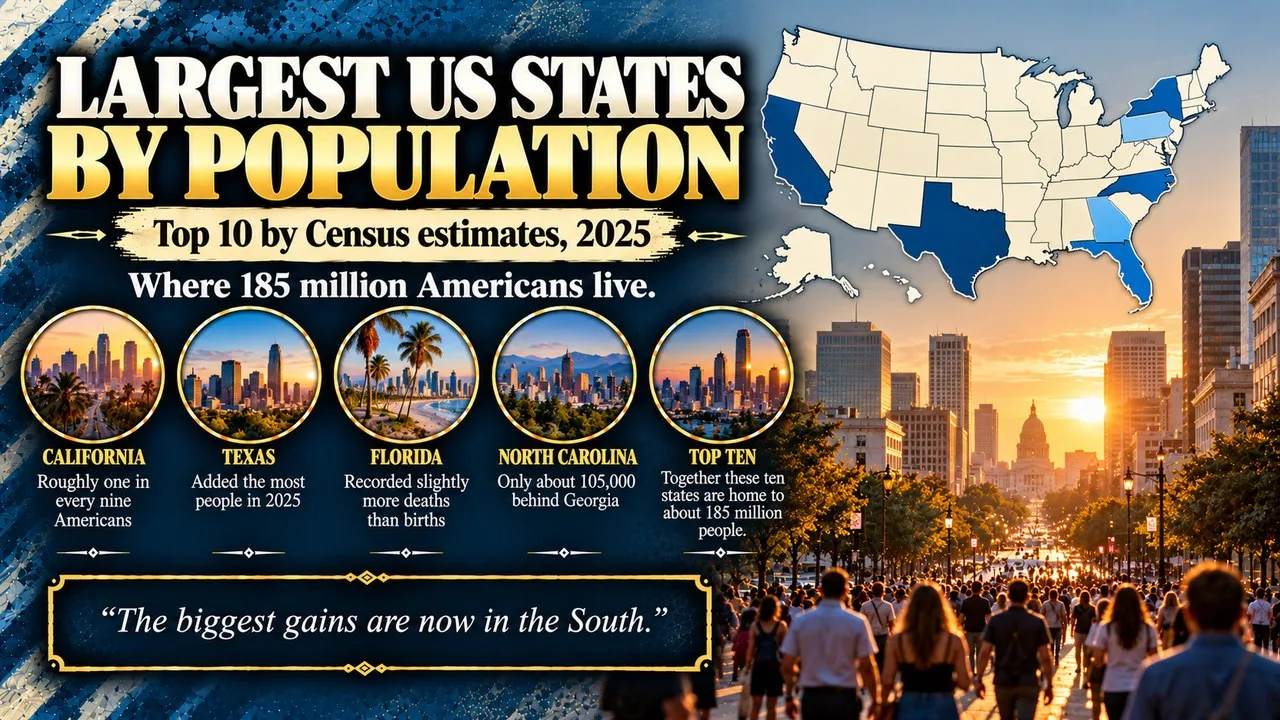
California remains the largest US state by population, with about 39.4 million people in 2025, followed by Texas, Florida, New York and Pennsylvania.
This Finepedia guide, written in October 2026, ranks the ten US states with the most residents, using the US Census Bureau's estimates for 1 July 2025, released in early 2026. Together these ten states are home to about 185 million people, or 54% of the country's 341.8 million. For more on the shape and history of the states, see the Finepedia guides Largest US States by Area: Top 10 and Newest US States in Order of Statehood: Top 10.
How We Chose These
We ranked the 50 states by their estimated resident population on 1 July 2025, from the Census Bureau's Vintage 2025 state totals. These yearly estimates build on the 2020 census by adding births and people moving in, and taking away deaths and people moving out. We rounded figures to the nearest thousand in the text and checked them against the bureau's QuickFacts pages and Wikipedia. House seat numbers come from the apportionment based on the 2020 census, which applies until the 2030 count. Estimates can be revised a little each year as new data arrive, so small gaps between neighbouring states, such as Georgia and North Carolina, may change.
The 10 Largest US States by Population at a Glance
| Rank | State | Population (July 2025) | Share of US | Change since 2020 |
|---|---|---|---|---|
| 1 | California | 39,355,309 | 11.5% | down 0.5% |
| 2 | Texas | 31,709,821 | 9.3% | up 8.8% |
| 3 | Florida | 23,462,518 | 6.9% | up 8.9% |
| 4 | New York | 20,002,427 | 5.9% | down 1.0% |
| 5 | Pennsylvania | 13,059,432 | 3.8% | up 0.4% |
| 6 | Illinois | 12,719,141 | 3.7% | down 0.8% |
| 7 | Ohio | 11,900,510 | 3.5% | up 0.9% |
| 8 | Georgia | 11,302,748 | 3.3% | up 5.5% |
| 9 | North Carolina | 11,197,968 | 3.3% | up 7.2% |
| 10 | Michigan | 10,127,884 | 3.0% | up 0.5% |
1. California Has More People Than Many Countries
California had about 39.36 million residents in July 2025, roughly one in every nine Americans. Its population barely changed during the year, slipping by about 9,500 people, as more residents moved to other states than arrived from them. Even so, it is far ahead of every other state, with about 7.6 million more people than Texas. Arrivals from abroad and births still added people, but not enough to offset those leaving for other states.
Key Facts
- Population (2025): 39,355,309
- Capital: Sacramento
- Largest city: Los Angeles
- House seats: 52, the most of any state
Did You Know?
Add up the 21 smallest states by population and California still has more residents than all of them. After the 2020 census it lost a seat in the House of Representatives for the first time in its history, falling from 53 to 52.
2. Texas Added the Most People in 2025
Texas had about 31.71 million residents in 2025, after growing by around 391,000 people in a single year, more than any other state. Since the 2020 census it has added about 2.56 million residents. Its growth comes from a mix of births, people moving from other states and arrivals from abroad. In 2025 alone, births outnumbered deaths by about 158,000, the largest natural increase of any state.
Key Facts
- Population (2025): 31,709,821
- Capital: Austin
- Largest city: Houston
- House seats: 38, after gaining two following the 2020 census
Why It Matters
Texas moved ahead of New York into second place in the mid-1990s and has pulled further ahead ever since. Several of the fastest-growing big cities in the country, including Austin, Fort Worth and San Antonio, are in Texas.
3. Florida Grows Through Migration
Florida had about 23.46 million residents in 2025, up by roughly 197,000 on the year before. In 2025 the state recorded slightly more deaths than births, so almost all of its growth came from people moving in from other states and other countries. It has grown by about 8.9% since 2020, the fastest rate in the top ten.
Key Facts
- Population (2025): 23,462,518
- Capital: Tallahassee
- Largest city: Jacksonville
- House seats: 28, after gaining one following the 2020 census
Did You Know?
Florida moved past New York into third place in 2014, according to Census Bureau estimates published that year. Its warm climate has long drawn retirees, which partly explains why deaths now slightly outnumber births.
4. New York Holds Steady at About 20 Million
New York had just over 20 million residents in 2025, almost unchanged from 2024. The state has about 201,000 fewer people than at the 2020 census, as departures to other states have outweighed new arrivals from abroad. More than 8 million of its residents live in New York City, the country's largest city by far.
Key Facts
- Population (2025): 20,002,427
- Capital: Albany
- Largest city: New York City
- House seats: 26
Why It Matters
For most of American history, New York had more people than any other state, until California overtook it in the early 1960s. Its biggest city remains the country's leading centre of finance, media and culture.
5. Pennsylvania Is the Largest State in the Northeast After New York
Pennsylvania had about 13.06 million residents in 2025, a small rise on both 2024 and 2020. Its population is spread between two big metropolitan areas, Philadelphia in the east and Pittsburgh in the west, with many smaller cities and farming counties in between.
Key Facts
- Population (2025): 13,059,432
- Capital: Harrisburg
- Largest city: Philadelphia
- House seats: 17
Did You Know?
Pennsylvania was one of the original 13 states, and both the 1776 declaration of independence and the US Constitution were signed in Philadelphia. In 2025 the state had more deaths than births, so its small gain came from people moving in.
6. Illinois Is Anchored by Chicago
Illinois had about 12.72 million residents in 2025, up slightly on the year but about 103,000 below its 2020 census count. Most of its people live in and around Chicago, the third largest city in the United States. The rest of the state is largely farmland, with smaller cities such as Rockford, Peoria and Springfield.
Key Facts
- Population (2025): 12,719,141
- Capital: Springfield
- Largest city: Chicago
- House seats: 17
Why It Matters
Arrivals from abroad have helped Illinois grow again in recent years, after a long run of people leaving for other states. Pennsylvania and Illinois are separated by only about 340,000 people.
7. Ohio Has Three Big Cities
Ohio had about 11.90 million residents in 2025, up by roughly 40,000 on the year. Unlike most states, it has three large metropolitan areas of similar weight, around Columbus, Cleveland and Cincinnati, rather than one dominant city.
Key Facts
- Population (2025): 11,900,510
- Capital: Columbus
- Largest city: Columbus
- House seats: 15
Did You Know?
Columbus has grown into the largest city in Ohio, overtaking Cleveland, which held that title for much of the 20th century. After a small dip in 2021, Ohio's population has risen every year since 2022.
8. Georgia Keeps Climbing
Georgia had about 11.30 million residents in 2025, around 589,000 more than at the 2020 census. Much of that growth has been in the Atlanta metropolitan area, which is now home to more than half of the state's people.
Key Facts
- Population (2025): 11,302,748
- Capital: Atlanta
- Largest city: Atlanta
- House seats: 14
Why It Matters
Georgia's growth has made the Atlanta area a major centre for transport, film and business. Hartsfield–Jackson Atlanta International handled more passengers in 2025 than any other airport on Earth.
9. North Carolina Is Closing In on Georgia
North Carolina had about 11.20 million residents in 2025, only about 105,000 behind Georgia. It added around 146,000 people during the year and about 757,000 since 2020, mostly people moving in from other states.
Key Facts
- Population (2025): 11,197,968
- Capital: Raleigh
- Largest city: Charlotte
- House seats: 14, after gaining one following the 2020 census
Did You Know?
Growth since 2020 has been 7.2%, the third fastest in the top ten after Florida and Texas. If the current trend continues, North Carolina could pass Georgia within a few years.
10. Michigan Completes the Top Ten
Michigan had about 10.13 million residents in 2025, a small rise on both 2024 and 2020. It is the only state made up of two large peninsulas, and its shores touch Lakes Superior, Michigan, Huron and Erie. Detroit is its biggest city, while Grand Rapids is the second.
Key Facts
- Population (2025): 10,127,884
- Capital: Lansing
- Largest city: Detroit
- House seats: 13
Why It Matters
Michigan is the smallest of the ten states that have more than 10 million people. Next in line is New Jersey, with about 9.55 million residents in 2025, followed by Virginia with 8.88 million and Washington, which passed 8 million for the first time in the 2025 estimates.
Frequently Asked Questions
Which state has the fewest people?
Wyoming has the smallest population of any state, with about 589,000 residents in 2025, followed by Vermont with about 645,000. California has roughly 67 times as many people as Wyoming.
How often are state populations counted?
A full census takes place every ten years, most recently in April 2020, with the next one due in 2030. Between censuses, the Census Bureau publishes new estimates for every state each year, usually in December or January.
Conclusion
The largest US states by population stretch from California and Texas in the West and South to New York, Pennsylvania and the Great Lakes states. The biggest gains are now in the South, where Texas, Florida, Georgia and North Carolina keep adding residents, while California, New York and Illinois are roughly flat. For more on the states, read the Finepedia guides Largest US States by Area: Top 10 and Newest US States in Order of Statehood: Top 10.
- US Census Bureau, State Population Totals and Components of Change: 2020-2025 (Vintage 2025), released 2026.
- US Census Bureau, U.S. Population Growth Slows Due to Historic Decline in Net International Migration, press release, 2026.
- US Census Bureau, QuickFacts for each of the ten states (accessed October 2026).
- US Census Bureau, 2020 Census Apportionment Results, April 2021.
- Wikipedia (accessed October 2026): List of U.S. states and territories by population, and articles on each of the ten states.
- 10 Most Today, 10 Largest States By Population, 10mosttoday.com (topic reference).



































Discussion
Log in with