





Top 10 Ancient Materials Scientists Are Still Studying
 By Dhiraj Sharma · Published
Share Post
Loading…
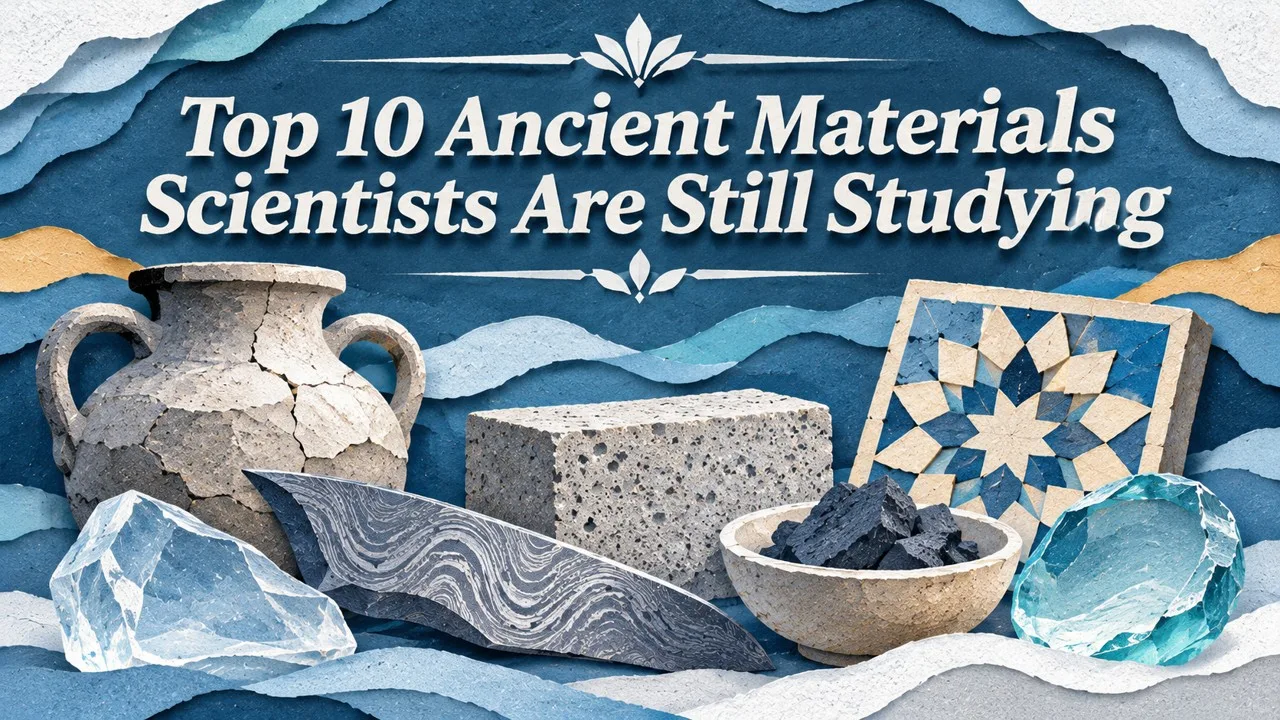
Ancient makers created materials that still puzzle scientists, from self-healing Roman concrete and Damascus steel to color-changing glass and rust-proof iron. It is tempting to assume that modern science has left ancient technology far behind. In many ways it has. Yet some materials made thousands of years ago still surprise researchers with properties that are hard to explain or reproduce, and studying them has led to new ideas for modern engineering.
Ancient craftspeople worked without chemistry textbooks or microscopes. They developed their methods through trial and error, passing knowledge from master to apprentice. Many recipes were closely guarded secrets, and some were lost entirely when the workshops that used them disappeared.
The ten materials below are Roman concrete, Damascus steel, Greek fire, Maya blue, Egyptian blue, the glass of the Lycurgus Cup, the iron of the Delhi pillar, Chinese sticky rice mortar, Han purple and the steel of Viking Ulfberht swords. They come from Europe, the Middle East, South Asia, China and the Americas.
Scientists now study these materials with tools such as electron microscopes, X-ray analysis and chemical modeling. Their findings are sometimes debated, and some claims made in popular reports go further than the evidence supports. Where research is ongoing or disputed, that is noted.
These materials show that ancient people were capable of remarkable innovation. They also show that the past can still teach modern scientists, offering clues for more durable buildings, new pigments and better ways to protect metal from corrosion.
Studying old materials is also a way of understanding the people who made them, including their trade networks, their workshops and the problems they were trying to solve.
Key Facts
| # | Material | Where and when | What scientists are learning |
|---|---|---|---|
| 1 | Roman concrete | Ancient Rome, about 2,000 years ago | Volcanic ash and lime chunks help it survive and repair cracks |
| 2 | Damascus steel | The Middle East, made from Indian and Sri Lankan steel | Microscopic structures may explain its strength |
| 3 | Greek fire | The Byzantine Empire, from the seventh century | Its exact recipe remains unknown |
| 4 | Maya blue | Mesoamerica, from the first millennium | Organic dye locked in clay resists weathering |
| 5 | Egyptian blue | Ancient Egypt, from around 3000 BC | Glows under infrared light |
| 6 | Lycurgus Cup | The Roman Empire, fourth century | Metal nanoparticles create color effects |
| 7 | Iron pillar of Delhi | India, about the fifth century | A thin protective layer slows corrosion |
| 8 | Sticky rice mortar | China, from more than a thousand years ago | Rice starch strengthens lime mortar |
| 9 | Han purple | China, Warring States and Han dynasty | Shows unusual magnetic behavior when cold |
| 10 | Ulfberht swords | Northern Europe, ninth to eleventh centuries | Some were made from high-quality crucible steel |
1. Concrete That Heals Itself
Roman builders made concrete from lime, volcanic ash and rock. Many Roman structures, including the Pantheon in Rome with its vast unreinforced concrete dome, still stand after about two thousand years, while some modern concrete deteriorates within decades [1].
Research has revealed several secrets. Studies of Roman harbor structures found that seawater reacting with the volcanic ash produced rare minerals that strengthened the concrete over time. In 2023, a team at the Massachusetts Institute of Technology reported that small white chunks of lime, once thought to be signs of poor mixing, may allow the concrete to heal its own cracks when water seeps in [1].
These findings have inspired efforts to develop more durable and environmentally friendly modern concrete. Researchers are testing mixtures that copy Roman methods.
2. Blades With Watery Patterns
Damascus steel was famous for blades with flowing, watery patterns and a reputation for toughness and sharpness. The blades were made in the Middle East from a type of steel called wootz, produced in India and Sri Lanka in small crucibles [2].
Related: Top 10 'Ancient Alien' Artifacts with Ordinary Explanations
The technique was lost, probably by the eighteenth century, perhaps because the specific ore sources ran out. In 2006, researchers reported finding carbon nanotubes and nanowires in a seventeenth-century Damascus sabre, a claim that attracted wide attention, though the full significance remains debated [2].
Other researchers have reproduced blades with similar patterns by using steel containing small amounts of elements such as vanadium. The story of Damascus steel continues to fascinate metallurgists and sword makers.
3. Fire That Burned on Water
Greek fire was a weapon used by the Byzantine Empire, which could be sprayed from tubes onto enemy ships and kept burning even on water. According to Byzantine sources, it was introduced around 672 by an architect named Kallinikos, who had fled from Syria [3].
The weapon helped Constantinople survive sieges by Arab fleets in the seventh and eighth centuries. Its recipe was a closely guarded state secret, known only to a few people, and it was eventually lost [3].
Historians and chemists believe it was probably based on petroleum, possibly mixed with resins and other substances. Experiments have tried to recreate it, but no one knows exactly how it was made or how the Byzantines sprayed it so effectively.
4. A Blue That Survives Centuries
Maya blue is a bright blue pigment used by the Maya and other Mesoamerican peoples on murals, pottery and sculptures. It has survived for centuries in hot, humid conditions that destroy most organic dyes [4].
Researchers found that Maya blue is made by combining indigo, a plant dye, with a clay mineral called palygorskite and heating the mixture. The indigo molecules become locked into the clay's structure, making the pigment remarkably resistant to acid, weathering and fading [4].
Some researchers have suggested that Maya blue was made as part of religious ceremonies, perhaps in rituals at the sacred well of Chichen Itza. Its stability has inspired research into new durable pigments that combine organic and mineral components.
5. The First Synthetic Pigment
Egyptian blue is considered the oldest known synthetic pigment. Ancient Egyptians made it by heating sand, copper, lime and an alkali, producing a calcium copper silicate. It was used in Egypt and later across the Mediterranean world [5].
Related: Top 10 Things That Existed While Woolly Mammoths Were Still Alive
In the twenty-first century, scientists discovered that Egyptian blue emits strong infrared light when exposed to visible light. This allows researchers to detect tiny traces of the pigment on ancient statues and paintings that look bare to the eye, revealing their original colors [5].
Scientists have also found that Egyptian blue can be split into ultra-thin sheets, which could be used in biomedical imaging, security inks and other technologies. An ancient pigment may help shape new inventions.
6. A Cup That Changes Color
The Lycurgus Cup is a Roman glass cup carved with a scene from Greek myth, now in the British Museum. In ordinary light, it appears jade green. When light shines through it from behind, it glows red [6].
Scientists discovered that the effect comes from tiny particles of gold and silver dispersed in the glass, far too small to see. The particles interact with light in ways that depend on the direction of the light, producing the color change [6].
The cup is often described as an early example of nanotechnology, though the Roman makers would not have understood the science. Researchers have used similar principles to develop sensitive sensors that can detect chemicals and disease markers.
7. Iron That Resists Rust
The iron pillar in Delhi stands about seven meters tall and is believed to date to the Gupta period, around the fifth century. Despite standing outdoors for more than 1,500 years, it shows remarkably little rust [7].
Researchers, including a team at the Indian Institute of Technology Kanpur, found that the iron contains relatively high amounts of phosphorus. Combined with the local climate and the way the iron was made, this helped form a thin protective layer on the surface that slows corrosion [7].
Related: Top 10 Ancient Peoples Whose Influence Is Still Visible
The pillar has become a symbol of ancient Indian metallurgy. Its study has contributed to research on corrosion-resistant materials.
8. Mortar Made With Rice
Builders in China used a mortar made by mixing lime with soup made from sticky rice. It was used in city walls, tombs, pagodas and sections of the Great Wall, and many of these structures have lasted for centuries [8].
In 2010, researchers reported that a starch in sticky rice called amylopectin acts as an inhibitor, controlling the growth of calcium carbonate crystals in the lime. The result is a compact, strong and water-resistant mortar [8].
The finding has practical uses. Sticky rice mortar has been used to restore historic buildings in China, because it is compatible with the original materials and more durable than some modern alternatives.
9. A Pigment With Quantum Properties
Han purple is a synthetic pigment made in ancient China, a barium copper silicate. It was used to decorate objects, including some figures of the Terracotta Army, and was produced for several centuries [9].
In 2006, physicists studying Han purple discovered that, at very low temperatures and in strong magnetic fields, it displays an unusual quantum behavior in which magnetic interactions effectively behave as if confined to two dimensions instead of three [9].
The ancient pigment became an unlikely subject of quantum physics research. Its discovery shows how materials made for art can reveal fundamental scientific phenomena.
10. Viking Swords of Unusual Quality
More than a hundred Viking Age swords have been found bearing the inscription Ulfberht. Some are made of unusually pure, high-carbon steel, far superior to most European metal of the time [10].
Related: Top 10 Remarkable Weapons and Armor From History
Researchers have suggested that this steel may have been imported from Central Asia or the Middle East, possibly through trade routes along the Volga River. Other Ulfberht swords are made of lower-quality iron, suggesting that the name may have been copied, like a counterfeit brand [10].
How the best swords were made and where their steel came from are still debated. A modern blacksmith reproduced an Ulfberht-style sword for a documentary, showing the skill required.
Conclusion
These materials show that ancient people were capable of sophisticated technology. They developed recipes and techniques that modern scientists are still trying to understand.
They also show the value of studying the past. Research on ancient materials has inspired new kinds of concrete, pigments, sensors and corrosion protection. The past is not just a subject for historians; it can also be a source of innovation.
Many secrets remain. The full recipe for Greek fire and the exact methods for making Damascus steel are still unknown. Future research may yet reveal them.
As analytical tools improve, scientists expect to learn even more from objects already sitting in museum collections, many of which have never been examined in detail.
Collaboration between archaeologists, chemists, physicists and engineers has been key to these discoveries, and many of the most interesting results have come from researchers willing to look at old objects with new questions.
The ancient world, it seems, still has lessons to teach.
- ^ [1] Accounts of Roman concrete. Wikipedia: Roman concrete Wikipedia: pozzolan
- ^ [2] Accounts of Damascus steel. Wikipedia: Damascus steel Wikipedia: crucible steel
- ^ [3] Accounts of Greek fire. Wikipedia: Greek fire Wikipedia: Byzantine navy
- ^ [4] Accounts of Maya blue. Wikipedia: Maya blue Wikipedia: palygorskite
- ^ [5] Accounts of Egyptian blue. Wikipedia: Egyptian blue Wikipedia: pigment
- ^ [6] Accounts of the Lycurgus Cup. Wikipedia: Lycurgus Cup Wikipedia: surface plasmon resonance
- ^ [7] Accounts of the Delhi iron pillar. Wikipedia: Iron pillar of Delhi Wikipedia: corrosion
- ^ [8] Accounts of sticky rice mortar. Wikipedia: sticky rice mortar Wikipedia: amylopectin
- ^ [9] Accounts of Han purple. Wikipedia: Han purple and Han blue Wikipedia: Terracotta Army
- ^ [10] Accounts of Ulfberht swords. Wikipedia: Ulfberht swords Wikipedia: Volga trade route






















Discussion
Log in with