




 By
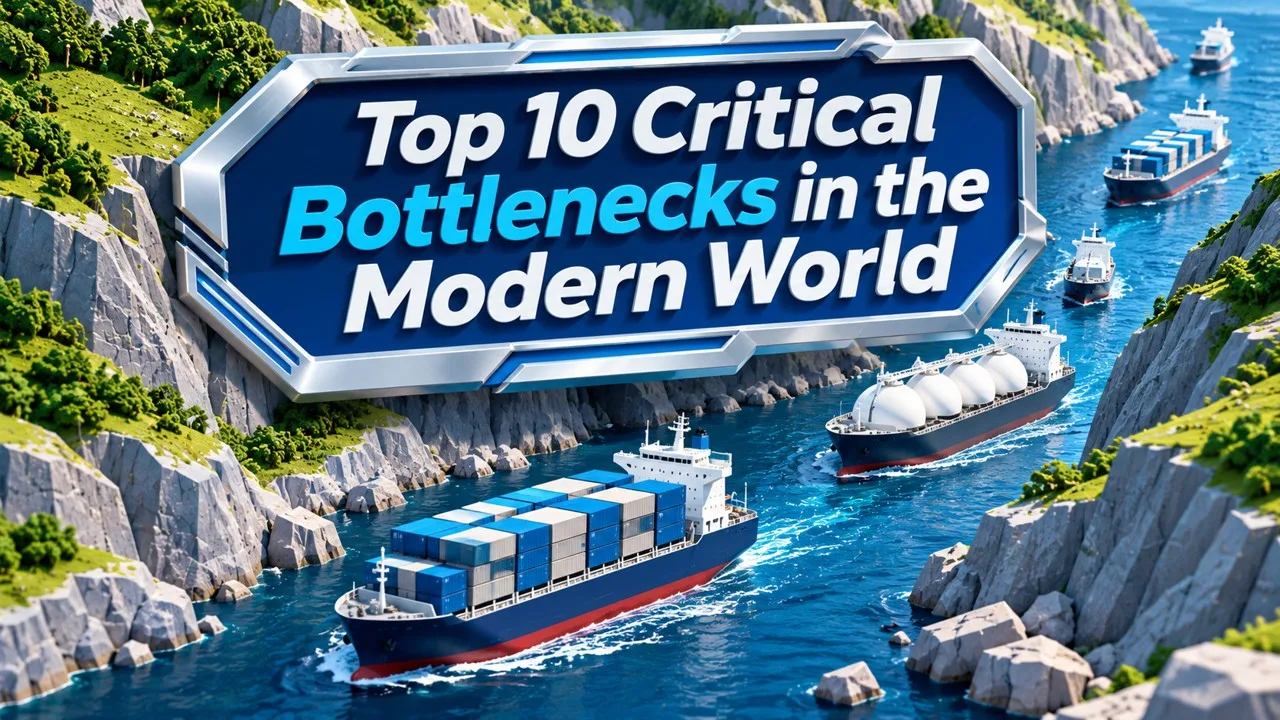
The modern economy relies on a few fragile chokepoints, from narrow straits and a dry canal to one chip maker, one machine supplier and one quartz town. The global economy can seem vast and resilient, with goods flowing between continents and countless companies competing in every market. But beneath that surface lie a number of critical bottlenecks: places, companies or resources on which much of the world depends, and for which there are few or no alternatives.
Some bottlenecks are geographic, such as narrow sea passages through which a large share of oil and trade must pass. Others are technological, such as a single company that makes a machine nobody else can build. Still others are natural resources concentrated in only a few places on Earth.
The ten bottlenecks below are the Strait of Hormuz, the Strait of Malacca, the Panama Canal, the world's most advanced chip factories, the machines used to make those chips, a quartz mining town in North Carolina, undersea internet cables, rare earth processing, cobalt mining and the global supply of helium.
The figures given here come from government agencies, industry reports and news coverage, and they change from year to year. They are approximate and meant to show the scale of dependence rather than exact shares.
Recent events, from the pandemic to droughts, hurricanes and conflicts, have made governments and businesses more aware of these weak points. Many are now investing in alternatives, but building new sources and routes takes years and often costs billions.
Understanding these bottlenecks helps explain why seemingly distant events, such as a storm in the Appalachian Mountains or a drought in Central America, can affect prices and products around the world.
Key Facts
| # | Bottleneck | Why it matters | Main risk |
|---|---|---|---|
| 1 | Strait of Hormuz | A large share of the world's oil passes through it | Conflict or blockade |
| 2 | Strait of Malacca | One of the busiest shipping lanes on Earth | Congestion, accidents or conflict |
| 3 | Panama Canal | A key link between the Atlantic and Pacific | Drought |
| 4 | Advanced chip manufacturing | Most of the world's most advanced chips come from Taiwan | Natural disasters or geopolitical tension |
| 5 | EUV lithography | One company makes the machines needed for the most advanced chips | Supply constraints and export controls |
| 6 | Spruce Pine quartz | A key source of ultra-pure quartz | Floods and storms |
| 7 | Undersea internet cables | Carry the vast majority of international data | Accidental damage or sabotage |
| 8 | Rare earth elements | Used in magnets for motors, wind turbines and electronics | Concentrated processing |
| 9 | Cobalt | A key ingredient in many lithium-ion batteries | Concentration and labor concerns |
| 10 | Helium | Used for MRI scanners, chip making and science | Few producing countries |
1. The World's Oil Chokepoint
The Strait of Hormuz connects the Persian Gulf with the Gulf of Oman and the Arabian Sea. At its narrowest, it is only about thirty-three kilometers wide, and the shipping lanes are much narrower [1].
According to the United States Energy Information Administration, roughly one fifth of the world's oil consumption passes through the strait each year, mainly from Saudi Arabia, Iraq, the United Arab Emirates, Kuwait and Iran. Large amounts of liquefied natural gas from Qatar also pass through it [1].
Because there are few alternative routes, any disruption, such as conflict or attacks on ships, can push up oil prices worldwide. Some Gulf countries have built pipelines to bypass the strait, but they can carry only part of the oil that normally flows through it.
2. The Gateway Between Oceans
The Strait of Malacca runs between the Malay Peninsula and the Indonesian island of Sumatra, linking the Indian Ocean with the Pacific. It is one of the busiest shipping lanes in the world, carrying a huge share of trade between Asia, the Middle East and Europe [2].
Related: History of Human Civilization: From Ancient Times to the Modern Age
At its narrowest point, near Singapore, the channel is less than three kilometers wide. Tens of thousands of ships pass through each year, including many oil tankers bound for China, Japan and South Korea [2].
Chinese leaders have described the country's dependence on the strait as the Malacca dilemma, because a blockade could cut off much of China's oil imports. Alternative routes through other Indonesian straits exist but add time and cost.
3. A Canal That Runs on Rain
The Panama Canal allows ships to cross between the Atlantic and Pacific Oceans without sailing around South America. It handles a significant share of world seaborne trade, especially between Asia and the east coast of the United States [3].
The canal's locks use fresh water from Gatun Lake. Each ship passing through uses tens of millions of liters of water. In 2023, a severe drought lowered the lake, forcing authorities to reduce the number of ships allowed through each day and limit how heavily they could be loaded [3].
Shipping companies faced long delays and higher costs, and some rerouted around other routes. The drought highlighted how climate and weather can affect even the most important global infrastructure.
4. The Factories Behind Advanced Chips
The most advanced computer chips, used in smartphones, data centers and artificial intelligence systems, are produced by a small number of companies. The leading manufacturer is the Taiwan Semiconductor Manufacturing Company, known as TSMC [4].
Industry estimates suggest that the large majority of the world's most advanced chips are made in Taiwan. Companies such as Apple and Nvidia rely on TSMC to manufacture the chips they design [4].
This concentration has raised concern among governments, because an earthquake, conflict or other disruption in Taiwan could affect industries around the world. The United States, Japan and Europe have offered large subsidies to build more chip factories on their own territory, including some run by TSMC.
Related: Mark Zuckerberg: The Rise of a Social Media Pioneer
5. The Only Maker of a Crucial Machine
Making the most advanced chips requires machines that use extreme ultraviolet light to print incredibly fine patterns on silicon. Only one company in the world makes these extreme ultraviolet lithography machines: ASML, based in the Netherlands [5].
Each machine is enormous, contains many thousands of parts from suppliers around the world and costs well over a hundred million dollars. The newest versions are even more expensive. Building one requires precision engineering that no other company has managed to replicate [5].
Because ASML is the only supplier, its machines have become a focus of international politics. Governments have restricted exports of the most advanced machines to certain countries, showing how a single company can be a strategic bottleneck.
6. A Small Town Behind Silicon Chips
Spruce Pine is a small town in the Blue Ridge Mountains of North Carolina. Mines in the area produce some of the purest natural quartz in the world, which is used to make crucibles needed to produce the silicon for chips and solar panels [6].
According to industry reports, Spruce Pine supplies a large share of the world's high-purity quartz for this use. There are few other known deposits of comparable quality, which makes the town an important part of the global semiconductor supply chain [6].
In September 2024, Hurricane Helene caused severe flooding in the region, temporarily shutting the mines. The disaster drew attention to how much the high-tech economy can depend on one small community.
7. The Cables Under the Sea
Most people imagine that the internet travels through satellites, but the vast majority of international data actually travels through undersea fiber optic cables. Hundreds of cables run along the ocean floor, connecting continents [7].
The cables are only about as thick as a garden hose in deep water. They can be damaged by ship anchors, fishing trawlers, earthquakes and underwater landslides. In 2022, a volcanic eruption cut Tonga's only international cable, leaving the country largely cut off from the internet for weeks [7].
Related: Top 10 Countries with the Most Natural Resources
Governments increasingly see cables as critical infrastructure. Concern has grown about deliberate sabotage, and several countries have increased monitoring of ships near important cable routes.
8. Processing Rare Earths
Rare earth elements are a group of seventeen metals used in powerful magnets, electronics, wind turbines, electric vehicles and military equipment. Despite their name, many are not especially rare in the Earth's crust, but they are difficult and polluting to process [8].
China dominates the industry. According to the International Energy Agency, it accounts for a large share of global rare earth mining and an even larger share of processing. Other countries have reduced their own processing capacity over the decades because of costs and environmental concerns [8].
China has at times restricted exports of rare earths and related technologies. Other countries are now investing in new mines and processing plants, but building them takes many years.
9. A Metal for Batteries
Cobalt is used in many lithium-ion batteries, including those in electric vehicles, phones and laptops. It helps batteries store energy and remain stable [9].
The Democratic Republic of the Congo produces about seventy percent of the world's mined cobalt. Much of it is mined in large industrial operations, but some comes from small-scale mining, where reports have documented dangerous conditions and child labor [9].
Concerns about supply and ethics have pushed battery makers to develop batteries that use less cobalt or none at all. Lithium iron phosphate batteries, which do not use cobalt, have become increasingly common.
Related: Top 10 Largest Oil Producing Countries
10. A Gas That Cannot Be Replaced
Helium is the second lightest element, and it has unique properties. It stays liquid at extremely low temperatures, making it essential for cooling the superconducting magnets in MRI scanners. It is also used in chip manufacturing, welding and scientific research [10].
Most helium is extracted from natural gas, and only a few countries produce significant quantities, including the United States, Qatar, Algeria and Russia. Disruptions at a few plants can cause global shortages, which have occurred several times since the mid-2000s [10].
Helium that escapes into the atmosphere eventually leaks into space, so it cannot be easily recovered. Hospitals and research labs have invested in recycling systems to conserve this irreplaceable resource.
Conclusion
These bottlenecks show how fragile the modern economy can be. Much of the world depends on a few narrow passages, a handful of companies and a small number of mines and plants.
They also show how events in distant places can affect everyday life. A drought in Panama, a storm in North Carolina or tension in the Persian Gulf can raise prices and disrupt supplies around the world.
Governments and businesses are trying to reduce these risks by building new factories, finding new sources and developing alternatives. But many bottlenecks cannot be removed quickly, and some may never be removed entirely.
For ordinary people, the lesson is that the products we take for granted, from fuel to phones, rely on long and complex chains. Every link in those chains matters, and the weakest ones deserve the closest attention.
- ^ [1] Accounts of the Strait of Hormuz. Wikipedia: Strait of Hormuz Wikipedia: Energy Information Administration
- ^ [2] Accounts of the Strait of Malacca. Wikipedia: Strait of Malacca Wikipedia: Malacca dilemma
- ^ [3] Accounts of the Panama Canal. Wikipedia: Panama Canal Wikipedia: Gatun Lake
- ^ [4] Accounts of advanced chip manufacturing. Wikipedia: TSMC Wikipedia: semiconductor industry
- ^ [5] Accounts of EUV lithography. Wikipedia: ASML Holding Wikipedia: extreme ultraviolet lithography
- ^ [6] Accounts of Spruce Pine quartz. Wikipedia: Spruce Pine, North Carolina Wikipedia: Hurricane Helene
- ^ [7] Accounts of undersea cables. Wikipedia: submarine communications cable Wikipedia: 2022 Hunga Tonga eruption
- ^ [8] Accounts of rare earth elements. Wikipedia: rare-earth element Wikipedia: International Energy Agency
- ^ [9] Accounts of cobalt mining. Wikipedia: cobalt Wikipedia: mining in the DR Congo
- ^ [10] Accounts of helium supply. Wikipedia: helium Wikipedia: magnetic resonance imaging





















Discussion
Log in with