




 By
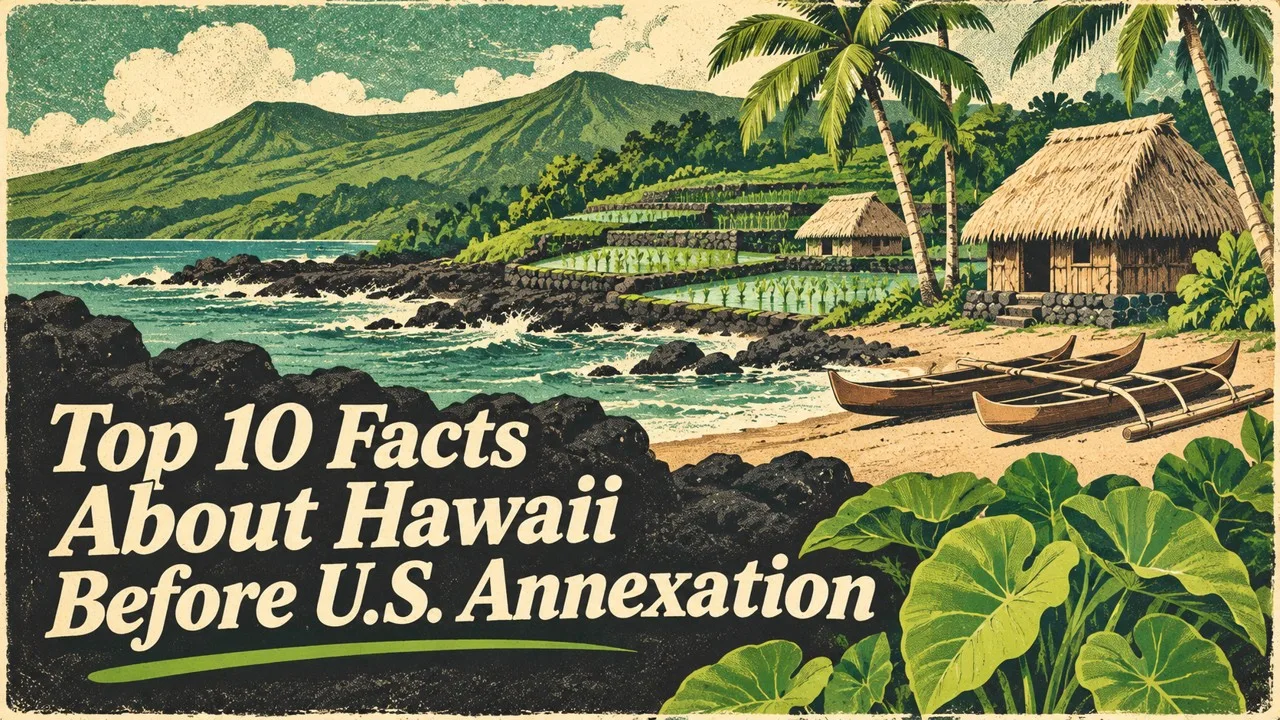
Before 1898, Hawaii was an independent kingdom with treaties, a constitution, high literacy and a palace lit by electricity before the White House. Today, Hawaii is known as the fiftieth state of the United States, famous for its beaches, volcanoes and surfing. But for most of its history, the islands were home to an independent society, and for most of the nineteenth century they formed an internationally recognized kingdom.
The Hawaiian Kingdom had its own monarchs, laws, constitution and diplomats. It signed treaties with major powers, sent representatives abroad and built modern institutions, including schools, newspapers and a royal palace equipped with the latest technology.
Its story is also one of great challenges. Contact with outsiders brought new diseases that devastated the population, and foreign businessmen gained growing economic and political power. In 1893, the monarchy was overthrown, and in 1898 the islands were annexed by the United States.
The overthrow remains a sensitive subject. In 1993, the United States Congress passed a resolution apologizing for the role of American officials and citizens in the events of 1893.
The ten facts below cover the islands from their settlement by Polynesian voyagers to the end of the kingdom. They show a society that was far more complex and modern than many people realize.
They also help explain why questions about Hawaiian history, land and sovereignty are still discussed today, and why many Native Hawaiians take pride in the achievements of their kingdom.
Understanding this history adds depth to any visit to the islands. Many of the places that tourists see, from palaces to fishponds and sacred sites, are connected to the events described below.
Key Facts
| # | Fact | When | Where |
|---|---|---|---|
| 1 | Polynesian voyagers | Roughly a thousand years ago | Across the Pacific |
| 2 | The abolition of the kapu | 1819 | Hawaii |
| 3 | Kamehameha I | 1790s to 1810 | Hawaiian Islands |
| 4 | Captain Cook and after | 1778 onward | Hawaiian Islands |
| 5 | Treaties and diplomacy | 1840s onward | Worldwide |
| 6 | Schools and newspapers | 1820s onward | Hawaii |
| 7 | The Great Mahele | 1848 | Hawaiian Kingdom |
| 8 | Plantations and immigration | Mid-nineteenth century onward | Hawaii |
| 9 | Kalakaua and Iolani Palace | 1880s | Honolulu |
| 10 | The end of the kingdom | 1893 to 1898 | Honolulu |
1. Settled by Expert Navigators
The Hawaiian Islands are among the most isolated inhabited places on Earth, thousands of kilometers from the nearest continent. They were settled by Polynesian voyagers who crossed the open ocean in large double-hulled canoes, guided by the stars, the swells and the flight of birds [1].
The exact date of settlement is debated, but many researchers now place it roughly a thousand years ago. The settlers brought plants and animals with them, including taro, sweet potatoes, pigs and dogs, and built a thriving society on the islands [1].
For a time, some outsiders doubted that such voyages could have been made deliberately. In 1976, the voyaging canoe Hokulea sailed from Hawaii to Tahiti using traditional navigation methods, showing that the ancient routes were possible and helping inspire a revival of Hawaiian culture.
2. A Strict System of Rules Ended in 1819
For centuries, Hawaiian society was governed by a system of rules and restrictions known as the kapu. It regulated many aspects of life, including what people could eat, where they could go and how they behaved toward chiefs. Men and women, for example, were not allowed to eat together [2].
Related: Top 10 Facts About Hawaii Before U.S. Annexation
In 1819, shortly after the death of Kamehameha I, the powerful queen Kaahumanu and the new king, Liholiho, publicly broke the kapu by eating together. The act signaled the end of the old religious system [2].
The abolition of the kapu was a dramatic change, carried out by Hawaiians themselves before the arrival of Christian missionaries the following year. It reshaped the islands' society and opened the way for new beliefs and institutions.
3. One King United the Islands
Before the late eighteenth century, the Hawaiian Islands were divided among rival chiefs who often fought one another. Kamehameha, a chief from the island of Hawaii, began a series of campaigns to bring the islands under his control [3].
Using a mix of warfare, alliances and Western weapons, he conquered most of the islands in the 1790s. In 1810, the ruler of Kauai agreed to accept his authority, completing the unification of the islands under a single kingdom [3].
Kamehameha I is remembered as the founder of the Hawaiian Kingdom. His birthday, June 11, is a state holiday in Hawaii, and statues of him stand in Honolulu, on the island of Hawaii and in the United States Capitol.
4. Contact Brought Devastating Disease
The British explorer James Cook reached the Hawaiian Islands in 1778, becoming the first European known to have visited them. He returned the following year and was killed during a confrontation at Kealakekua Bay in 1779 [4].
Contact with outsiders brought diseases such as measles, influenza and smallpox, to which Hawaiians had no immunity. Over the following century, the Native Hawaiian population fell dramatically, by some estimates by around eighty to ninety percent [4].
The population collapse had profound effects on Hawaiian society, culture and politics. It weakened the kingdom and made it more vulnerable to foreign influence, especially as newcomers arrived to work and trade on the islands.
5. An Internationally Recognized Kingdom
The Hawaiian Kingdom worked hard to secure recognition from foreign powers. It sent diplomats abroad and signed treaties with countries including the United States, Britain and France [5].
Related: Top 10 Facts About Thunderstorms People Often Miss
In 1843, a British naval officer, Lord George Paulet, occupied the islands for several months in what became known as the Paulet Affair. When the British government learned of it, an admiral restored the kingdom's sovereignty. The day of restoration, known as La Hoihoi Ea, was celebrated as a national holiday [5].
Later in 1843, Britain and France jointly recognized Hawaiian independence. By the late nineteenth century, the kingdom maintained diplomatic and consular offices in many countries.
6. One of the Most Literate Nations
Hawaiian was traditionally an oral language, passed down through chants, stories and genealogies. In the 1820s, American missionaries worked with Hawaiians to create a written alphabet for the language [6].
Literacy spread rapidly. The kingdom set up schools across the islands, and by the middle of the nineteenth century, a large share of the population could read and write in Hawaiian, a higher rate than in many Western countries at the time [6].
Dozens of Hawaiian-language newspapers were published during the kingdom's history. They contained news, debates, stories and traditional knowledge, and they remain an important source for historians and Hawaiian language learners today.
7. The Land Was Divided for the First Time
In traditional Hawaiian society, land was not owned as private property. Instead, it was managed by chiefs under the authority of the ruler, and commoners had rights to use it in return for labor and goods [7].
In 1848, under King Kamehameha III, the kingdom carried out a major land reform known as the Great Mahele, dividing land among the crown, the government and the chiefs. Later laws allowed commoners to claim land and permitted foreigners to buy it [7].
The reform had far-reaching consequences. Many commoners did not receive land, and over time, foreign businessmen acquired large estates, especially for sugar plantations. Questions about land remain central to Hawaiian history and politics.
Related: Top 10 Facts About Elevators
8. Sugar Drew Workers From Around the World
Sugar became the dominant industry in Hawaii during the nineteenth century. Plantations owned largely by American and European businessmen grew sugarcane on huge estates, and a treaty with the United States in 1875 allowed Hawaiian sugar to enter the American market without tariffs [8].
With the Native Hawaiian population declining, plantation owners recruited workers from abroad, including China, Japan, Portugal, Korea and the Philippines. These immigrants transformed the population of the islands [8].
The mixing of cultures shaped Hawaii's unique society, including its food, language and customs. A pidgin language developed on the plantations to help workers from different backgrounds communicate.
9. A Palace With Electric Lights
King Kalakaua, who reigned from 1874 to 1891, was known as the Merrie Monarch for his love of music, dance and celebration. He encouraged a revival of hula and other traditional arts, which had been discouraged by missionaries [9].
In 1881, he traveled around the world, becoming the first reigning monarch known to have circled the globe. He met leaders in Asia, Europe and the United States and studied their countries [9].
Kalakaua built Iolani Palace in Honolulu, completed in 1882. The palace had electric lights by 1886, several years before the White House, and it also had telephones and indoor plumbing. It is now a museum.
10. The Monarchy Was Overthrown
In 1887, a group of mostly American businessmen and residents forced Kalakaua to accept a new constitution that limited royal power and restricted voting rights. It became known as the Bayonet Constitution, because it was imposed under the threat of force [10].
After Queen Liliuokalani came to the throne in 1891, she sought to restore royal authority. In January 1893, a group of businessmen and politicians, supported by the presence of United States Marines, overthrew her and declared a provisional government [10].
Related: Top 10 Facts About the Rubik's Cube
The new government sought annexation by the United States, which took place in 1898 through a joint resolution of Congress. Many Native Hawaiians opposed annexation, and a petition against it was signed by tens of thousands of people.
Conclusion
Before annexation, Hawaii was a sophisticated and internationally recognized kingdom. Its people built a literate society, established modern institutions and engaged with the wider world as an independent nation.
The kingdom also faced immense challenges, from the devastation of disease to the growing power of foreign businessmen. These pressures eventually led to the overthrow of the monarchy and annexation by the United States.
The history of the Hawaiian Kingdom remains important today. It shapes debates about land, sovereignty and culture, and it inspires efforts to revive the Hawaiian language and traditions.
Visitors to Hawaii can still see traces of the kingdom, from Iolani Palace to statues of Kamehameha I. They are reminders of a nation whose story is far richer than many people realize.
Learning that story is a way of honoring the people who built the kingdom and those who keep its memory alive today.
The story did not end with annexation. Hawaii became a United States territory in 1900 and a state in 1959. In the 1970s, a movement often called the Hawaiian Renaissance brought new interest in traditional navigation, music, dance and language. Hawaiian is now an official language of the state alongside English, and immersion schools teach children in the language that their ancestors once used to publish newspapers and write laws.
Their history deserves to be remembered and retold.
- ^ [1] Accounts of Polynesian settlement. Wikipedia: Polynesian navigation Wikipedia: Hokulea
- ^ [2] Accounts of the kapu. Wikipedia: kapu Wikipedia: Kaahumanu
- ^ [3] Accounts of Kamehameha I. Wikipedia: Kamehameha I Wikipedia: Hawaiian Kingdom
- ^ [4] Accounts of contact and disease. Wikipedia: James Cook Wikipedia: Native Hawaiians
- ^ [5] Accounts of Hawaiian diplomacy. Wikipedia: Paulet affair Wikipedia: La Hoihoi Ea
- ^ [6] Accounts of Hawaiian literacy. Wikipedia: Hawaiian alphabet Wikipedia: Hawaiian language
- ^ [7] Accounts of the Great Mahele. Wikipedia: Great Mahele Wikipedia: Kamehameha III
- ^ [8] Accounts of sugar and immigration. Wikipedia: Sugar plantations in Hawaii Wikipedia: Hawaii Creole English
- ^ [9] Accounts of Kalakaua. Wikipedia: Kalakaua Wikipedia: Iolani Palace
- ^ [10] Accounts of the overthrow. Wikipedia: Overthrow of the Hawaiian Kingdom Wikipedia: Apology Resolution






















Discussion
Log in with