











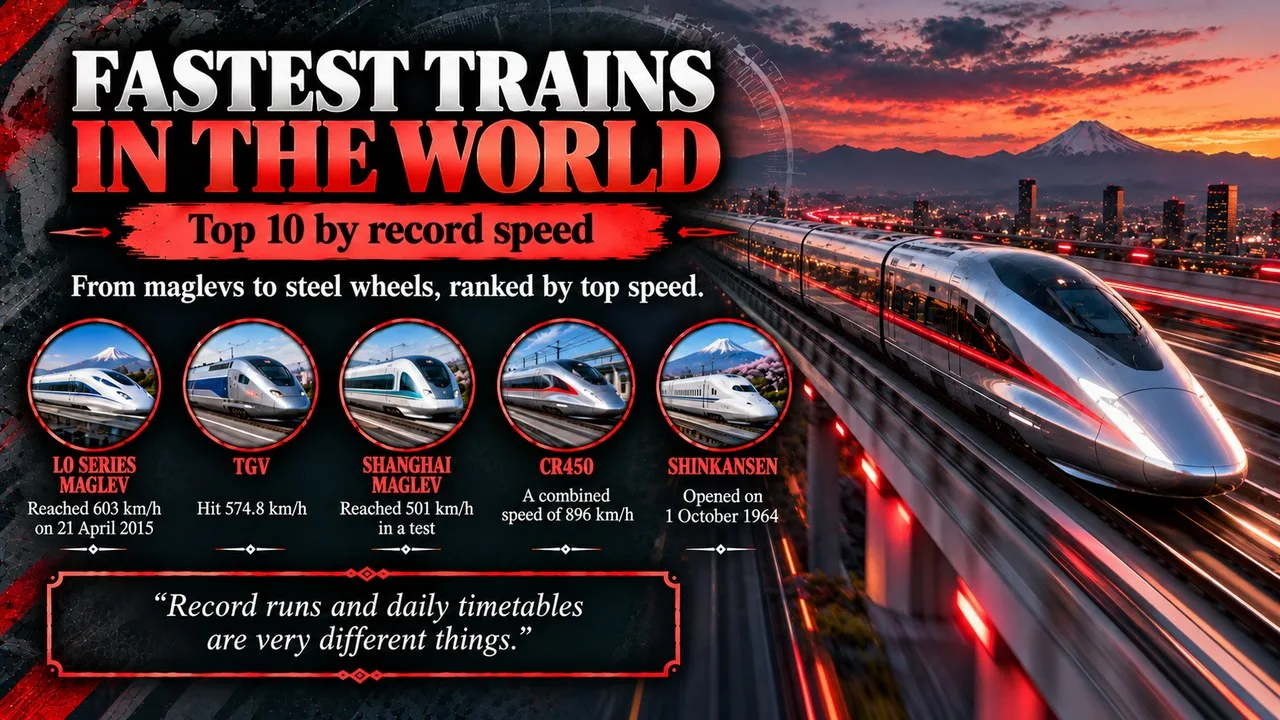
Japan's L0 Series maglev heads this list of the world's fastest trains at 603 km/h, ahead of France's record TGV and China's maglev and high-speed fleets.
This Finepedia guide, written in October 2026, ranks 10 train families by the highest speed they, or a test train built directly for them, have reached on rails or a guideway. Each entry also gives the speed passengers actually travel at, because record runs and daily timetables are very different things. For more on how people get around, see the Finepedia guides Most Common Modes of Transportation: Top 10 and Busiest Cities in the World: Top 10.
How We Chose These
We counted only trains that carry passengers today or are being prepared to do so, and we gave each family a single place, so the TGV appears once even though it has broken the record several times. Record figures come from operators, national rail research bodies and published speed tables, checked against at least two sources. Some prototypes just missed the cut or were folded into their family entry, such as Japan's ALFA-X test train and China's earlier CRH380A record. Service speeds are given as of October 2026, since operators raise them from time to time.
The 10 Fastest Trains at a Glance
| Rank | Train family | Country | Top test speed | Top service speed |
|---|---|---|---|---|
| 1 | L0 Series maglev | Japan | 603 km/h (2015) | Not yet in service |
| 2 | TGV | France | 574.8 km/h (2007) | 320 km/h |
| 3 | Shanghai Maglev | China | 501 km/h (2003) | 300 km/h |
| 4 | CRH380 | China | 487.3 km/h (2011) | 350 km/h |
| 5 | CR450 | China | 453 km/h | Not yet in service |
| 6 | Shinkansen | Japan | 443 km/h (1996) | 320 km/h |
| 7 | KTX and HEMU-430X | South Korea | 421.4 km/h (2013) | 320 km/h |
| 8 | CR400 Fuxing | China | 420 km/h (2016) | 350 km/h |
| 9 | ICE and Velaro | Germany | 406.9 km/h (1988) | 320 km/h |
| 10 | Frecciarossa 1000 | Italy | 393.8 km/h (2016) | 300 km/h |
1. Japan's L0 Series Maglev Holds the Outright Record
A seven-car L0 Series train carrying a test crew reached 603 km/h on 21 April 2015 on the Yamanashi test line west of Tokyo. It floats about 10 cm above its concrete guideway on superconducting magnets, so no wheels touch anything once it is up to speed.
Key Facts
- Record: 603 km/h on 21 April 2015, five days after a 590 km/h run
- Test line: 42.8 km in Yamanashi Prefecture
- Planned route: the Chuo Shinkansen between Tokyo and Nagoya
- Planned service speed: about 500 km/h
Did You Know?
Central Japan Railway first aimed to open the Tokyo to Nagoya section in 2027, cutting the trip to about 40 minutes. Construction delays mean the company now says it will not open before 2034 at the earliest, so the world's fastest train is still carrying only test riders as of October 2026.
2. The TGV Is the Fastest Train on Steel Wheels
France's TGV has broken the world record for wheeled trains several times since its launch on the Paris to Lyon route in 1981. Its best run came on 3 April 2007, when a specially tuned five-car set code-named V150 hit 574.8 km/h on the new LGV Est line towards Strasbourg.
Key Facts
- Record: 574.8 km/h on 3 April 2007
- Train: modified TGV POS set 4402 with larger wheels and extra power
- Earlier record: 515.3 km/h in 1990 on the LGV Atlantique
- Service speed: up to 320 km/h on the fastest French lines
Why It Matters
No train running on ordinary rails has beaten the V150 run in almost two decades. The tests helped engineers study how track, overhead wires and wheels behave at extreme speeds. TGV-based trains now also run abroad, including Morocco's Al Boraq, which has carried passengers at up to 320 km/h since 2018.
3. The Shanghai Maglev Was the First Fast Maglev in Daily Service
The Shanghai Maglev links Longyang Road station with Pudong International Airport, a distance of about 30 km. Built with German Transrapid technology, it reached 501 km/h in a test on 12 November 2003 and began regular trips in 2004.
Key Facts
- Test record: 501 km/h on 12 November 2003
- Route length: about 30 km, covered in roughly 8 minutes
- Peak service speed: 431 km/h until 2021
- Current service speed: 300 km/h
Did You Know?
For about 17 years the Shanghai Maglev was the fastest scheduled passenger train on Earth, regularly touching 431 km/h on part of each trip. In 2021 its top speed was cut to 300 km/h, so riders today travel at about the same pace as China's fastest wheeled trains.
4. China's CRH380 Pushed Wheeled Trains Close to 490 km/h
The CRH380 trains were built for China's main high-speed lines and entered service in October 2010 between Shanghai and Hangzhou. During trials on the new Beijing to Shanghai line, a 16-car CRH380BL reached 487.3 km/h on 10 January 2011.
Key Facts
- Record: 487.3 km/h by a CRH380BL on 10 January 2011
- Earlier run: 486.1 km/h by a CRH380AL in December 2010
- Entered service: October 2010
- Service speed: up to 350 km/h on the main lines
Why It Matters
The CRH380 runs proved that China could design and build trains for very high speeds rather than relying only on imported designs. The family still makes up a large part of the country's high-speed fleet, which by distance is the biggest high-speed rail network in the world.
5. The CR450 Is the Next Step for Chinese Rail
The CR450 is China's newest high-speed train, unveiled as two prototypes in December 2024. Test runs reached 453 km/h for a single train, and two trains passing each other set a combined speed of 896 km/h.
Key Facts
- Test speed: 453 km/h for a single train
- Combined passing speed: 896 km/h
- Designed service speed: 400 km/h
- Status: 600,000 km of trial running completed in 2026, not yet in passenger service
Did You Know?
The CR450 can accelerate from a standstill to 350 km/h in 4 minutes and 40 seconds. It has a longer and sleeker nose and a lower roof than the CR400, and engineers say these changes cut air resistance by about 22 percent. As of October 2026, no date for passenger service had been announced.
6. The Shinkansen Started the High-Speed Age
Japan's Shinkansen opened on 1 October 1964 between Tokyo and Osaka, just before the Tokyo Olympics. Its fastest test on conventional rails came on 26 July 1996, when the experimental 300X train reached 443 km/h on the original Tokaido line.
Key Facts
- Opened: 1 October 1964, the first high-speed railway in the world
- Record: 443 km/h by the 300X test train in 1996
- Fastest service: 320 km/h on the Tohoku Shinkansen since 2014
- Planned speed: 360 km/h once the Hokkaido extension opens
Why It Matters
The Shinkansen showed the world that trains could beat cars and planes on busy routes between big cities. Its fleet has carried billions of passengers, and its record of punctuality and safety inspired high-speed lines across Europe and Asia.
7. South Korea's HEMU-430X Made the Country a Speed Leader
South Korea opened its KTX high-speed network on 1 April 2004 using trains based on the French TGV. On 28 March 2013 the home-grown HEMU-430X test train reached 421.4 km/h on the Gyeongbu line between Seoul and Busan.
Key Facts
- Record: 421.4 km/h on 28 March 2013
- Network launch: KTX services began on 1 April 2004
- Spin-off trains: KTX-Eum (2021) and KTX-Cheongryong (2024)
- Fastest service speed: 320 km/h on KTX-Cheongryong
Did You Know?
Unlike the first KTX trains, which had engines at each end, the HEMU-430X spread its motors along the whole train. Korea's rail research institute said the record made South Korea the fourth country to pass 420 km/h on rails, after France, China and Japan.
8. The CR400 Fuxing Runs the Fastest Daily Wheeled Trips
China's CR400 Fuxing trains were designed entirely in China and entered service in 2017. On 15 July 2016, two test trains crossed at 420 km/h apiece, a combined 840 km/h, on the Zhengzhou to Xuzhou line.
Key Facts
- Test speed: 420 km/h in July 2016
- Combined passing speed: 840 km/h
- Service speed: 350 km/h, the fastest wheeled service in regular use
- Main route: the Beijing to Shanghai high-speed line
Why It Matters
Fuxing means rejuvenation in Chinese. Since September 2017 these trains have run at 350 km/h between Beijing and Shanghai, and the fastest services cover the 1,318 km route in well under five hours. That makes the train a real competitor to flights between the two cities.
9. Germany's ICE Was First to Break 400 km/h
On 1 May 1988 the experimental ICE V train reached 406.9 km/h on the line between Hanover and Würzburg. It was the first time any rail vehicle had gone faster than 400 km/h, although France took the record back a year later.
Key Facts
- Record: 406.9 km/h by the ICE V on 1 May 1988
- Network opened: 1991
- Related train: Siemens Velaro, which reached 403.7 km/h in Spain in 2006
- Service speed: 300 km/h in Germany and 320 km/h in France
Did You Know?
The ICE 3 design grew into the Siemens Velaro family, now used in Spain, Russia, China, Turkey and the United Kingdom, among others. On 15 July 2006 a Spanish Velaro set of Renfe Class 103 hit 403.7 km/h, a record for a train in standard production form.
10. The Frecciarossa 1000 Is Italy's Fastest Train
The Frecciarossa 1000 was developed jointly by Bombardier and AnsaldoBreda, firms now part of Alstom and Hitachi Rail. On 26 February 2016 one set reached 393.8 km/h on the high-speed line between Turin and Milan, a record for Italy.
Key Facts
- Record: 393.8 km/h on 26 February 2016
- Entered service: 2015
- Service speed: 300 km/h in Italy, limited by the track
- Length: 200 m with eight cars
Why It Matters
The Frecciarossa 1000 now runs well beyond Italy, with services from Milan to Paris and on Spain's Madrid to Barcelona route. It shows how fast trains are crossing borders in Europe and competing directly with short-haul flights.
Frequently Asked Questions
What is the fastest train in the world right now?
The fastest train ever tested is Japan's L0 Series maglev at 603 km/h, but it does not yet carry paying passengers. Among trains in daily service, China's CR400 Fuxing is the fastest, running at up to 350 km/h between Beijing and Shanghai.
What is the difference between a maglev and a normal high-speed train?
A maglev uses powerful magnets to lift the train above a guideway and push it forward, so there is no wheel friction. Normal high-speed trains run on steel wheels and rails, which is cheaper to build and fits into existing stations, but limits top speed.
Conclusion
From the Shinkansen of 1964 to the CR450 now in trials, the race for speed has pushed trains past 600 km/h in testing and to 350 km/h in daily use. Maglevs hold the outright record, but wheeled trains from France, China, Japan, Korea, Germany and Italy keep getting faster and cleaner. For more on how people travel, read the Finepedia guides Most Common Modes of Transportation: Top 10 and Busiest Cities in the World: Top 10.
- Central Japan Railway Company, SCMaglev and Chuo Shinkansen project pages, jr-central.co.jp (accessed October 2026).
- SNCF and Alstom, V150 world speed record of 3 April 2007 (accessed October 2026).
- Korea Railroad Research Institute, press release on the HEMU-430X 421.4 km/h run, 1 April 2013.
- Xinhua, World's fastest high-speed train blazes to 453 km/h in pre-service trials, 21 October 2025.
- Caixin Global, China Takes World's Fastest Train One Step Closer to Market, 10 August 2026.
- China Daily, Next-gen higher-speed CR450 trains put on fast track, October 2026.
- Wikipedia (accessed October 2026): List of speed records in rail transport, L0 Series, TGV world speed record, Shanghai maglev train, CRH380B, CR450, Shinkansen, KTX, Fuxing (train), ICE V, Siemens Velaro and Frecciarossa 1000.
- 10 Most Today, 10 Fastest Trains in the World, 10mosttoday.com (topic reference).






























Discussion
Log in with