











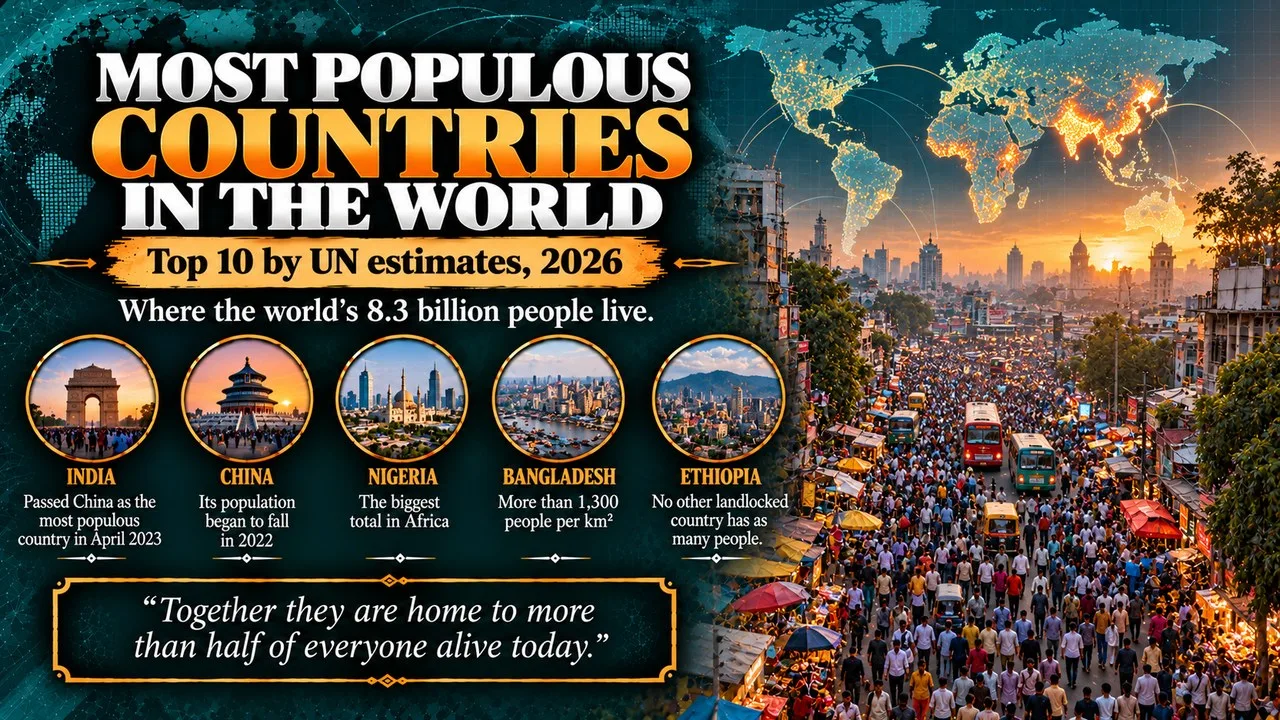
The most populous countries in the world are led by India and China, each with over 1.4 billion people, ahead of the United States, Indonesia and Pakistan.
This Finepedia guide, written in October 2026, ranks the 10 countries with the most people, using United Nations estimates for mid-2026. Together they are home to more than half of everyone alive today. For more on the world's nations, see the Finepedia guides Largest Countries in the World: Top 10 by Area and Most Visited Countries in the World: Top 10.
How We Chose These
Our figures come from the 2024 edition of the UN's World Population Prospects, which gives a consistent estimate for every country, here taken for mid-2026 and rounded. We checked them against each country's latest census, which can differ because counts are taken in different years and in different ways. Population changes every day, so treat these as estimates as of October 2026. Mexico, with about 133 million people, and Japan, with about 122 million, are the next two countries after the top ten.
The 10 Most Populous Countries at a Glance
| Rank | Country | Population (mid-2026 estimate) | Region | Yearly change |
|---|---|---|---|---|
| 1 | India | 1.48 billion | South Asia | Growing slowly |
| 2 | China | 1.41 billion | East Asia | Falling |
| 3 | United States | 349 million | North America | Growing slowly |
| 4 | Indonesia | 288 million | Southeast Asia | Growing slowly |
| 5 | Pakistan | 259 million | South Asia | Growing fast |
| 6 | Nigeria | 242 million | West Africa | Growing fast |
| 7 | Brazil | 214 million | South America | Growing slowly |
| 8 | Bangladesh | 178 million | South Asia | Growing steadily |
| 9 | Russia | 143 million | Eastern Europe and North Asia | Falling |
| 10 | Ethiopia | 139 million | East Africa | Growing fast |
1. India Has the Most People on Earth
India is home to about 1.48 billion people, roughly one in every six humans. The United Nations estimates that it passed China as the most populous country in April 2023, ending China's long run at the top.
Key Facts
- Population: about 1.48 billion (UN estimate, mid-2026)
- Share of world population: about 18 percent
- Median age: about 29 years
- Last full census: 2011, with the next count due in 2027
Did You Know?
India's population is still growing, but more slowly than before, because families are having fewer children. The average number of births per woman is now just under two. India also has 22 languages listed in its constitution, and Hindi is the most widely spoken. Uttar Pradesh, India's most crowded state, has more people than all but a handful of countries.
2. China's Population Has Started to Shrink
China has about 1.41 billion people and held the top spot among nations for centuries. Its population began to fall in 2022, the first decline in about six decades, as births fell and the population aged.
Key Facts
- Population: about 1.41 billion
- Trend: falling every year since 2022
- Median age: about 41 years
- Births per woman: about 1, among the lowest in the world
Why It Matters
A shrinking and ageing population means fewer young workers to support a growing number of retirees. China ended its one-child policy in 2016 and now allows families to have three children, but birth numbers have stayed low. Like India, China still has more people than all of Europe combined.
3. The US Ranks Third With About 349 Million People
The United States has about 349 million people, far fewer than India or China but more than any other country. Its 2020 census counted about 331 million, and growth since then has come mainly from immigration.
Key Facts
- Population: about 349 million
- Census: every 10 years, the last in 2020
- Largest state by population: California, with about 39 million
- Median age: about 39 years
Did You Know?
The United States is the only country outside Asia and Africa in the top four. Its population is spread unevenly, with more than 80 percent of people living in towns and cities, while large parts of the West remain thinly settled. Texas and Florida have been among the fastest-growing states in recent years.
4. Indonesia Is the Largest Island Nation by Population
Indonesia has about 288 million people spread across thousands of islands between the Indian and Pacific oceans. No other Southeast Asian nation comes close, and it ranks fourth worldwide.
Key Facts
- Population: about 288 million
- Islands: more than 17,000
- Most crowded island: Java, home to over half of all Indonesians
- Median age: about 31 years
Why It Matters
Java is the most populous island on Earth, which puts great pressure on its cities, especially the capital Jakarta. To ease that crowding, Indonesia is building a new capital, Nusantara, on the island of Borneo.
5. Pakistan Is One of the Fastest-Growing Large Countries
Pakistan has about 259 million people, and it adds roughly four million more each year. Its 2023 census, the first carried out digitally, counted about 241 million.
Key Facts
- Population: about 259 million
- Latest census: 2023
- Growth rate: about 1.6 percent a year
- Median age: about 21 years
Did You Know?
Pakistan has one of the youngest populations among big countries, with most people under 30. If current trends continue, the UN expects it to remain among the five most populous countries for decades. Karachi and Lahore are its two biggest cities, each with well over 10 million people.
6. Nigeria Has More People Than Any Other African Nation
Nigeria has about 242 million people, the biggest total in Africa. Its population is growing by about 2 percent a year, and it is one of the youngest countries anywhere.
Key Facts
- Population: about 242 million
- Median age: about 18 years
- Births per woman: just over 4
- Last national census: 2006
Why It Matters
The UN projects that Nigeria could overtake the United States to become the third most populous country later this century. Because no full census has been held since 2006, estimates of its population vary more than for most countries on this list. Lagos, its largest city, is one of the biggest urban areas in Africa.
7. Brazil Leads South America
Brazil has about 214 million people, the largest population in Latin America. Its census in 2022 counted about 203 million residents, and growth has slowed as family sizes have fallen.
Key Facts
- Population: about 214 million
- Latest census: 2022, run by the national statistics agency IBGE
- Births per woman: about 1.6
- Urban share: most Brazilians live in towns and cities
Did You Know?
Brazil's population lives mostly near the Atlantic coast, in big cities like São Paulo, Rio de Janeiro and Salvador. The huge Amazon region in the north covers much of the country's land but holds only a small share of its people.
8. Bangladesh Packs Millions Into a Small Space
Bangladesh has about 178 million people living in an area smaller than many US states. Its 2022 census counted about 170 million, and its population density is the highest of any large country.
Key Facts
- Population: about 178 million
- Density: more than 1,300 people per km²
- Latest census: 2022
- Capital: Dhaka, one of the most crowded cities on Earth
Why It Matters
Bangladesh is the only country in the top ten for both total population and density. Its fertility rate has fallen sharply since independence in 1971, to about two births per woman, one of the biggest changes of its kind in the developing world.
9. Russia Is Huge in Size but Losing People
Russia has about 143 million people according to UN estimates, spread across the largest territory of any country. Its population has been falling for years, because deaths outnumber births.
Key Facts
- Population: about 143 million (UN estimate)
- Area: about 17 million km², the largest of any country
- Density: about 9 people per km²
- Trend: falling, with national and UN estimates differing
Did You Know?
Most Russians live in the European west of the country, around cities such as Moscow and Saint Petersburg. Siberia and the Far East cover most of the land but hold only a small fraction of the people.
10. Ethiopia Leads All Landlocked Countries in Population
Ethiopia has about 139 million people, which puts it second in Africa, behind only Nigeria. It has no coastline, and no other landlocked country has as many people.
Key Facts
- Population: about 139 million
- Growth rate: about 2.5 percent a year
- Median age: about 19 years
- Diversity: more than 80 ethnic groups
Why It Matters
Ethiopia has recently moved ahead of Mexico in UN estimates, and it is expected to keep growing quickly for decades. Its rising population brings both a large young workforce and a big demand for schools, jobs and food.
Frequently Asked Questions
Which country has the most people in the world?
India comes first, with about 1.48 billion as of 2026. It overtook China in 2023, according to United Nations estimates.
How many people live in the world?
The United Nations estimates that the world population passed 8 billion in November 2022. As of 2026, it is roughly 8.3 billion and still growing, though more slowly than in the past.
Conclusion
The world's most populous countries range from giants like India and China to fast-growing nations such as Nigeria, Pakistan and Ethiopia. Some, like China and Russia, are now shrinking, while others will keep growing for decades, reshaping the global map of people. For more on the world's nations, read the Finepedia guides Largest Countries in the World: Top 10 by Area and Most Visited Countries in the World: Top 10.
- United Nations, Department of Economic and Social Affairs, Population Division, World Population Prospects 2024 (accessed October 2026).
- Worldometer, Population by Country 2026, based on UN World Population Prospects (accessed October 2026).
- United Nations, India overtakes China as the world's most populous country, UN DESA policy brief, April 2023.
- National statistics offices: US Census Bureau (2020 census), Pakistan Bureau of Statistics (2023 census), IBGE Brazil (2022 census) and Bangladesh Bureau of Statistics (2022 census).
- Wikipedia (accessed October 2026): List of countries by population (United Nations) and Demographics of India, China, the United States, Indonesia, Pakistan, Nigeria, Brazil, Bangladesh, Russia and Ethiopia.
- 10 Most Today, 10 Countries With the Largest Population, 10mosttoday.com (topic reference).




























Discussion
Log in with