


 By
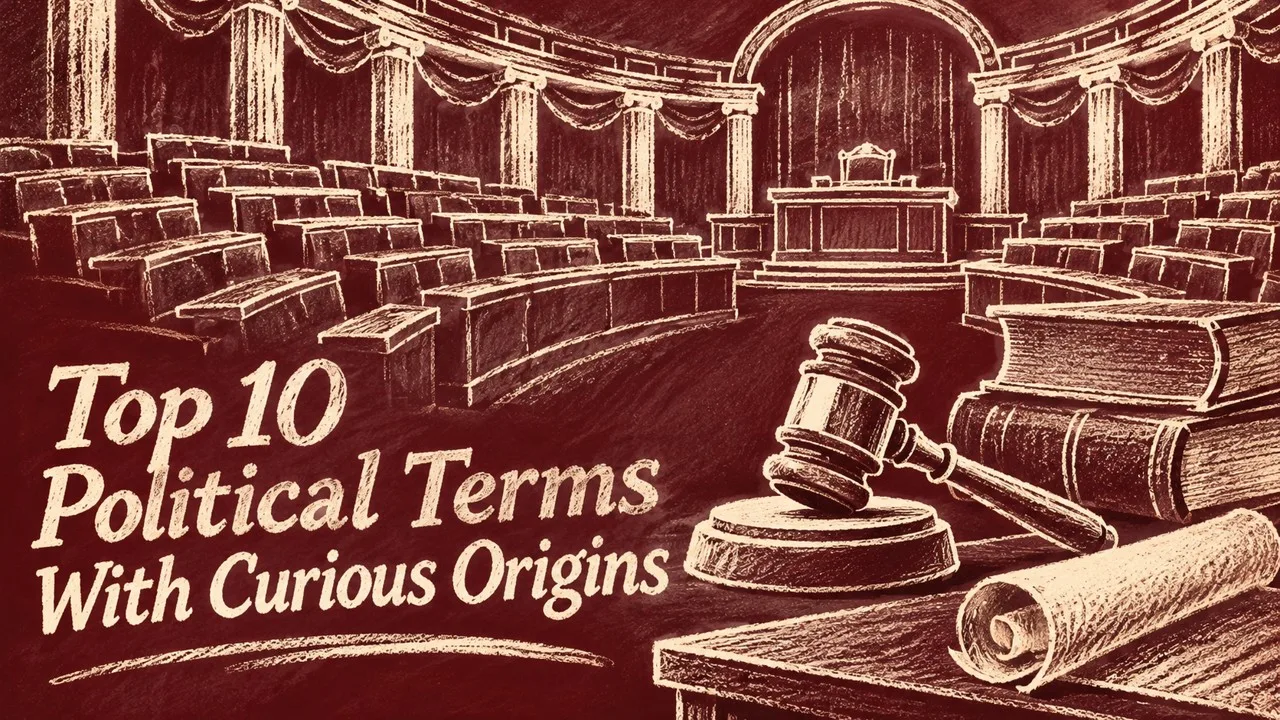
Many political words have odd origins, from a salamander-shaped district and Roman white togas to pirates, bankrupt brokers and Athenian pottery shards. Politics has its own vocabulary, and much of it is used so often that nobody stops to wonder where it came from. News reports mention filibusters, lame ducks, candidates and gerrymanders every day. Yet many of these words began in places far from parliaments and election campaigns.
Some came from cartoons, others from stock markets, pirate ships or farmyards. A few are named after real people whose names became shorthand for a particular tactic. Others were insults that the targets eventually adopted as badges of identity.
The ten terms below are gerrymander, filibuster, lame duck, left and right, candidate, boycott, mugwump, pork barrel, ostracism and Tory. Their histories range from ancient Athens to nineteenth-century Ireland and the United States.
The stories have been checked against standard histories and dictionaries. Where an origin is uncertain, that is noted, because word histories attract colorful legends as easily as political careers attract rumors.
Knowing where these words came from can make political news a little more interesting. It also shows how language changes, as a joke or an insult becomes, over time, an ordinary term in serious debate.
Political words also travel. Many of the terms below began in one country and spread to others through newspapers, translations and the movement of ideas. A word first used in a Boston newspaper or an Irish village can, within a generation, appear in parliaments and editorials on several continents. That spread is itself a sign of how connected political life has been for centuries.
Key Facts
| # | Term | Origin | Approximate date |
|---|---|---|---|
| 1 | Gerrymander | A cartoon about a Massachusetts district | 1812 |
| 2 | Filibuster | Dutch and Spanish words for freebooters | 1850s in politics |
| 3 | Lame duck | London's eighteenth-century stock exchange | 1700s |
| 4 | Left and right | Seating in the French National Assembly | 1789 |
| 5 | Candidate | Latin candidatus, clothed in white | Ancient Rome |
| 6 | Boycott | Captain Charles Boycott in County Mayo | 1880 |
| 7 | Mugwump | A Massachusett word for a leader | 1884 |
| 8 | Pork barrel | Salt pork as a reward | 1800s |
| 9 | Ostracism | Exile votes in ancient Athens | 5th century BC |
| 10 | Tory | Irish word for an outlaw | 1680s |
1. A District Shaped Like a Salamander
In 1812, Massachusetts redrew its state senate districts in a way that favored the party of Governor Elbridge Gerry. One district north of Boston had such a twisted shape that critics said it looked like a salamander [1].
In March 1812, the Boston Gazette printed a cartoon showing the district as a winged monster, and the term gerrymander, a blend of Gerry and salamander, was born. The cartoon is often attributed to the artist Elkanah Tisdale, though the authorship has been debated [1].
Gerry's name was pronounced with a hard G, like Gary, but the word is now usually said with a soft G. The practice of drawing district boundaries for political advantage is still widely debated, and the word remains in daily use.
2. From Pirates to Speeches
The word filibuster comes from the Spanish filibustero, which in turn came from the Dutch vrijbuiter, meaning freebooter or pirate. In the seventeenth century it was used for buccaneers who raided Spanish ships and colonies in the Caribbean [2].
Related: Top 25 Interesting Facts About the Solar System
In the 1850s, Americans used filibuster for private adventurers who launched unauthorized military expeditions into Latin America. Around the same time, the word began to be applied to legislators who used long speeches and procedural tactics to block action, as if they were hijacking the legislature [2].
Today the word is best known in the United States Senate, where a filibuster can delay or block a vote unless enough senators agree to end debate. The pirate origin still fits the image of a minority holding proceedings hostage.
3. Bankrupt Brokers
Lame duck began as slang in the London stock market of the eighteenth century. It described a broker or investor who could not pay their debts, waddling out of the market like an injured duck. The writer Horace Walpole used the phrase in a letter in 1761 [3].
In the nineteenth century, Americans began using lame duck for politicians who had lost an election but were still serving out their terms. Such officials were seen as weakened, with little influence over the future [3].
In the United States, the Twentieth Amendment, ratified in 1933, shortened the long lame-duck period between elections and the start of new terms. The phrase is now used around the world for any leader whose time in office is ending.
4. Seating in a Revolutionary Assembly
The political meaning of left and right comes from the French Revolution. In 1789, members of the National Assembly began to sit in groups. Supporters of the king and of religion gathered to the right of the presiding officer, while supporters of revolution and change gathered to the left [4].
The seating arrangement continued in later French legislatures, and the terms spread across Europe in the nineteenth century. Left came to mean support for social change and equality, while right came to mean support for tradition and established order [4].
The meanings have shifted over time and differ between countries. Still, the basic picture of a spectrum from left to right comes from where people happened to sit in a hall in revolutionary France.
5. White Togas in Rome
The word candidate comes from the Latin candidatus, meaning clothed in white. In ancient Rome, men seeking public office wore a toga that had been specially whitened, often with chalk, to stand out in the crowd [5].
Related: Top 25 Interesting Facts About the Universe
The bright white toga, called the toga candida, was meant to suggest purity and honesty. The same Latin root gives English the word candid, meaning frank and open [5].
Candidates in Rome went around the forum greeting voters and asking for support, often accompanied by followers. The custom of wearing white is long gone, but the word still links modern election hopefuls to their ancient predecessors.
6. An Irish Land Agent
The word boycott comes from Captain Charles Boycott, an English land agent who managed estates in County Mayo, Ireland. In 1880, during a period of tension over rents and evictions, the Irish National Land League urged local people to refuse all dealings with him [6].
Workers stopped harvesting his crops, shops refused to serve him and mail stopped arriving. The campaign attracted national attention, and volunteers had to be brought in under military protection to gather his harvest, at a cost much greater than the crops were worth [6].
Within months, newspapers were using boycott as a verb, and the word quickly spread to other languages. It remains a common term for organized refusal to buy, sell or deal with a person, company or country.
7. A Word for Political Independents
Mugwump comes from the Massachusett language spoken by a Native American people of New England, from a word often translated as war leader or important person. Early English writers used it jokingly for a self-important person [7].
In the presidential election of 1884, the word was applied to Republicans who refused to support their party's candidate, James G. Blaine, and backed the Democrat Grover Cleveland instead. Opponents mocked them as self-righteous, and the label stuck [7].
Related: Top 10 Mythical Creatures in World Mythology - That Inspired Myths Across Civilizations (unchanged)
A later joke claimed that a mugwump sat on the fence, with his mug on one side and his wump on the other. Today the word describes a political independent or someone who refuses to follow party lines.
8. Barrels of Salt Pork
Pork barrel is a term for government spending on local projects designed to win votes. It is often traced to the barrels of salt pork used to store and distribute food in the nineteenth century, when a well-stocked barrel signaled plenty [8].
One account links it to the practice of handing out salt pork to enslaved people in the American South, who rushed to take their share. The writer Edward Everett Hale used the phrase in a story in 1863, and it entered political language in the following decades [8].
The term is now used worldwide for spending that benefits a politician's district more than the public at large. Related terms such as pork and porkbarreling also come from the same image.
9. Votes on Pottery Shards
Ostracism comes from ancient Athens, where citizens could vote to exile a person thought to be dangerous to the state. Voters scratched the name of the person they wanted to remove onto broken pieces of pottery, called ostraka [9].
If enough votes were cast, the person with the most votes had to leave Athens for ten years, though they kept their property and citizenship. Archaeologists have found thousands of these pottery shards, some bearing the names of famous Athenians such as Themistocles [9].
The practice was used mainly in the fifth century BC and then fell out of use. The word survived, however, and now means any exclusion from a group or society.
10. An Insult That Became a Party Name
Tory comes from the Irish word toraidhe, often translated as pursued man or outlaw. In the seventeenth century, it was used for Irish rebels and bandits. During the Exclusion Crisis of 1679 to 1681, it was used as an insult for English supporters of the king's Catholic brother, James [10].
Related: Top 25 Weird Facts About Left-Handed People
Their opponents were called Whigs, a name probably shortened from Whiggamore, a term for Scottish Presbyterian rebels. Both names were meant as insults, but both sides gradually adopted them [10].
The Tories became one of Britain's main political parties, and the word is still used for the Conservative Party. Like many political labels, it shows how an insult can turn into a proud identity.
Conclusion
These words show how political language is built from many sources, from cartoons and slang to ancient customs and local conflicts. Some origins are well documented, while others remain partly uncertain, as word histories often do.
They also show that political life has always been full of satire and nicknames. Many of these terms began as jokes or insults, and only later became neutral or even official.
The next time a news report mentions a filibuster or a lame duck, it is worth remembering that the words carry centuries of history with them, from Roman togas to London stockbrokers.
Political vocabulary keeps growing. New words appear with each generation of campaigns and controversies, and some of them will surely have origins just as surprising to future readers. Whether a term survives depends on whether it fills a real need, giving a name to something people want to talk about but could not easily describe before.
Looking up the history of a familiar political word is often a quick way to discover a forgotten episode of the past.
- ^ [1] Accounts of gerrymandering and Elbridge Gerry. Wikipedia: gerrymandering Wikipedia: Elbridge Gerry
- ^ [2] Accounts of the filibuster. Wikipedia: filibuster Wikipedia: filibuster (military)
- ^ [3] Accounts of the lame duck. Wikipedia: lame duck Wikipedia: Twentieth Amendment
- ^ [4] Accounts of left and right in politics. Wikipedia: left-right political spectrum Wikipedia: National Constituent Assembly
- ^ [5] Accounts of the word candidate and the toga. Wikipedia: candidate Wikipedia: toga
- ^ [6] Accounts of Captain Boycott. Wikipedia: Charles Boycott Wikipedia: boycott
- ^ [7] Accounts of mugwumps. Wikipedia: Mugwump Wikipedia: 1884 election
- ^ [8] Accounts of pork barrel politics. Wikipedia: pork barrel Wikipedia: Edward Everett Hale
- ^ [9] Accounts of ostracism in Athens. Wikipedia: ostracism Wikipedia: ostracon
- ^ [10] Accounts of Tories and Whigs. Wikipedia: Tory Wikipedia: Whigs






















Discussion
Log in with