

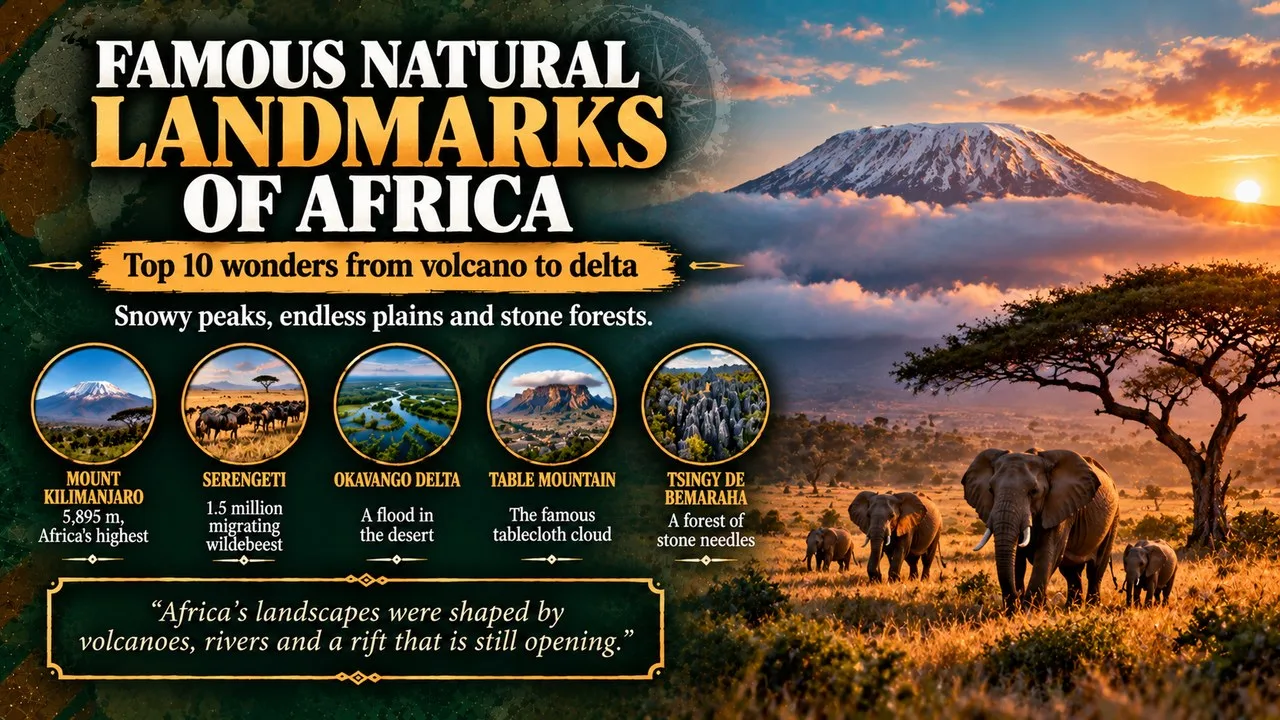
Famous natural landmarks of Africa include snowy Kilimanjaro, the Serengeti's vast plains, Botswana's Okavango Delta and the flat top of Table Mountain.
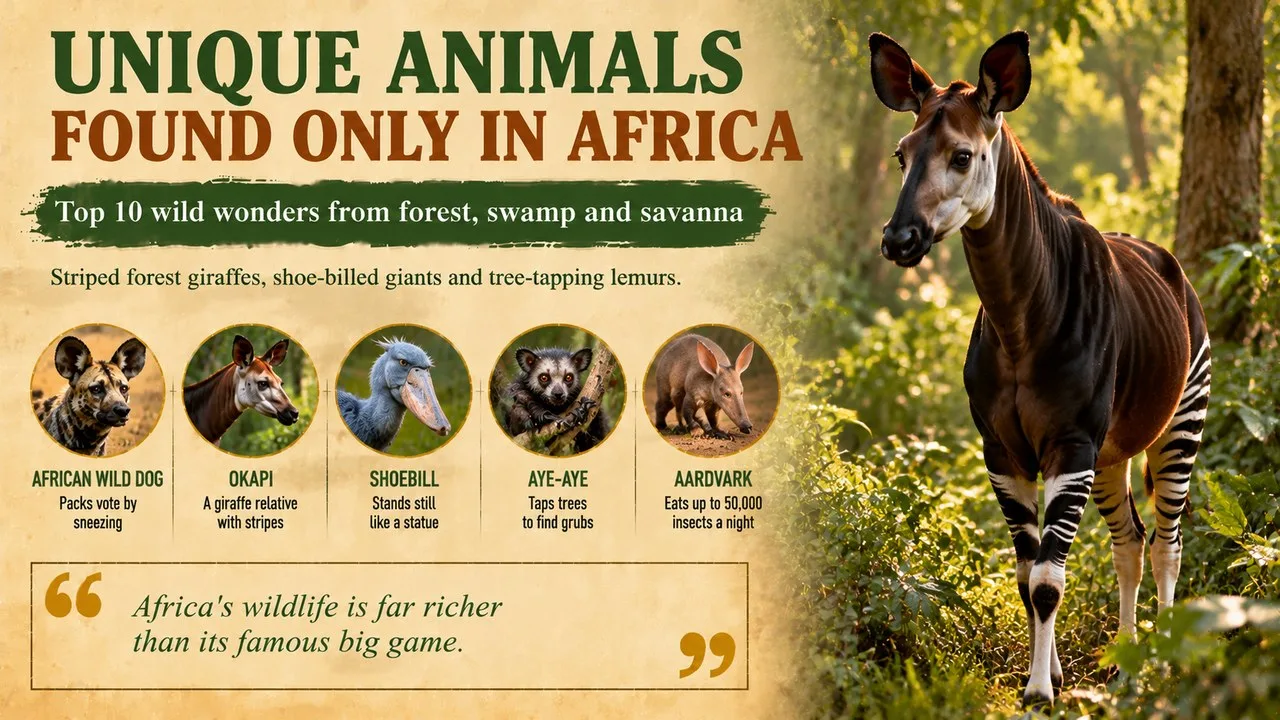
This Finepedia guide, written in October 2026, presents 10 of the continent's best-known natural wonders, from volcanoes and lakes to a forest of limestone needles. Each entry explains where the landmark is, how nature shaped it and what makes it worth the journey. For more about African nature, see the Finepedia guides Unique Animals Found Only in Africa: Top 10 and Mighty Waterfalls of the World: Top 10.
How We Chose These
We picked landmarks that are famous around the world, protected as parks or heritage sites and spread across different parts of the continent. Some well-known places are left out because other Finepedia guides already cover them: Victoria Falls appears in our waterfalls guide, Fish River Canyon in our canyons guide, Sossusvlei and the Sahara dunes in our desert landscapes guide and the Danakil salt flats in our salt flats guide. The order is a guide, not a scientific ranking.
The 10 Natural Landmarks at a Glance
| Rank | Landmark | Country | Type |
|---|---|---|---|
| 1 | Mount Kilimanjaro | Tanzania | dormant volcano |
| 2 | Serengeti | Tanzania | savanna and grassland |
| 3 | Ngorongoro Crater | Tanzania | volcanic caldera |
| 4 | Okavango Delta | Botswana | inland river delta |
| 5 | Table Mountain | South Africa | flat-topped mountain |
| 6 | Great Rift Valley | East Africa, from Ethiopia to Mozambique | rift valley |
| 7 | Virunga Mountains | Rwanda, DR Congo and Uganda | volcano chain |
| 8 | Lake Malawi | Malawi, Mozambique and Tanzania | rift lake |
| 9 | Tsingy de Bemaraha | Madagascar | limestone karst |
| 10 | Avenue of the Baobabs | Madagascar | line of ancient trees |
1. Mount Kilimanjaro Is the Roof of Africa
Mount Kilimanjaro, in northern Tanzania, rises to 5,895 m and is the highest point in Africa. It stands alone above the surrounding plains rather than as part of a range, which makes it the tallest free-standing mountain on Earth.
Key Facts
- Height: 5,895 m at Uhuru Peak
- Type: a dormant volcano with three cones, Kibo, Mawenzi and Shira
- First recorded ascent: 1889, by Hans Meyer and Ludwig Purtscheller
- Protection: Kilimanjaro National Park, a UNESCO site since 1987
Did You Know?
The highest summit took the name Uhuru Peak after Tanzania was formed in 1964, and uhuru means freedom in Swahili. Climbers pass through rainforest, heath, alpine desert and ice on the way up, almost like walking from the equator to the Arctic.
2. The Serengeti Hosts the Great Migration
The Serengeti National Park covers about 14,763 km² of grassland and woodland in northern Tanzania. Every year more than 1.5 million wildebeest, joined by large herds of zebras and gazelles, circle through it and into Kenya's Maasai Mara in search of fresh grass.
Key Facts
- Area: about 14,763 km²
- National park since: 1940
- UNESCO listing: 1981
- Big cats: Africa's biggest population of lions lives here
Why It Matters
The Great Migration is the biggest movement of land animals on the planet, and it shapes the whole landscape. Grazing herds keep the grass short, while predators such as lions, hyenas and crocodiles follow them across rivers and plains.
3. Ngorongoro Crater Is a Wildlife-Filled Caldera
Ngorongoro Crater formed between two and three million years ago, when a huge volcano blew out and collapsed inward. Today its flat floor is a natural enclosure filled with elephants, lions, buffalo and some of Tanzania's rare black rhinos.
Key Facts
- Depth: about 610 m from rim to floor
- Floor area: about 260 km²
- Visitors: more than 750,000 to the conservation area in 2023
- Nearby: Olduvai Gorge, a key site for early human fossils
Did You Know?
The name is said to come from the Maasai, who copied the ringing sound of cowbells, ngoro ngoro. Unlike a national park, the conservation area was set up to protect wildlife while letting Maasai herders graze their cattle, a balance that is still debated today.
4. The Okavango Delta Floods in the Desert
The Okavango Delta in Botswana is a vast inland delta where a river spreads out into the Kalahari instead of reaching the sea. Each year about 11 km³ of floodwater flows in from the highlands of Angola and fans out over channels, lagoons and islands.
Key Facts
- Flooded area: between 6,000 and 15,000 km², depending on the year
- World Heritage: the 1,000th site on the UNESCO list, in June 2014
- Wildlife: lions, leopards, elephants, buffalo and rhinos
- Getting around: visitors often glide through on a mokoro, a dugout canoe
Why It Matters
Almost all of the water that reaches the delta evaporates or is used by plants, so it never flows out to sea. The seasonal flood arrives months after the rains have fallen, turning dry ground into a green refuge that animals depend on.
5. Table Mountain Overlooks Cape Town
Table Mountain towers roughly 1,000 m over Cape Town, and its flat summit plateau stretches for about 3 km between steep cliffs. It is flanked by Devil's Peak and Lion's Head, forming one of the most recognised city backdrops in the world.
Key Facts
- Highest point: Maclear's Beacon, 1,086 m
- Cableway: carrying visitors since 4 October 1929
- Plants: about 2,285 species, most of them fynbos shrubs
- Honour: chosen as a New7Wonders of Nature winner in 2011
Did You Know?
When south-easterly winds blow, a layer of cloud often spills over the summit and down the cliffs. Local people call it the tablecloth, and it can appear within minutes on an otherwise clear day.
6. The Great Rift Valley Is Splitting a Continent
The Great Rift Valley is a chain of linked valleys and basins that, in its original sense, stretches about 6,500 km from Syria, along the Red Sea and down to Mozambique. In Africa it is lined with volcanoes, steep cliffs and deep lakes such as Turkana and Tanganyika.
Key Facts
- Total length: about 6,500 km
- Name coined: 1896, by the British geologist John Walter Gregory
- Key point: the Afar triple junction in Ethiopia, where three rifts meet
- Famous lakes: Turkana, Tanganyika and Malawi
Why It Matters
The rift marks the place where the African plate is slowly being pulled apart, a few millimetres a year. Its sediments have also preserved some of the most important early human fossils, including the skeleton known as Lucy, found in Ethiopia's Afar region in 1974.
7. The Virunga Mountains Shelter Mountain Gorillas
Eight large volcanoes make up the Virunga Mountains, which rise where Uganda, Rwanda and DR Congo come together. Their misty forests are one of only two places on Earth where mountain gorillas live.
Key Facts
- Highest peak: Mount Karisimbi, 4,507 m
- Active volcanoes: Nyiragongo and Nyamuragira, both in DR Congo
- Recent eruption: Nyiragongo erupted in May 2021
- Parks: Virunga, Volcanoes and Mgahinga Gorilla national parks
Did You Know?
The American scientist Dian Fossey founded the Karisoke Research Center here in 1967 to study the gorillas. Her work, later told in the film Gorillas in the Mist, helped turn gorilla tourism into a major source of funding for conservation.
8. Lake Malawi Holds More Fish Species Than Any Lake
Lake Malawi fills the southern tip of the East African Rift and is shared by Malawi, Mozambique and Tanzania. Measuring about 580 km long and up to 706 m deep, it is one of the largest and deepest lakes in Africa.
Key Facts
- Area: about 29,600 km²
- Greatest depth: 706 m
- Fish: 700 or more cichlid species, almost all found nowhere else
- Protection: Lake Malawi National Park, a UNESCO site since 1984
Why It Matters
The lake is a natural laboratory of evolution, since hundreds of colourful cichlid species developed there from a few ancestors. Its fish are also a vital source of food for millions of people living along its shores.
9. Tsingy de Bemaraha Is a Forest of Stone
In western Madagascar, rain and groundwater have carved limestone into a maze of razor-sharp pinnacles called tsingy. The Tsingy de Bemaraha park protects two main zones of pinnacles, known as the Great and Little Tsingy, with the Manambolo River flowing between.
Key Facts
- Rock: limestone karst, cut into needles and deep cracks
- Name: tsingy is usually explained as a place you cannot cross barefoot
- UNESCO listing: 1990
- Visiting: rope bridges and ladders lead across the needles
Did You Know?
Because the summit, slopes and base of each pinnacle have different light and moisture, they act as separate habitats. As a result the park is home to many plants and animals, including lemurs, found only in tiny corners of this landscape.
10. The Avenue of the Baobabs Lines a Dirt Road
Near Morondava in western Madagascar, a short stretch of dirt road is lined by giant Grandidier's baobabs, forming the Avenue of the Baobabs. The trees are survivors of a dense forest that once covered the area before it was cleared for farming.
Key Facts
- Number of trees: about 20 to 25 along a 260 m stretch
- Height: about 30 m
- Local name: renala, meaning mother of the forest
- Protection: temporary protection granted by the government in July 2007
Why It Matters
The avenue is one of the most photographed places in Madagascar, especially at sunset. It shows how a few trees spared by farmers can become a national symbol, and nearby, two twisted baobabs known as the Baobab Amoureux are said to be lovers.
Frequently Asked Questions
What is the most famous natural landmark in Africa?
Mount Kilimanjaro is usually named first, because it is the highest mountain on the continent and visible for many kilometres. Victoria Falls and the Serengeti are also strong candidates.
Can you climb Mount Kilimanjaro without technical skills?
Yes. Most routes to Uhuru Peak are long hikes rather than technical climbs, but altitude sickness is a real risk. Climbers usually take six to nine days to allow their bodies to adjust.
Conclusion
From the snowy summit of Kilimanjaro to the stone needles of Tsingy de Bemaraha, Africa's natural landmarks show the power of volcanoes, rivers and time. Many are protected as parks and heritage sites, and they support both rare wildlife and local communities. For more about the continent, read the Finepedia guides Unique Animals Found Only in Africa: Top 10 and Mighty Waterfalls of the World: Top 10.
- UNESCO World Heritage Centre, listings for Kilimanjaro National Park, Serengeti National Park, Ngorongoro Conservation Area, Okavango Delta, Lake Malawi National Park and Tsingy de Bemaraha.
- South African National Parks and Tanzania National Parks, visitor information (accessed October 2026).
- Wikipedia (accessed October 2026): Mount Kilimanjaro, Serengeti National Park, Ngorongoro Conservation Area, Okavango Delta, Table Mountain, Great Rift Valley, Virunga Mountains, Lake Malawi, Tsingy de Bemaraha National Park and Avenue of the Baobabs.
- 10 Most Today, 10 Most Famous Natural Landmarks in Africa, 10mosttoday.com (topic reference).



























Discussion
Log in with